
Stability Testing for Generics: FDA Requirements Explained
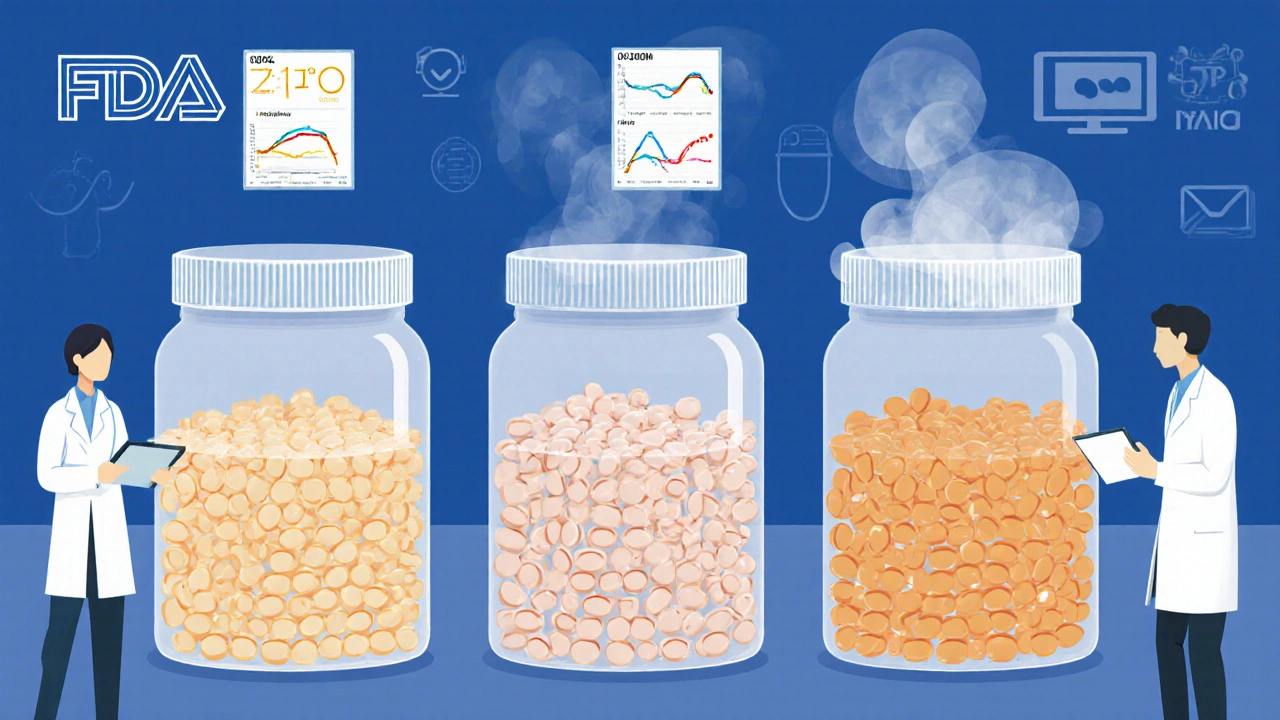
When you pick up a generic pill at the pharmacy, you expect it to work just like the brand-name version. But how does the FDA make sure that generic drug doesn’t lose its strength, break down into harmful substances, or become ineffective before the expiration date? The answer lies in stability testing - a rigorous, science-driven process that every generic drug must pass before it reaches patients.
Why Stability Testing Matters for Generic Drugs
Generic drugs aren’t just copies. They’re required to be bioequivalent - meaning they deliver the same active ingredient in the same amount and at the same rate as the brand-name drug. But bioequivalence alone isn’t enough. A drug can work perfectly on day one, then degrade over time. That’s where stability testing comes in.The FDA mandates stability testing to prove that a generic drug will remain safe, effective, and chemically unchanged from the moment it’s manufactured until the last day of its shelf life. This isn’t just paperwork. It’s about preventing real-world harm: a weakened antibiotic could fail to treat an infection. A degraded heart medication might not control blood pressure. Even a simple pain reliever that breaks down too fast could cause inconsistent relief.
Under the Hatch-Waxman Act of 1984, generic manufacturers don’t need to repeat all the clinical trials done by the original drugmaker. But they must prove their version is stable. That’s why stability data is one of the most common reasons the FDA sends back an application with a Complete Response Letter - accounting for over 34% of all deficiencies in 2019 alone.
What the FDA Requires: The Core Rules
The FDA’s expectations for stability testing are laid out in two key documents: ICH Q1A(R2) and the 2018 guidance titled ANDAs: Stability Testing of Drug Substances and Products Questions and Answers. Here’s what you need to know:
- Three batches minimum: Manufacturers must test at least three production-scale batches of the drug product. These aren’t lab samples - they’re made using the same equipment, processes, and materials planned for commercial production.
- Real-time and accelerated conditions: Long-term testing happens under the proposed storage conditions - usually 25°C and 60% humidity. Accelerated testing pushes the drug harder: 40°C and 75% humidity. This helps predict how the drug will behave over years in just months.
- Testing frequency: For products with a 12-month or longer shelf life, testing must happen every 3 months in the first year, every 6 months in the second year, and then once a year after that.
- What gets tested: It’s not just potency. The FDA requires testing for physical changes (like tablet cracking or liquid cloudiness), chemical degradation (impurities forming over time), microbial contamination, and even how well the drug is delivered - like whether an inhaler still sprays the right amount.
- Same packaging: The stability study must use the exact same container and closure system that will be sold to patients. A pill in a plastic bottle behaves differently than one in a glass vial with a desiccant.
For the FDA to approve an ANDA, you need at least 6 months of accelerated data and 6 months of long-term data. But here’s the catch: you’re not done when you submit. The FDA expects you to continue testing after approval to confirm the expiration date you claimed.
How Generics Differ from Brand-Name Drugs in Testing
It’s a myth that generic manufacturers have it easier. Yes, they can reference the brand-name drug’s stability data. But they still have to prove their own product is stable - and that’s harder than it sounds.
Brand-name companies spend years optimizing their formula and manufacturing process. They test dozens of variations before settling on the final version. Generic makers start with a finished product and try to match it. Even tiny differences - a different binder, a slightly altered drying step, or a new supplier for an inactive ingredient - can change how the drug degrades.
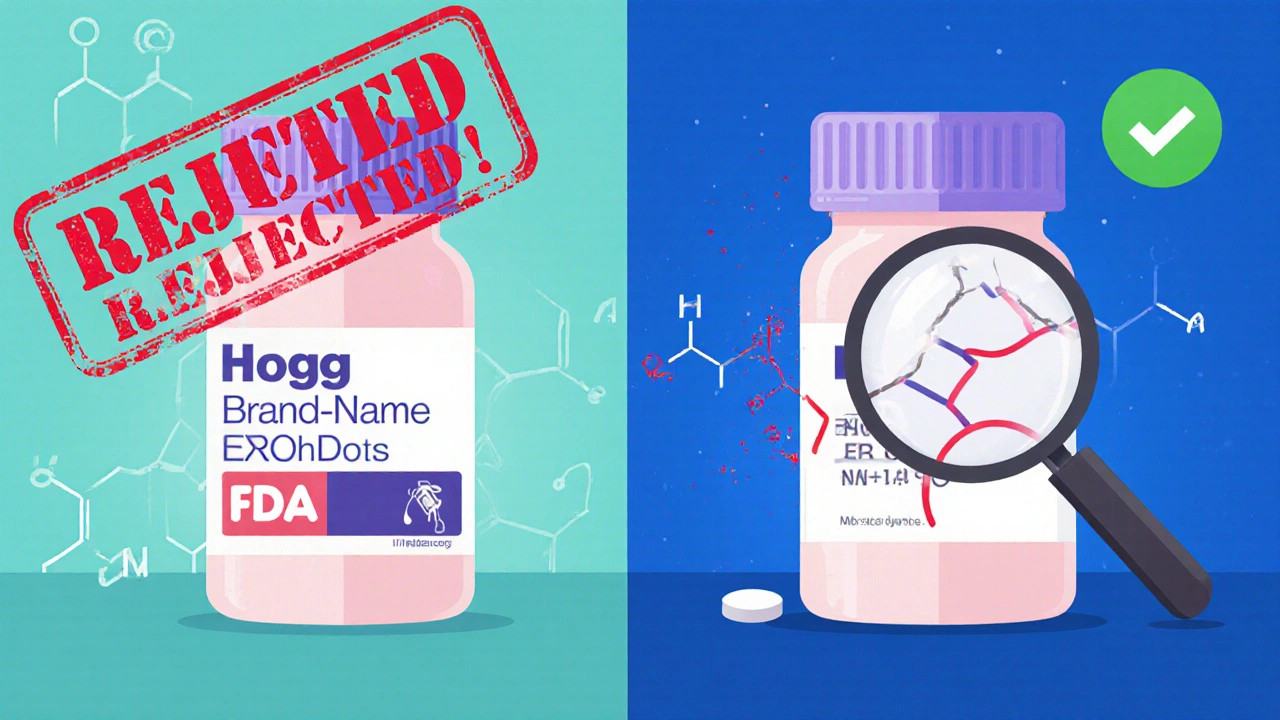
That’s why generic manufacturers still need to run forced degradation studies, even if they’re not as extensive as those done by innovators. They must show their drug breaks down in the same way as the reference product. If the brand-name drug forms a specific impurity at 40°C, so must the generic. If it doesn’t, the FDA will reject it.
And while brand-name companies often have decades of stability data to draw from, generic companies often have none - unless they’ve made the same drug before. That’s why stability testing failures are more common in generics. In 2022, 92.7% of stability-related deficiencies in ANDA submissions came from generic manufacturers.
Common Mistakes That Cause FDA Rejections
Many generic companies fail not because they don’t understand the rules - but because they cut corners on execution. Here are the top reasons ANDAs get rejected for stability issues:
- Missing or vague protocols: The FDA wants a detailed plan before testing begins. If your protocol doesn’t specify exactly how you’ll measure potency or detect impurities, it’s a red flag. Over 98% of completeness failures are due to poor protocols.
- Bad storage conditions: Stability chambers must maintain exact temperature and humidity. A deviation of just 2°C can invalidate months of data. In 2022, 18.4% of stability data issues came from chamber malfunctions or poor monitoring.
- Inadequate sampling: You can’t just test one batch and assume the rest are the same. The FDA requires sampling at every time point, from every batch. Skipping samples is a quick way to get a Complete Response Letter.
- Unvalidated test methods: If your lab’s method for measuring drug strength isn’t proven to detect degradation products, the data is meaningless. Over 31% of stability-related rejections cite this issue.
- Not testing all strengths and sizes: If you make 10mg, 20mg, and 40mg tablets, you can’t test just the 20mg and assume the others are fine. The FDA allows bracketing or matrixing - testing a subset - but only if you can scientifically justify it.
How Manufacturers Are Adapting
The stakes are high. Stability testing can cost up to $487,500 per ANDA application - nearly 19% of total development costs. And with over 40% of U.S. generic approvals going to Indian manufacturers - who face 63% of all stability-related rejections - the pressure is intense.
Top companies are investing in solutions:
- Automated monitoring: 78% of leading generic makers now use real-time digital sensors to track temperature and humidity in stability chambers. This catches drifts before data is ruined.
- Pre-submission meetings: Companies that meet with the FDA before submitting their ANDA reduce deficiency rates by over 40%. It’s not a luxury - it’s a strategy.
- Bracketing and matrixing: When scientifically sound, testing only a few strengths or container sizes saves time and money. In 2022, two-thirds of ANDAs that used this approach got approved on the first try.
- Quality by Design (QbD): Instead of testing after the fact, some companies build stability into the formulation from day one. This means choosing excipients and processes that naturally resist degradation.
What’s Changing in 2025 and Beyond
The rules are getting stricter. In June 2025, the FDA released a draft guidance proposing major updates:
- 24 months of real-time data: Currently, 12 months of long-term data is enough for approval. Under the new draft, you’ll need 24 months - meaning drugs will be approved with longer shelf lives from the start.
- Photostability requirements: Products exposed to light (like eye drops or clear bottles) will need more rigorous testing under controlled light conditions.
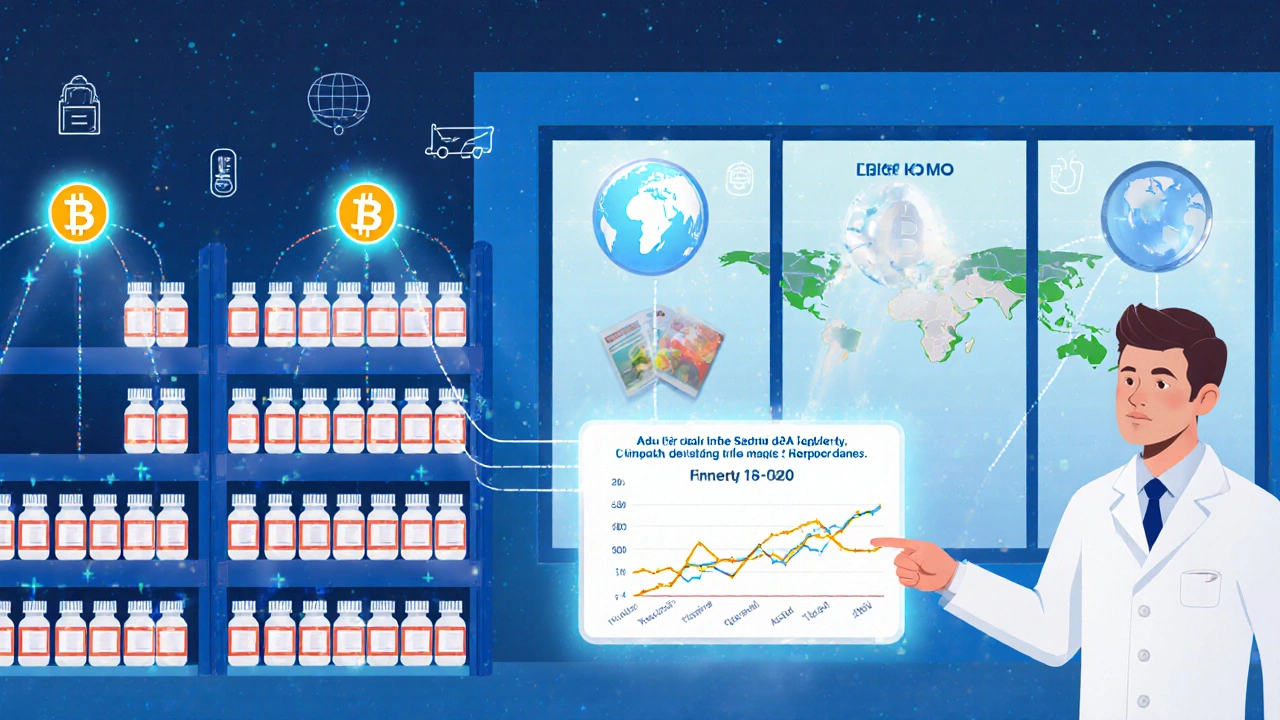
- Climate zones: Global supply chains mean drugs are shipped worldwide. New guidelines will require stability data that reflects storage in different climates - from tropical to arid.
- Nanomaterials and digital tracking: As new drug forms emerge - like nanoparticles or inhalable biologics - the FDA is adding specific testing rules. And in 2025, pilot programs are starting to use blockchain to verify stability data, reducing fraud and errors.
These changes will raise costs. Analysts predict a 22% increase in stability testing expenses by 2027. But they’ll also improve safety. Longer shelf lives mean less waste. Better data means fewer recalls.
What Patients Should Know
You don’t need to understand chromatography or humidity chambers. But you should know this: the generic drug you take is held to the same standard as the brand-name version. The FDA doesn’t allow shortcuts on stability. Every batch is tested. Every expiration date is backed by data. Every container is validated.
If your generic pill looks different or tastes different, that’s normal - inactive ingredients vary. But if it doesn’t work as expected, it’s not because the FDA lowered the bar. It’s because the bar is high - and the system is designed to catch anything that falls short.
Do generic drugs need the same stability testing as brand-name drugs?
Yes. Both generic and brand-name drugs must follow the same ICH Q1A(R2) guidelines. Generic manufacturers don’t need to repeat clinical trials, but they must prove their product is stable under real-world conditions using three production-scale batches, with both long-term and accelerated testing. The FDA requires the same physical, chemical, and microbiological testing for both.
How long does stability testing take before a generic drug is approved?
The FDA requires a minimum of 6 months of accelerated data and 6 months of long-term data to approve an ANDA. But because long-term studies take time, most manufacturers start testing 12 to 18 months before submitting. The actual approval timeline depends on how complete and accurate the data is - poor data can add 12+ months to the review process.
Can a generic drug have a longer shelf life than the brand-name version?
Yes, but only if the generic manufacturer proves it through data. The FDA doesn’t automatically match the brand’s expiration date. If a generic drug shows less degradation over time under proper storage, it can be approved with a longer shelf life - but this is rare. Most generics match or slightly shorten the brand’s expiration date due to formulation differences.
What happens if a generic drug fails stability testing after approval?
If post-approval stability data shows the drug is degrading faster than expected, the manufacturer must notify the FDA immediately. The agency can issue a recall, require label changes, or suspend production. In severe cases, the drug’s approval can be revoked. Manufacturers are required to continue testing for the entire shelf life - even after the drug is on the market.
Are there any exceptions to stability testing requirements?
For very stable, well-established drugs - like aspirin or acetaminophen - the FDA may allow reduced testing under specific conditions. But this is rare and only applies to products with decades of proven stability data. Even then, manufacturers must still test at least one batch under accelerated conditions to confirm shelf life. No generic drug is exempt from basic stability requirements.
Next Steps for Generic Manufacturers
If you’re developing a generic drug, here’s what to do now:
- Start stability testing as early as possible - ideally during formulation development.
- Design your protocol using ICH Q1A(R2) and the FDA’s 2018 Q&A document as your blueprint.
- Invest in automated environmental monitoring for your stability chambers.
- Consider a pre-submission meeting with the FDA to avoid common pitfalls.
- Validate every analytical method before testing begins - don’t assume your lab’s method is good enough.
- Plan for 24 months of real-time data by 2026 - the new standard is coming.
Stability testing isn’t the most glamorous part of drug development. But it’s the foundation of patient trust. Get it right, and your drug reaches the market. Get it wrong, and you lose time, money, and credibility - and patients pay the price.
Sue Barnes
November 29, 2025 AT 17:54This is why I don't trust generics. I've had pills that either did nothing or made me feel like I got hit by a truck. The FDA says it's all regulated, but if 92% of stability failures come from generics, someone's cutting corners. I'm not a guinea pig.
jobin joshua
November 30, 2025 AT 17:44Brooo 😍 this is wild! I work in a pharma lab in India and let me tell you - stability chambers are like babies. One degree off and BAM - six months of data gone 💀. But hey, we’re getting better! 🚀
Sachin Agnihotri
December 1, 2025 AT 03:50Wow, this is actually super informative. I didn’t realize how much goes into generic drugs. I always thought they were just cheap knockoffs, but the fact that they have to match the degradation profile? That’s wild. And the 24-month data requirement coming in 2025? That’s gonna be a nightmare for small labs, but honestly, it’s the right call. Safety first, always.
Evelyn Salazar Garcia
December 2, 2025 AT 13:42USA makes the best drugs. India shouldn’t be allowed to export generics.
Clay Johnson
December 3, 2025 AT 16:37The regulatory framework is structurally sound. The application of it is where human error and economic pressure converge. Stability data is not a proxy for quality - it is the only objective metric that exists. Everything else is rhetoric.
Chris Taylor
December 4, 2025 AT 06:03I used to be skeptical of generics too - until my dad needed a heart med and the brand was $800 a month. The generic cost $12. Same pill. Same results. I’m not saying it’s perfect, but the system works way more often than it fails. Just don’t buy from sketchy online pharmacies.
Josh Evans
December 5, 2025 AT 10:28Love this breakdown. My cousin works at a generic company and told me they spend more time on stability than on the actual chemistry sometimes. Crazy how much paperwork and science goes into something you swallow in 2 seconds.
Allison Reed
December 7, 2025 AT 07:03This is exactly the kind of transparency we need more of. So many people think generics are ‘lesser’ - but the truth is, they’re held to the same standard. Kudos to the scientists grinding away in labs so you can take your blood pressure pill without going broke. 👏
Jacob Keil
December 8, 2025 AT 15:39So the FDA is just a puppet for Big Pharma right? They let generics in but make them jump through hoops so the brand names can keep charging $1000 a bottle. Wake up people. This isn’t science - it’s profit protection.
Rosy Wilkens
December 10, 2025 AT 14:26Did you know that the FDA’s stability protocols were designed by pharmaceutical lobbyists? The 24-month requirement? A distraction. The real issue is that the FDA doesn’t inspect most overseas labs - they rely on self-reported data. That’s why 63% of rejections come from India. They’re not failing because they’re bad - they’re failing because they’re being set up to fail.
Andrea Jones
December 11, 2025 AT 06:34So you’re telling me I’ve been paying extra for brand-name ibuprofen for years… and it’s basically the same thing? 🤦♀️ And now they want 24 months of data? Sweet, now my prescriptions will cost even more. Thanks, bureaucracy.
Justina Maynard
December 12, 2025 AT 20:58Let’s be real - the real villain here isn’t the generic maker, it’s the damn packaging. I’ve had pills that turned to dust in my purse because the bottle wasn’t airtight. If you’re gonna test stability, test it in the real world - not just in some climate-controlled room. My bathroom isn’t 60% humidity and 25°C - it’s a steam room after a shower.
Jermaine Jordan
December 14, 2025 AT 11:28This is the most important conversation in medicine right now. People die because a pill crumbles. People die because a lab skipped a test. And yet, we treat this like a backroom accounting exercise. We’re not just talking about drugs - we’re talking about trust. The moment we stop believing that our medicine is safe, the entire system collapses. This isn’t regulation. This is civilization holding its breath.
Chetan Chauhan
December 14, 2025 AT 18:56Wait so you’re saying generics are just as good? That’s not what my uncle said when he took his generic blood pressure med and ended up in the ER. Also, I think the FDA is just trying to make us buy more brand name stuff. And why do they need blockchain? That’s just tech buzzwords. 😴
Phil Thornton
December 16, 2025 AT 02:42Stability testing is the unsung hero of pharmacy. No one talks about it. But if it fails, you’re dead. Simple as that.