
Respiratory Combination Inhalers: What You Need to Know Before Switching to Generic Versions

When you’re managing asthma or COPD, your inhaler isn’t just a device-it’s your lifeline. That’s why switching from a brand-name combination inhaler like Symbicort or Advair to a generic version can feel risky, even if it saves money. Many people assume all generics are the same: cheaper, just as effective, and easy to swap. But with respiratory combination inhalers, that’s not true. The device itself-how it works, how you use it-can make all the difference in whether your medication reaches your lungs properly.
Why Generic Inhalers Aren’t Like Generic Pills
With pills, if the active ingredient is the same, you’re usually good to go. But with inhalers, you’re not just getting a chemical copy. You’re getting a device that delivers that chemical. Two inhalers might contain the exact same drugs-budesonide and formoterol, for example-but if one is a Turbuhaler and the other is a Spiromax, they work completely differently. The Turbuhaler requires you to twist a base to load the dose. The Spiromax uses a side slider. One needs a slow, deep breath. The other demands a quick, forceful inhale. If you’ve been using Symbicort Turbohaler for years and suddenly get switched to Spiromax without training, you might not even realize you’re not inhaling correctly. A 2020 study found that 76% of patients switched without proper instruction used the new device wrong. That’s not a small risk-it’s a dangerous one.The Real Cost of a Bad Switch
Saving $20 a month on medication means nothing if you end up in the ER because your asthma got worse. Data from the UK and the U.S. shows clear patterns: when patients are switched without counseling, exacerbations go up. One study tracked patients for six months after switching from Symbicort Turbohaler to a generic Spiromax. Those who weren’t trained had a 22% higher rate of asthma attacks. Another survey of over 1,200 asthma patients found that 32% went to the emergency room within three months of being switched to a different inhaler device. On Drugs.com, Symbicort Turbohaler has a 6.2 out of 10 rating. The generic Spiromax? 4.8. Why? Common complaints: "Harder to use," "Feels less effective," "I didn’t know how to breathe right." One patient wrote: "I didn’t realize I needed to breathe in harder. My asthma got so bad I ended up in hospital."How Different Countries Handle Substitution
The U.S. and Europe take opposite approaches. The FDA says generic inhalers should be interchangeable without extra training. Their logic: if the drug meets bioequivalence standards, the device should be fine. But clinical evidence doesn’t back that up. Meanwhile, the European Medicines Agency (EMA) requires proof of therapeutic equivalence-not just chemical similarity, but real-world performance. They demand studies showing lung deposition, clinical outcomes, and patient usability. The UK’s NICE guidelines are blunt: "Switching inhaler devices without a consultation may be associated with worsened asthma control." Germany requires pharmacists to give 15 minutes of in-person training for first-time inhaler users. In the U.S., only 28% of community pharmacies consistently offer that training. Most say they don’t have time.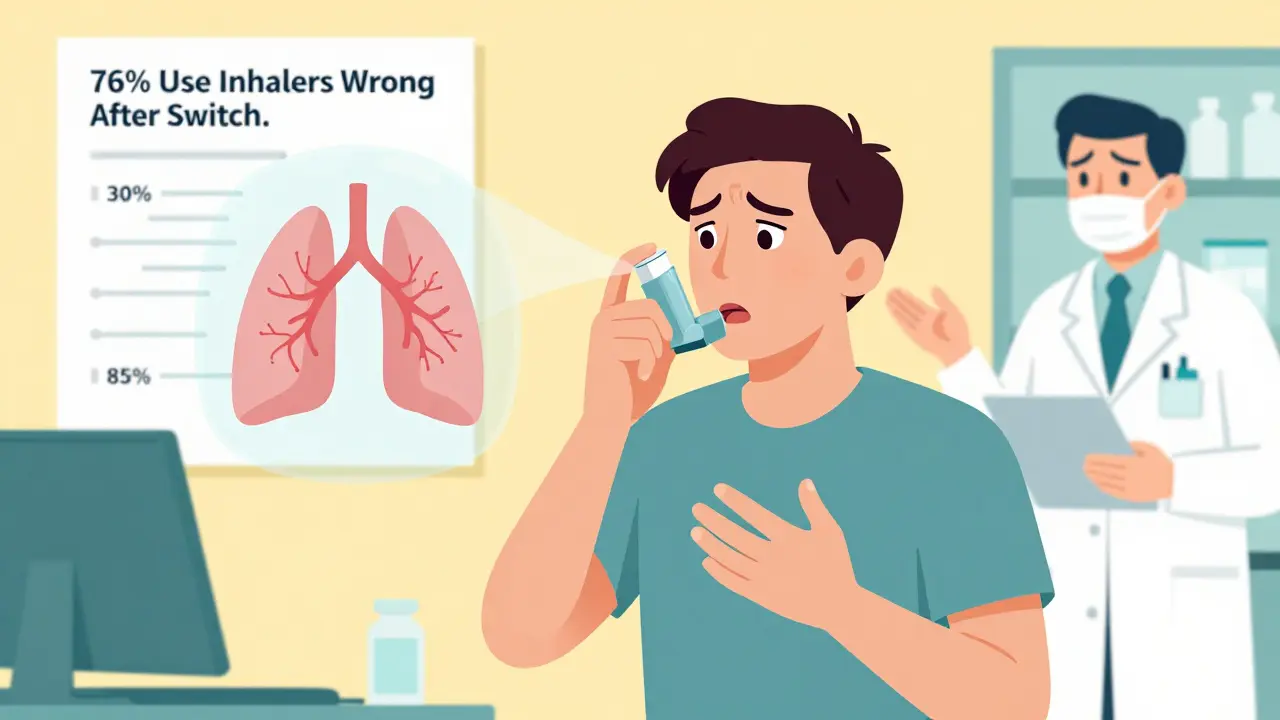
What Happens When You’re Switched Without Warning
You might not even know you’ve been switched. Pharmacies often substitute automatically unless the prescription says "Dispense as Written" or "Do Not Substitute." Patients assume the new inhaler works the same. They don’t check the label. They don’t ask questions. They just use it-and then wonder why they’re wheezing more. Reddit’s r/asthma community had over 80 posts from people who were switched to generics without warning. 83% reported worse symptoms. One user said, "I thought my asthma was getting worse. Turns out, I was using the inhaler wrong the whole time."What You Should Do Before Switching
If your doctor or pharmacist suggests switching to a generic inhaler, don’t just say yes. Ask these questions:- Is the new inhaler the same type of device? (DPI vs. pMDI)
- Do I need to learn a new technique?
- Can you show me how to use it correctly?
- Can I try it before I leave the pharmacy?

What Providers Need to Do Better
Doctors and pharmacists aren’t always trained on inhaler devices themselves. One NIH study found that 43% of general practitioners couldn’t demonstrate correct technique for either Turbuhaler or Spiromax. That’s alarming. If your provider doesn’t know how to use it, how can they teach you? Health systems that implement structured inhaler education programs see a 41% drop in substitution-related hospital visits. That’s not just better care-it’s cheaper care. A 2023 report estimated that inappropriate substitution costs the U.S. healthcare system $1.2 billion a year in avoidable ER trips and admissions.The Future: Smarter Inhalers and Stronger Rules
New technology is helping. Smart inhalers with sensors (like Propeller Health) track when and how you use them. They send alerts if your inhalation is too weak or too fast. A 2022 study showed these devices cut asthma exacerbations by 33% when used with feedback. Regulators are catching up. The FDA’s 2023 draft guidance now requires clinical endpoint studies for some inhaler generics-not just chemical tests. The European Respiratory Society says inhalers should be prescribed by brand name to avoid confusion. GINA’s 2023 guidelines now prioritize device familiarity over cost.Bottom Line: Don’t Swap Without a Plan
Generic inhalers aren’t bad. But they’re not interchangeable like pills. The device matters. The technique matters. The training matters. If you’re being switched, say no until you’ve seen it in action. Ask for a demo. Practice with your provider. Don’t let a cost-saving move put your health at risk. Your lungs can’t afford a guessing game.Can I switch from my brand-name inhaler to a generic without talking to my doctor?
No, you shouldn’t. Even if your pharmacy substitutes automatically, you need to consult your doctor or respiratory pharmacist first. Generic inhalers often use different devices that require different breathing techniques. Switching without proper training can lead to poor medication delivery, worsening symptoms, and even emergency hospital visits.
Are generic combination inhalers less effective than brand-name ones?
Not necessarily-but they can be if used incorrectly. The active ingredients are the same, but the device design affects how much medicine reaches your lungs. Studies show patients who switch without training have up to 22% more asthma exacerbations. With proper instruction, generic inhalers work just as well. The difference isn’t in the drug-it’s in the delivery.
How do I know if my inhaler has been switched?
Check the label and the device. Brand-name inhalers like Symbicort Turbohaler or Advair Diskus have specific shapes, colors, and loading mechanisms. Generic versions often look different-even if they contain the same drugs. If your inhaler suddenly looks or feels different, ask your pharmacist what changed. Don’t assume it’s the same.
What should I do if my symptoms get worse after switching inhalers?
Contact your doctor immediately. Don’t wait. Worsening symptoms after switching could mean you’re not using the new device correctly. Ask for a technique check-up. Bring your inhaler to your appointment and demonstrate how you use it. You may need to switch back or get trained on the new device.
Can my pharmacist refuse to substitute my inhaler?
Yes. In most states, pharmacists can substitute unless your prescription says "Dispense as Written" or "Do Not Substitute." But if you ask them not to switch, they should honor it. Some states have laws requiring counseling before substitution-others don’t. Always speak up. Your safety matters more than pharmacy policy.
Is there a way to track if I’m using my inhaler correctly?
Yes. Smart inhalers with built-in sensors (like Propeller Health or Adherium) can track your inhalation technique and remind you when you miss a dose. These devices connect to apps and show you whether you’re inhaling hard enough or holding your breath long enough. Studies show they reduce asthma attacks by 33% when used with feedback.
Why do some doctors still recommend switching to generics?
Cost is a big factor. Combination inhalers can cost over $300 without insurance. Generics may be under $50. Many doctors want to help patients afford care. But the best doctors pair cost savings with safety: they ensure patients understand the new device and receive proper training before switching. Cost shouldn’t come at the cost of control.
Tiffany Machelski
December 16, 2025 AT 21:26i just got switched to the generic and didn’t realize i was breathing wrong until i started wheezing at 3am... i thought it was my allergies. dumb mistake. never assume it’s the same.
SHAMSHEER SHAIKH
December 17, 2025 AT 10:51Dear friends, let me say this with the utmost sincerity: the inhaler is not merely a vessel-it is a conduit of life! To swap devices without proper instruction is akin to replacing a violin with a kazoo and expecting symphony! The data is irrefutable; the risks are catastrophic; and the responsibility lies not only with the patient-but with the system that permits such negligence!
May every pharmacist be trained, every physician be vigilant, and every patient be empowered with knowledge. The EMA understands this. The FDA? Still asleep at the wheel.
James Rayner
December 18, 2025 AT 01:28man... i’ve been on advair for 12 years. switched to the generic last year. thought i was fine. turns out i was barely getting any meds into my lungs. felt like a zombie for months. finally got it checked-turns out i was puffing like i was trying to blow out birthday candles. 😅
now i use the propeller thing. it beeps at me if i mess up. weird at first... now i’d be lost without it.
Souhardya Paul
December 19, 2025 AT 06:10totally agree with the point about training. i work at a clinic and we started doing teach-backs after seeing three patients end up in the ER over 6 months. now we make everyone demonstrate the inhaler before they leave. takes 3 minutes. saves so much more than that.
also, if your pharmacist doesn’t offer to show you how to use it, ask. they’re supposed to. it’s not extra-it’s standard.
Josias Ariel Mahlangu
December 19, 2025 AT 18:30people who don’t read the label or ask questions deserve what they get. this isn’t rocket science. if the device looks different, it’s different. stop being lazy and take responsibility for your own health.
anthony epps
December 21, 2025 AT 17:06i didn’t know inhalers had different ways to use them. i thought you just pressed it and breathed. guess i was wrong. now i’m scared to switch anything.
Andrew Sychev
December 23, 2025 AT 11:38THEY’RE PROFITING OFF YOUR BREATHING. YOU THINK THEY CARE IF YOU WHEEZE? NO. THEY CARE IF YOU BUY THE NEXT ONE. THIS ISN’T HEALTHCARE. THIS IS A MARKETPLACE WHERE YOUR LUNGS ARE A LINE ITEM.
THE FDA IS ASLEEP. THE PHARMACIES ARE ASLEEP. YOU’RE THE ONLY ONE WHO CAN STAY AWAKE.
Dan Padgett
December 24, 2025 AT 01:50in my village back home, we used to say: "you don’t change your horse halfway through the river." same thing here. if your inhaler’s working, don’t swap it for a shiny new one that feels like a stranger in your hand.
the medicine? same. the way it gets to your lungs? that’s the magic. and magic needs care.
Hadi Santoso
December 25, 2025 AT 11:12just got switched to a generic last week. looked at the box-"Spiromax"? never heard of it. called my doc. she was like, "oh yeah, that’s the new one, let me show you."
she didn’t even know how to use it either. 😅 so we watched a video on her phone. turned out i was breathing too slow. now i’m good.
point is: ask. even if they don’t know. just ask.
Arun ana
December 25, 2025 AT 22:54my dad switched and ended up in the hospital. he didn’t say anything because he didn’t want to "bother" anyone. now i make sure to check his inhaler every time i visit. simple thing. big difference. ❤️
Kayleigh Campbell
December 27, 2025 AT 14:14so let me get this straight: you can swap my insulin for a generic but my inhaler? nah, that’s a minefield. cool. so my lungs are more delicate than my pancreas? 🤔
also, why do we let pharmacies play roulette with life-saving devices? someone’s gonna get sued one day. and it won’t be the pharmacy.
Rich Robertson
December 27, 2025 AT 16:54as someone who’s been on combination inhalers for 18 years, i’ve seen the shift from brand to generic. i’ve been switched twice. both times, i asked for training. both times, the pharmacist gave me 2 minutes and a pamphlet.
the third time? i brought my own video of how i used my old one. showed them. asked them to match the motion. they finally got it.
it’s not hard. it’s just not prioritized. and that’s the real problem.