
Proton Pump Inhibitors and Antifungals: Drug Interaction Risks and Management
PPI-Antifungal Interaction Checker
Check Your Medication Combination
Interaction Result
Risk Level for
Clinical Recommendations
When you take a common heartburn medication and an antifungal together, the results can be dangerous-or even life-saving. This isn't just theoretical; it's a real-world drug interaction issue affecting thousands of patients every day. Proton pump inhibitors (PPIs) reduce stomach acid, while azole antifungals treat fungal infections. But when these drugs meet, their chemistry can clash in unexpected ways.
The Problem: Why PPIs and Antifungals Don't Always Get Along
Proton pump inhibitors (PPIs) are medications that block stomach acid production. Common examples include omeprazole, esomeprazole, and lansoprazole. Meanwhile, azole antifungals like fluconazole, itraconazole, and voriconazole treat fungal infections. When taken together, these drugs can interfere with each other's absorption and effectiveness, leading to treatment failures or unexpected side effects.
How PPIs Change Your Stomach's Chemistry
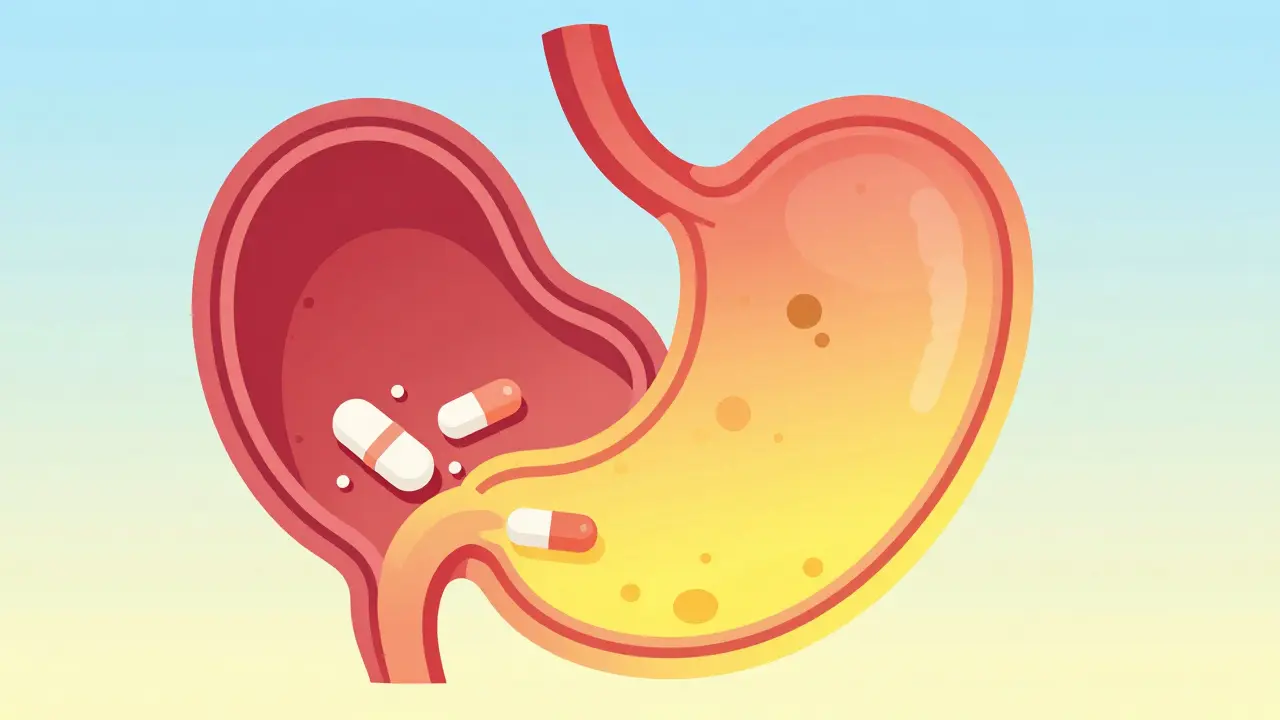
PPIs work by blocking the H+/K+ ATPase pumps in your stomach lining. These pumps are responsible for producing stomach acid. When PPIs bind to these pumps, they reduce acid production significantly. Normally, stomach pH is around 1.5-2.5-highly acidic. After taking a PPI, pH rises to 4-6. This change directly affects drugs that need acid to dissolve properly.
Itraconazole is a common antifungal that requires stomach acid for absorption. Studies show when taken with PPIs, its blood levels drop by 60%. This happens because itraconazole's solubility decreases as pH increases. At pH 1.2, itraconazole dissolves at 22 mg/mL, but at pH 6.8, solubility falls to just 0.02 mg/mL. Without enough acid, it doesn't get absorbed properly.
The Enzyme Battle: CYP450 Interactions
Beyond stomach pH, PPIs and antifungals interact through liver enzymes. The cytochrome P450 system (CYP450) processes many drugs. Some PPIs inhibit specific CYP enzymes, while certain antifungals either inhibit or are metabolized by these same enzymes. This creates a complex back-and-forth effect.
For example, CYP3A4 is a major enzyme that breaks down itraconazole and ketoconazole. Many PPIs like omeprazole also affect CYP3A4 activity. However, the interaction isn't straightforward-some PPIs inhibit CYP3A4, while others have minimal effect. This variability makes predicting outcomes challenging.
Another key enzyme is CYP2C19. Fluconazole inhibits CYP2C19, and PPIs like omeprazole are metabolized by this enzyme. When taken together, they can either increase or decrease each other's levels in the blood. This bidirectional interaction means both drugs' effectiveness can be compromised.
Which Antifungals Are Most Affected?
| Antifungal | Effect of PPIs on Absorption | Key Reason | Clinical Impact |
|---|---|---|---|
| Itraconazole | 60% reduction in AUC | pH-dependent solubility | Subtherapeutic levels, treatment failure |
| Ketoconazole | 60% reduction in AUC | pH-dependent solubility | Not recommended with PPIs |
| Fluconazole | Minimal effect | High water solubility | No dose adjustment needed |
| Voriconazole | 25-35% reduced clearance | CYP2C19 inhibition | Requires therapeutic drug monitoring |
What Doctors Do to Keep You Safe
When both medications are necessary, doctors follow specific protocols to minimize risks. The University of California San Francisco Medical Center's 2024 Drug Interaction Protocol recommends taking itraconazole at least 2 hours before a PPI. This timing allows the antifungal to absorb before the PPI raises stomach pH.
For ketoconazole, the Mayo Clinic's 2023 Antifungal Guidelines suggest separating doses by 4-6 hours. However, this only reduces absorption loss from 60% to 45%. Many clinicians prefer switching to alternative antifungals like echinocandins when possible. A 2023 survey of 217 infectious disease pharmacists found that 87% routinely recommend alternatives rather than managing the interaction directly.
For voriconazole, the Cleveland Clinic's 2024 Therapeutic Drug Monitoring Protocol requires checking blood levels within 72 hours of starting PPI therapy. Dose adjustments of 25-50% may be needed based on the results. Target trough concentrations should stay between 1-5.5 μg/mL for effective treatment.
What's Next? New Research and Solutions
Researchers are tackling this problem from multiple angles. A 2024 study published in PMC (PMC10831725) revealed that PPIs might actually enhance antifungal effectiveness in some cases. Omeprazole was found to inhibit fungal plasma membrane ATPase (Pam1p), reducing the minimum inhibitory concentration (MIC) of fluconazole against resistant Candida glabrata strains by 4-8 fold.
The FDA's 2024 Antifungal Development Initiative is funding research into pH-independent formulations. A submicron particle version of itraconazole (SUBA-itraconazole) showed 92% bioavailability regardless of stomach pH in a 2023 Phase I trial. This could eliminate absorption issues entirely.
Meanwhile, a Phase II trial (NCT05876543) at Johns Hopkins University is testing omeprazole as an antifungal adjuvant. Results are expected in Q3 2025. If successful, this could lead to new treatment strategies for drug-resistant fungal infections.
Can I take fluconazole with a PPI?
Yes, fluconazole is generally safe to take with PPIs. Unlike other azole antifungals, fluconazole has high water solubility and isn't affected by stomach pH changes. Its bioavailability remains consistent at 90%±5% regardless of gastric pH. The main concern with fluconazole is its effect on other medications-like warfarin-due to CYP2C9 inhibition.
Why is itraconazole so sensitive to PPIs?
Itraconazole requires an acidic environment to dissolve properly. When PPIs raise stomach pH to 4-6, itraconazole's solubility drops from 22 mg/mL at pH 1.2 to just 0.02 mg/mL at pH 6.8. This drastic change prevents proper absorption, leading to 60% lower blood levels. The FDA added a black box warning in June 2023 advising against combining these drugs.
What should I do if I need both a PPI and itraconazole?
Avoid combining them if possible. If absolutely necessary, take itraconazole at least 2 hours before the PPI. Your doctor should monitor your blood levels closely and consider switching to an alternative antifungal like an echinocandin. The Infectious Diseases Society of America's 2023 guidelines explicitly recommend against this combination due to high risk of treatment failure.
Do all PPIs interact with antifungals the same way?
No. Different PPIs affect CYP enzymes differently. Omeprazole and esomeprazole strongly inhibit CYP2C19, while pantoprazole has a weaker effect. For voriconazole, which is metabolized by CYP2C19, omeprazole may have a greater impact than other PPIs. Always discuss specific PPI choices with your doctor when taking antifungals.
Is there any benefit to taking PPIs with antifungals?
Emerging research suggests yes, in specific cases. A 2024 study found that omeprazole can enhance fluconazole's effectiveness against resistant Candida glabrata by inhibiting fungal plasma membrane ATPase (Pam1p). This synergy reduced the minimum inhibitory concentration (MIC) by 4-8 fold. However, this is still experimental and not yet part of standard treatment protocols.
Samantha Beye
February 4, 2026 AT 13:16Always double-check drug interactions-this could save lives. A simple step can prevent serious complications.
Pamela Power
February 5, 2026 AT 22:00Basic pharmacology 101: itraconazole requires acidic environment for absorption. PPIs raise stomach pH, leading to 60% drop in bioavailability. If you're not aware of this, you shouldn't be prescribing. Pathetic.
Arjun Paul
February 7, 2026 AT 11:15The table clearly shows itraconazole and ketoconazole's vulnerability. Fluconazole's stability is a relief. Still, clinicians must stay vigilant.
Carol Woulfe
February 7, 2026 AT 17:16Big Pharma is happy to ignore these interactions. They profit from patients suffering side effects. The FDA's guidelines are too lenient. Always question the source.
Cole Streeper
February 9, 2026 AT 13:33This is all a setup. PPIs are being pushed to increase antifungal resistance. The real issue is corporate greed. They want us dependent on these drugs. Check the sources!
Rene Krikhaar
February 9, 2026 AT 23:53When taking itraconazole and PPIs together, take the antifungal at least two hours before the PPI. This helps absorption.
Also, monitor blood levels closely.
It's a common issue but manageable.
Georgeana Chantie
February 11, 2026 AT 08:34I don't agree with this. American doctors know how to handle this. We have the best medical protocols. Just follow the guidelines-no big deal. 🇺🇸
Brendan Ferguson
February 12, 2026 AT 13:14Both sides have valid points. The key is individual patient assessment. For some, switching antifungals is best; others can manage with timing. Always consult a pharmacist.
divya shetty
February 14, 2026 AT 10:36This is why we need stricter regulations. Patients are at risk due to lax oversight. Every healthcare provider must be educated on these interactions. No exceptions.
Sam Salameh
February 16, 2026 AT 01:44As an American, I've seen this handled perfectly. We have the best medical protocols. Just follow the guidelines-no big deal. 🇺🇸
anjar maike
February 16, 2026 AT 14:13Fluconazole safe with PPIs 🌟
Cullen Bausman
February 17, 2026 AT 02:59This interaction is well-documented. Omeprazole inhibits CYP2C19 affecting voriconazole. Always check for alternatives. It's common sense.