
Peak Flow Monitoring in Asthma: Daily Tracking and Thresholds
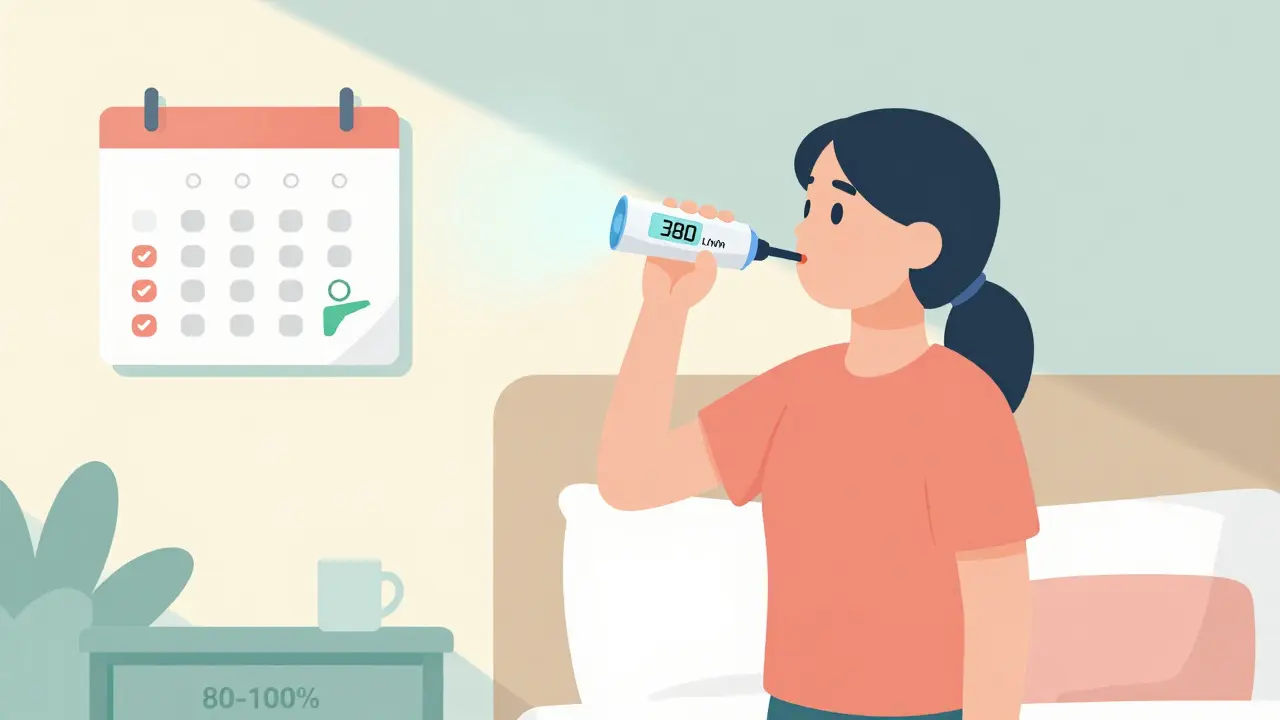
When your asthma is under control, you might not think about breathing. But if you’ve ever had a flare-up come out of nowhere, you know how dangerous that can be. That’s where peak flow monitoring comes in. It’s not flashy. It doesn’t require a doctor’s visit every time. But for people with asthma, especially those who don’t feel symptoms until it’s too late, tracking your peak expiratory flow (PEF) every day can be the difference between a normal day and an emergency room trip.
Why Peak Flow Monitoring Matters
Peak flow monitoring measures how fast you can blow air out of your lungs after taking a deep breath. It’s a simple number - measured in liters per minute - but it tells you something your body might not: your airways are narrowing, even before you feel tightness, wheezing, or coughing. Studies show that for many people, peak flow readings can drop 24 to 48 hours before symptoms appear. This is especially true if you have poor symptom awareness. You might not feel anything wrong, but your lungs are already struggling. That’s why doctors recommend daily tracking - not just when you feel bad, but every single day, even when you’re feeling fine. The goal isn’t to scare you. It’s to give you early warning. Think of it like a smoke detector. You don’t wait until the house is on fire to check it. You test it monthly. Peak flow monitoring works the same way.How to Track Your Peak Flow Correctly
It’s not enough to just blow into a meter once in a while. If you want accurate data, you need consistency.- Use the same peak flow meter every time. Different brands and models give different readings. Switching meters ruins your trend line.
- Take readings at the same time each day. Lung function naturally dips in the early morning and rises later. Most experts recommend measuring once in the morning (between 7 and 9 a.m.) and once in the evening (between 6 and 8 p.m.).
- Stand up straight. Don’t slouch. Take a deep breath, seal your lips around the mouthpiece, and blow out as hard and fast as you can - like you’re blowing out candles on a birthday cake from across the room.
- Do it three times. Write down the highest number. Don’t average them. The highest one is your best effort.
- Record everything. Use a paper diary, a phone app, or even a sticky note on your fridge. If you don’t write it down, it doesn’t count.
People with mild, stable asthma might only need to check twice a week. But if your asthma is moderate, severe, or unpredictable, twice daily is the minimum. Some patients with frequent flare-ups track four times a day - morning, noon, evening, and before bed.
Establishing Your Personal Best
Your peak flow number isn’t the same as someone else’s. It’s not even the same as the number on the chart in your doctor’s office. What matters is your personal best. To find it, you need to monitor for at least two to three weeks while your asthma is well-controlled. That means no symptoms, no rescue inhaler use, no missed work or school. Take your readings twice daily during this period. The highest number you consistently get is your personal best. Don’t assume your personal best matches the predicted value for your age, height, or gender. It might be higher. It might be lower. That’s okay. Your body is unique. Your personal best is your baseline. For children, this number changes as they grow. Recheck it every six to twelve months. If your asthma control changes - say, after starting a new medication - reset your personal best after a few weeks of stable control.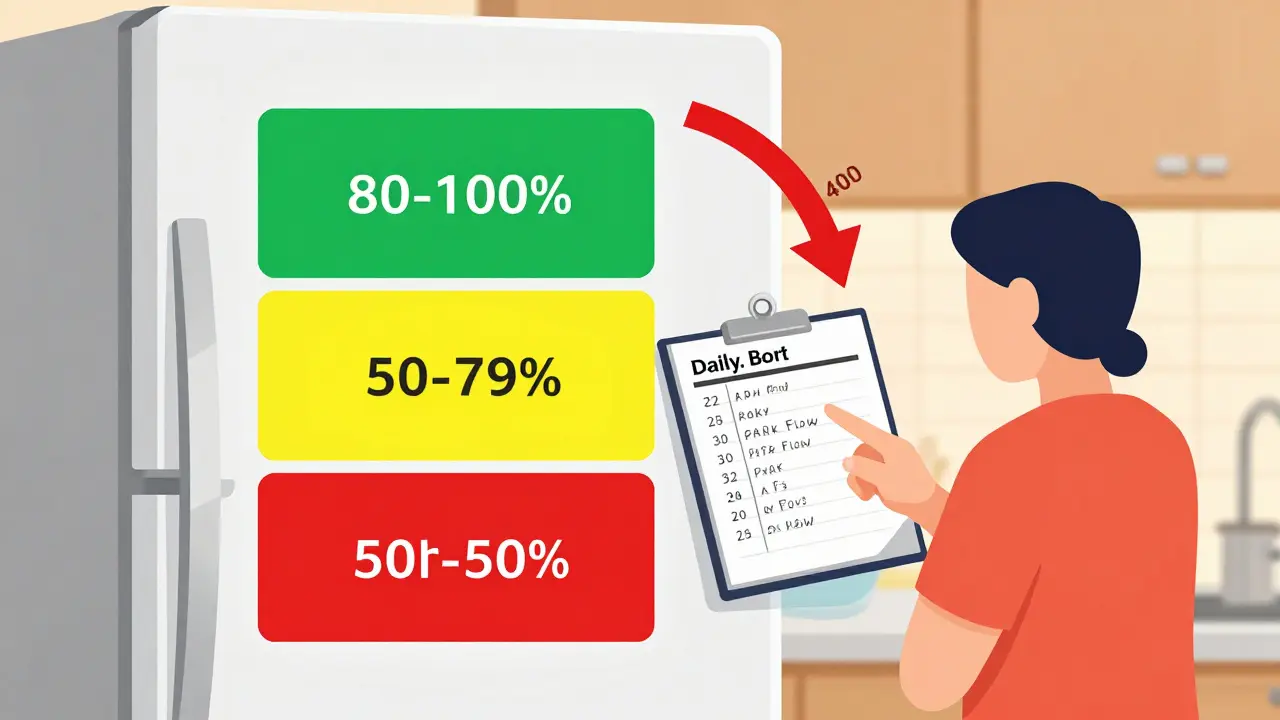
The Green, Yellow, Red Zone System
Once you know your personal best, divide it into three zones - like a traffic light.- Green Zone (80%-100% of personal best): You’re in control. No changes needed. Keep doing what you’re doing.
- Yellow Zone (50%-79% of personal best): Caution. Your airways are narrowing. You might not feel symptoms yet, but your body is sending a signal. Follow your asthma action plan. This usually means increasing your controller medication or using your rescue inhaler sooner than usual.
- Red Zone (below 50% of personal best): Medical alert. Your breathing is dangerously restricted. Use your rescue inhaler immediately and call your doctor or go to the emergency room. Don’t wait. Don’t hope it gets better. This is a red flag.
A drop of 20% to 30% from your personal best is often the first sign of an impending flare-up. That’s why tracking daily matters. If your personal best is 400 L/min, and you wake up at 320, that’s an 80% reading - still in the green. But if you drop to 280, that’s 70% - yellow zone. That’s your cue to act.
When to Trust Your Numbers Over Your Feelings
Some people feel fine even when their peak flow is in the red zone. Others panic when their number dips 10% but still sits in the green. This is why you need to trust the meter more than your instincts. One patient I worked with - let’s call her Lisa - always felt okay. She rarely used her inhaler. But her peak flow readings kept dipping every Sunday morning. She ignored it. Then, one Monday, she ended up in the hospital with severe asthma. Her personal best was 420. On Sunday, it was 210 - 50%. She felt fine. The meter didn’t lie. This happens often. People with chronic asthma get used to breathing “normally” - even when it’s not normal. Their bodies adapt. The meter doesn’t adapt. It just tells you the truth.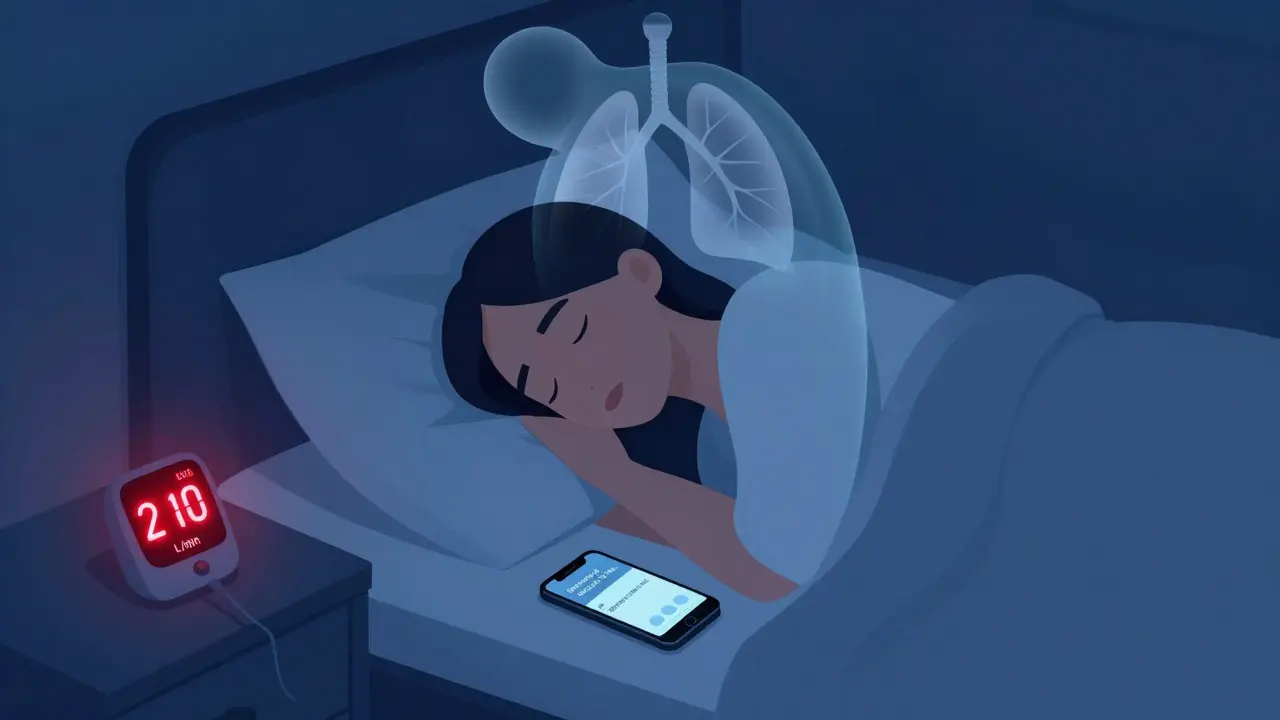
Limitations and What to Watch Out For
Peak flow meters aren’t perfect. They’re not as precise as spirometry, which is why doctors use it in clinics. But spirometry isn’t always available, especially outside of office hours. Peak flow meters are cheap, portable, and give you real-time data you can act on. The biggest mistake people make? Using different meters. A cheap plastic meter from the pharmacy might read 10% higher than the one your doctor uses. That throws off your entire tracking system. Always use the same device. Bring it to every appointment so your doctor can compare readings. Also, don’t use it if you’re sick with a cold or flu. Your readings will be low - not because your asthma is worsening, but because your airways are inflamed from the infection. That’s not a flare-up. That’s a different problem.How This Fits Into Your Asthma Action Plan
Your asthma action plan isn’t just a piece of paper. It’s your daily roadmap. And peak flow monitoring is one of its most powerful tools. If your plan says: “When peak flow drops below 80%, take an extra puff of your controller inhaler,” then you follow that. No guessing. No waiting. No hoping. Studies show that people who use a written action plan with peak flow tracking have fewer ER visits, fewer hospitalizations, and better quality of life. It’s not magic. It’s math. You measure. You react. You prevent.What Comes Next
If you’re not already tracking your peak flow, start today. Get a meter if you don’t have one. Most pharmacies sell them for under $20. No prescription needed. Take two readings every morning and evening for two weeks. Write them down. Find your highest number. That’s your personal best. Then, calculate your zones:- Green: 80% or higher
- Yellow: 50% to 79%
- Red: below 50%
Put those numbers on your fridge. Set phone reminders. Make it part of your routine - like brushing your teeth.
Peak flow monitoring won’t cure your asthma. But it gives you back control. It turns fear into action. And in asthma, that’s everything.
Skye Kooyman
January 27, 2026 AT 12:53Been using a peak flow meter for 3 years now. Honestly? Life changer. I used to think I was fine until I couldn’t breathe. Now I see the numbers drop and I act before it’s a crisis. No more ER visits. Just a little routine that saves my lungs.
Kipper Pickens
January 28, 2026 AT 03:20From a pulmonary standpoint, the interindividual variability in PEF trajectories is often underestimated. The Z-scores derived from population-based nomograms fail to account for epigenetic modulation of bronchial reactivity, particularly in patients with non-allergic endotypes. Consistency in device calibration and circadian phase alignment is non-negotiable for longitudinal data integrity. Without this, you're just collecting noise.
Joanna Domżalska
January 29, 2026 AT 03:23Why do we even need this? If you feel fine, why mess with numbers? My grandma didn’t have a meter and lived to 92. Maybe your body knows better than a plastic tube.
bella nash
January 30, 2026 AT 13:36It is imperative to recognize that the utilization of peak expiratory flow monitoring constitutes a paradigmatic shift in the patient's ontological relationship with their own physiological state. The apparatus functions not merely as a diagnostic instrument, but as a hermeneutic tool mediating the subject's corporeal self-perception.
Sally Dalton
January 31, 2026 AT 11:23OMG YES THIS! I used to ignore mine until I almost passed out at work 😭 I started tracking and now I have a sticky note on my mirror with my zones. I even got a cute little app with little stars when I hit green zone 🌟🌟🌟 I feel so in control now. Thank you for writing this!!
Shawn Raja
February 1, 2026 AT 08:11Peak flow meters. The original wellness tracker. Before Fitbits, before Apple Watches - we had these clunky plastic things that told us the truth when our egos were lying. Funny how the most basic tech is the one that saves lives. Meanwhile, people are paying $500 for sleep tracking that doesn’t even know when they’re breathing.
Ryan W
February 1, 2026 AT 20:58Why are we letting non-medical personnel self-diagnose with consumer-grade devices? This is why American healthcare is broken. You don’t need to monitor PEF unless you’re under specialist supervision. It’s just liability insurance for doctors. And don’t get me started on those cheap meters from CVS - they’re calibrated for toddlers.
Allie Lehto
February 3, 2026 AT 10:01People like you think you can just track numbers and be safe… but what about the soul? What about the emotional toll of living like a machine? I used to check mine every day… then I realized I was punishing myself for breathing wrong. I stopped. I breathe. I live. 🙏
Robin Van Emous
February 4, 2026 AT 17:04I appreciate the effort put into this, really. I’ve been using a peak flow meter for 15 years, and I agree with almost everything here. But I’d just add - if you’re traveling, bring your meter with you. I had a flare-up in Mexico once because I used a different brand and thought I was in the green. Turned out I was in the red. Lesson learned.
Angie Thompson
February 6, 2026 AT 13:58YESSSS this is my bible now 🙌 I used to think asthma was just wheezing and panic… now I know it’s a quiet war inside my lungs. I track twice a day like clockwork - morning coffee, night tea. My green zone is 410. I got it tattooed on my wrist (tiny, subtle). My doctor cried when she saw it. 💙
rasna saha
February 7, 2026 AT 09:28I’m from India and we don’t have easy access to these meters here. But I taught my sister how to use one I brought from the US. She’s 12 and has asthma. Now she checks every day before school. We celebrate green zones with chai and biscuits. Small wins matter.
Jessica Knuteson
February 8, 2026 AT 22:39My personal best is 380. I dropped to 270 last Tuesday. Felt fine. Didn’t use my inhaler. Ended up in the ER. The meter didn’t lie. Don’t be me.