
Narrow Therapeutic Index Drugs: What Patients Need to Know
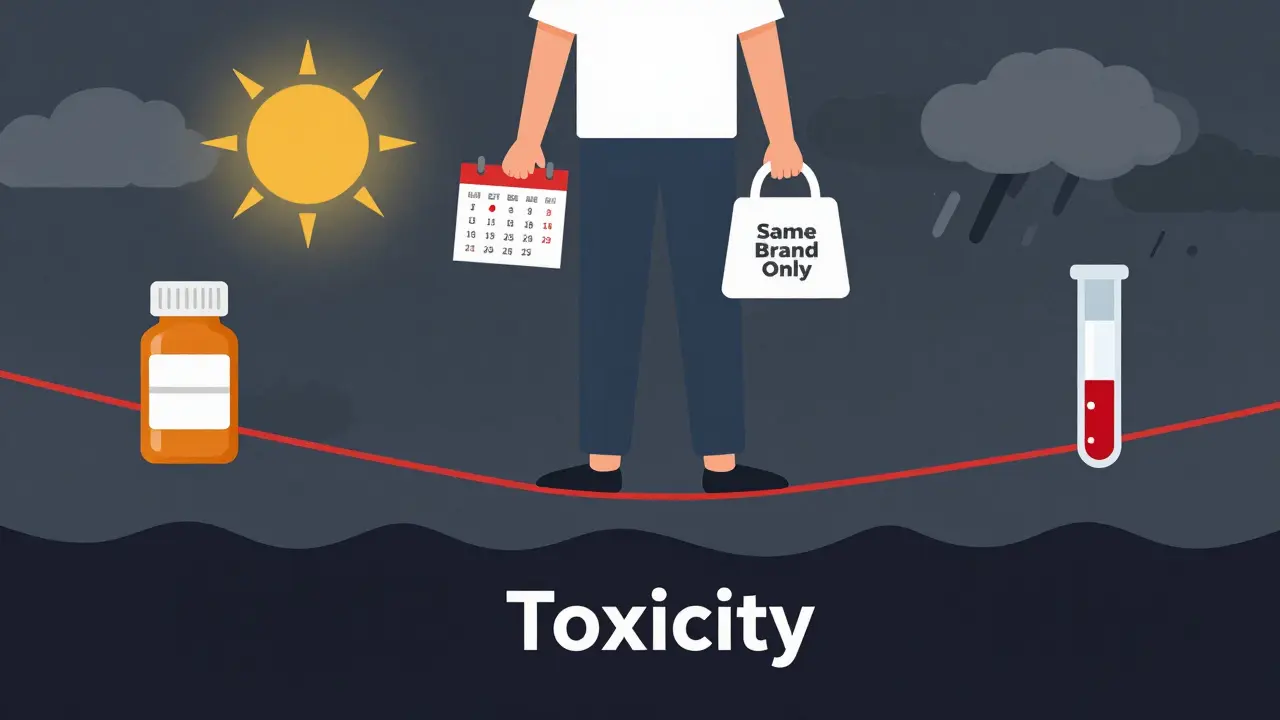
Some medications work like a tightrope walk - one step too far, and you could fall. That’s the reality with narrow therapeutic index drugs, or NTI drugs. These aren’t your everyday pills. Even a tiny change in dose - maybe just 10% - can turn a helpful treatment into a dangerous one. For patients taking these drugs, staying safe means understanding how they work, why consistency matters, and what to watch for.
What Makes a Drug ‘Narrow Therapeutic Index’?
Every drug has a sweet spot: the amount that helps without hurting. For most medicines, that range is wide. You can miss a dose or take it a little late, and nothing major happens. But with NTI drugs, the line between right and wrong is razor-thin. The difference between a therapeutic dose and a toxic one is often less than double. That’s why doctors call it a narrow therapeutic window.
Take warfarin, for example. It’s used to prevent blood clots. The goal is to keep your INR (a blood test) between 2.0 and 3.0. If it goes above 3.5, your risk of dangerous bleeding skyrockets. If it drops below 2.0, you’re at risk for a stroke or clot. A single generic switch, a change in diet, or even a new antibiotic can throw that balance off. That’s not a guess - it’s backed by real patient stories and clinical data.
The FDA defines NTI drugs as those where small changes in blood levels can cause life-threatening problems or permanent disability. That’s not hyperbole. It’s a formal classification based on decades of research. Drugs like lithium, digoxin, and tacrolimus fall into this category because their safety margins are so small.
Common NTI Drugs You Might Be Taking
You might not realize you’re on an NTI drug unless your doctor or pharmacist tells you. Here are the most common ones:
- Warfarin (Coumadin, Jantoven) - Blood thinner. Requires weekly or monthly INR checks.
- Lithium (Lithobid) - Used for bipolar disorder. Blood levels must stay between 0.6 and 1.2 mmol/L. Above 1.5, you risk confusion, tremors, or seizures.
- Levothyroxine (Synthroid) - Thyroid hormone replacement. Even small changes in dose can cause fatigue, weight gain, or heart palpitations.
- Digoxin (Lanoxin) - Heart medication. Therapeutic level: 0.5-0.9 ng/mL. Above 2.0, it can cause deadly heart rhythms.
- Tacrolimus (Prograf) - Immunosuppressant for transplant patients. Levels must be tightly controlled to prevent rejection or kidney damage.
- Phenytoin (Dilantin) and Carbamazepine (Tegretol) - Seizure meds. Too high = toxicity; too low = seizures return.
- Methotrexate (Trexall) - Used for cancer, rheumatoid arthritis, and psoriasis. Toxicity can damage bone marrow and liver.
These aren’t rare drugs. Millions of people take them. But many don’t know they’re in a high-risk group. If you’re on any of these, your doctor should have flagged it. If they didn’t, ask.
Why Generic Switches Can Be Risky
Generic drugs are usually safe, cheaper, and just as effective. But for NTI drugs, that’s not always true - and here’s why.
Most generics are approved if they deliver 80% to 125% of the brand drug’s amount in your blood. That’s a 45% range. For NTI drugs, that’s too wide. A 10% difference in absorption can push you from safe to toxic.
That’s why the FDA and EMA now require stricter testing for NTI generics. The acceptable range is now 90% to 111% - less than half the variation. But even then, small differences in fillers, coatings, or manufacturing can affect how your body absorbs the drug.
Real patients have felt the impact. One warfarin user reported her INR jumped from 2.5 to 4.1 after switching to a different generic - leading to emergency treatment for bleeding. Another levothyroxine patient saw her TSH level spike from 1.8 to 8.4 after switching manufacturers, causing months of fatigue and weight gain.
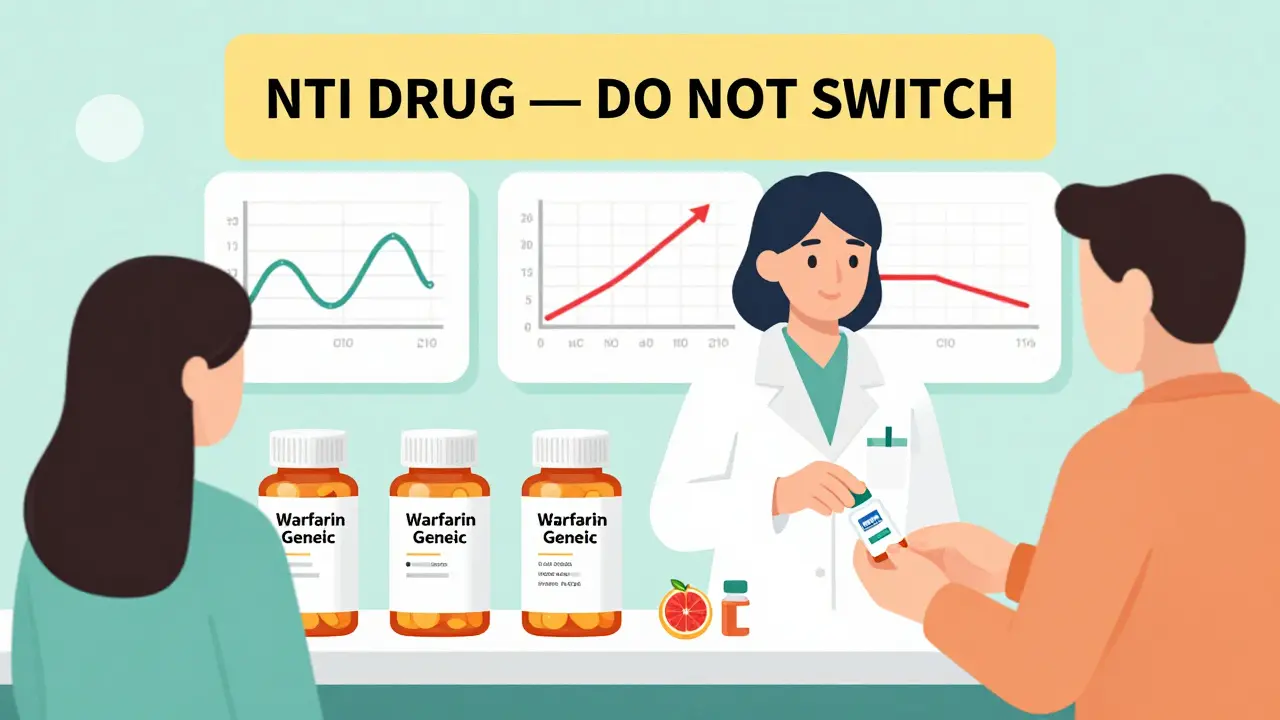
Some states, like North Carolina, require pharmacists to get your doctor’s approval before switching your NTI drug. Other states don’t. Always ask: “Is this the same brand I’ve been taking?” If you’re unsure, keep your current version - even if it costs more.
Monitoring: Your Lifeline
There’s no way around it: if you’re on an NTI drug, you need regular blood tests. No exceptions.
- Warfarin: INR checked every 1-4 weeks, especially when starting or changing doses.
- Lithium: Blood levels every 3-6 months, or more often if your dose changes or you get sick.
- Digoxin: Levels checked every few months, or if you feel dizzy, nauseous, or have an irregular heartbeat.
- Tacrolimus: Weekly checks right after transplant, then every few weeks as you stabilize.
- Levothyroxine: TSH checked 6-8 weeks after any dose change, then every 6-12 months if stable.
These aren’t optional. Skipping a test can be dangerous. One study found patients who missed monitoring were 2.3 times more likely to be hospitalized for NTI-related issues.
Keep a simple log: write down your dose, when you took it, and any symptoms (headache, fatigue, rash, dizziness). Bring it to every appointment. Patients who track their meds and symptoms have 32% fewer bad reactions.
What You Can Do to Stay Safe
Managing an NTI drug isn’t just about taking pills. It’s about building habits.
- Stick to one pharmacy. They track your history and can flag dangerous interactions.
- Don’t switch brands or generics without talking to your doctor. Even if the name looks the same, the manufacturer might be different.
- Watch for interactions. Grapefruit juice, certain antibiotics, and even high-fiber diets can change how your body handles these drugs.
- Know the warning signs. For warfarin: unexplained bruising, nosebleeds, dark urine. For lithium: hand tremors, slurred speech, confusion. For levothyroxine: rapid heartbeat, sweating, weight loss. Don’t wait - call your doctor if something feels off.
- Use reminders. Set phone alarms. Use pill organizers. These drugs demand precision - your brain can’t be trusted to remember perfectly.
And don’t be afraid to ask questions. If your doctor says, “It’s just a generic,” ask: “Is this one approved for NTI drugs? Has it been tested for bioequivalence under the stricter 90-111% rule?”
The Future: Personalized Dosing and Genetic Testing
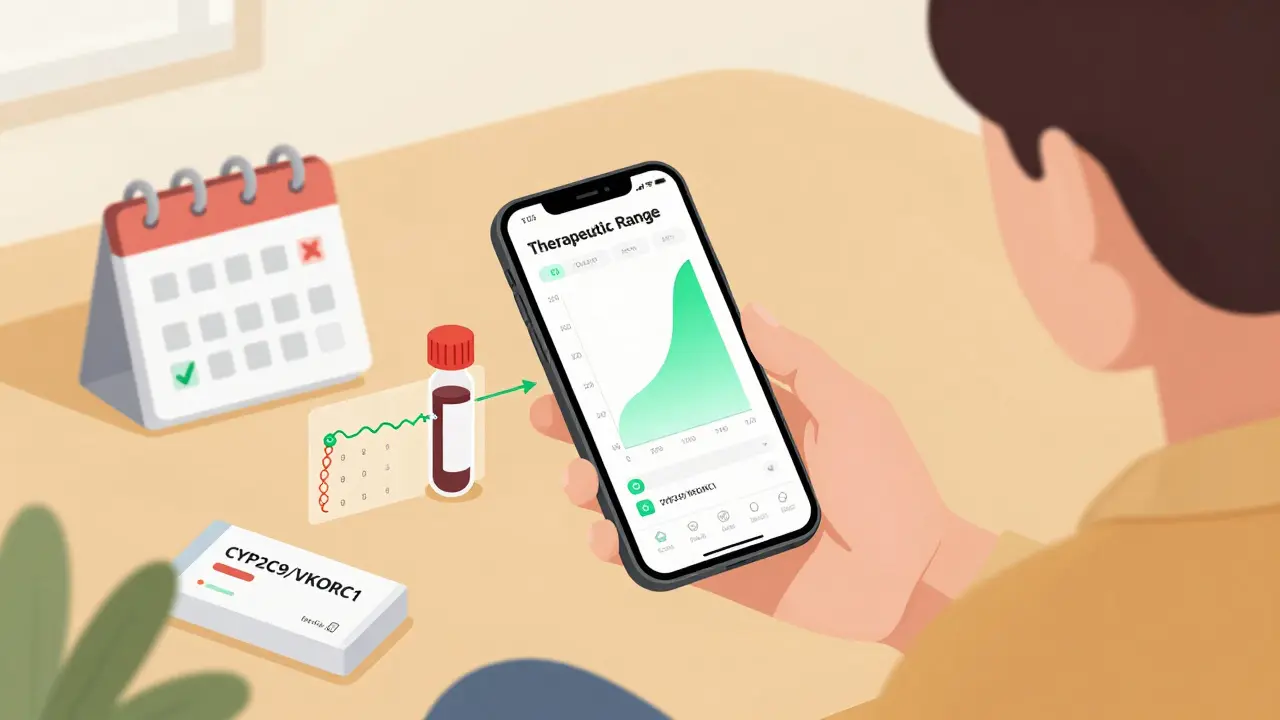
Science is catching up. Researchers now know that genes affect how people process NTI drugs. For warfarin, two gene variants - CYP2C9 and VKORC1 - explain up to 60% of why some people need tiny doses while others need much more.
By 2026, genetic testing before starting certain NTI drugs could become standard. It won’t eliminate monitoring, but it could cut down the trial-and-error phase. One study showed this approach could reduce adverse events by 35%.
The FDA is also rolling out barcode scanning in hospitals for 12 high-risk NTI drugs to prevent dosing errors. Mobile apps that track doses, symptoms, and lab results are now cleared by the FDA - and they’re helping patients stay on top of their care.
This isn’t science fiction. It’s the new normal. If you’re on an NTI drug, you’re part of a group that’s driving major changes in how medicine is personalized.
Final Thought: You’re Not Alone
NTI drugs are scary - but they’re manageable. Thousands of people live stable, healthy lives on them. The key isn’t perfection. It’s awareness. It’s communication. It’s showing up for your blood tests and asking the hard questions.
If you’re taking one of these drugs, you’ve already taken the first step: learning. Now, keep going. Talk to your pharmacist. Track your symptoms. Never assume a generic is the same. And remember: your body is listening. If something feels wrong, it probably is.
Are all generic drugs unsafe for NTI medications?
No, not all generics are unsafe. But they must meet stricter bioequivalence standards (90-111%) compared to regular drugs (80-125%). Some generics are approved for NTI use and are safe when taken consistently. The risk comes from switching between different generic brands - even if they’re both approved. Always ask your pharmacist if the generic you’re getting is the same one you’ve been using.
Can I stop taking my NTI drug if I feel fine?
Never stop or change the dose of an NTI drug without talking to your doctor. Even if you feel fine, stopping suddenly can cause serious harm. For example, stopping levothyroxine can lead to severe fatigue, depression, or heart problems. Stopping lithium can trigger a bipolar episode. These drugs work in the background - you won’t always feel their effects, but your body depends on them.
Why do I need blood tests so often?
Because your body’s absorption of NTI drugs can change due to diet, other medications, illness, or even stress. Blood tests measure the actual amount of drug in your system, not just the dose you took. That’s the only way to know if you’re in the safe range. Skipping tests is like driving blindfolded - you might be fine today, but you’re at risk for a crash tomorrow.
What should I do if I miss a dose?
Don’t double up. Call your doctor or pharmacist immediately. For some NTI drugs like warfarin or lithium, missing one dose might not be critical. For others, like tacrolimus after a transplant, it could be dangerous. Each drug has different rules. Your provider will tell you whether to skip, take a partial dose, or adjust the next one.
Can I take supplements or herbal products with my NTI drug?
Many supplements can interfere with NTI drugs. St. John’s wort can lower levels of tacrolimus and lithium. Vitamin K can make warfarin less effective. Calcium and iron can block levothyroxine absorption. Always tell your doctor and pharmacist about every supplement, herb, or over-the-counter pill you take - even if you think it’s harmless.
Glendon Cone
December 30, 2025 AT 13:55Man, I’ve been on warfarin for 5 years now and this post hit home. 🫡 I switched generics once without asking and ended up in the ER with a nosebleed that wouldn’t stop. Now I only get the exact same brand - even if it costs $80 instead of $12. Worth it. Also, I use a pill organizer with alarms and a little notebook. My pharmacist knows me by name now. 😅
Henry Ward
January 1, 2026 AT 07:57So let me get this straight - you’re telling me that if I take a generic lithium pill from Company A today and Company B tomorrow, I could literally go into a seizure? And the FDA lets this happen? This isn’t medicine, it’s Russian roulette with a prescription pad. People are dying because Big Pharma and pharmacies can’t be bothered to keep it consistent. #PharmaIsAScam
Shae Chapman
January 2, 2026 AT 18:17OMG I’m crying reading this 😭 I’m on levothyroxine and I didn’t even know it was an NTI drug until my endo screamed at me last month because my TSH jumped after a generic switch. I thought generics were all the same!! Now I carry my bottle like it’s a baby and I’ve started logging my symptoms in a Google Doc. My dog even knows when I’m off - he licks my face more when I’m hypothyroid. 🐶❤️
Nadia Spira
January 4, 2026 AT 06:48The entire paradigm of pharmacoeconomics is fundamentally incompatible with the pharmacokinetic constraints of NTI agents. The 80–125% bioequivalence threshold is a relic of 20th-century regulatory complacency - a statistical fiction masquerading as clinical safety. We are systemically enabling iatrogenic catastrophe by conflating cost-efficiency with therapeutic equivalence. The 90–111% standard is a Band-Aid on a hemorrhage. We need pharmacogenomic-guided dosing mandates - not patient education pamphlets. 🧬🩸
henry mateo
January 4, 2026 AT 21:02i read this whole thing and i had no idea ntis were such a big deal. i take digoxin and i just thought the doc was being extra with the blood tests. i missed one last month and felt weird but thought it was just stress. oof. gonna call my dr tomorrow. ty for this 🙏
Kunal Karakoti
January 5, 2026 AT 03:56In the grand dance of biology and chemistry, the human body is both the dancer and the stage. NTI drugs reveal how fragile this choreography is - one misstep in absorption, one whisper of grapefruit juice, and the rhythm breaks. We treat medicine like a machine, but it is a symphony. And we, the patients, are the only ones who can hear when the notes go sour. 🎻
Aayush Khandelwal
January 5, 2026 AT 18:24Bro, this is wild. I’m on tacrolimus post-kidney transplant and my team does weekly blood draws like it’s a religious ritual. I’ve seen people get rejected because their levels dipped 0.1 ng/mL. But here’s the kicker - I switched from Prograf to a generic and my levels stayed *perfect*. No drama. So yeah, some generics are fine - but you gotta monitor like your life depends on it… because it does. 🤝💊
Joseph Corry
January 6, 2026 AT 06:18Let’s be real - if you need this much education just to take a pill, maybe you shouldn’t be on it at all. This isn’t medicine, it’s a full-time job. I’ve got a friend on lithium who tracks her intake with a spreadsheet, uses a dedicated pharmacy, and has a blood test calendar synced to her Alexa. That’s not healthcare - that’s survival mode. Maybe the real solution is developing safer drugs instead of making patients into pharmacists.