
International Perspectives on NTI Generics: Regulatory Approaches
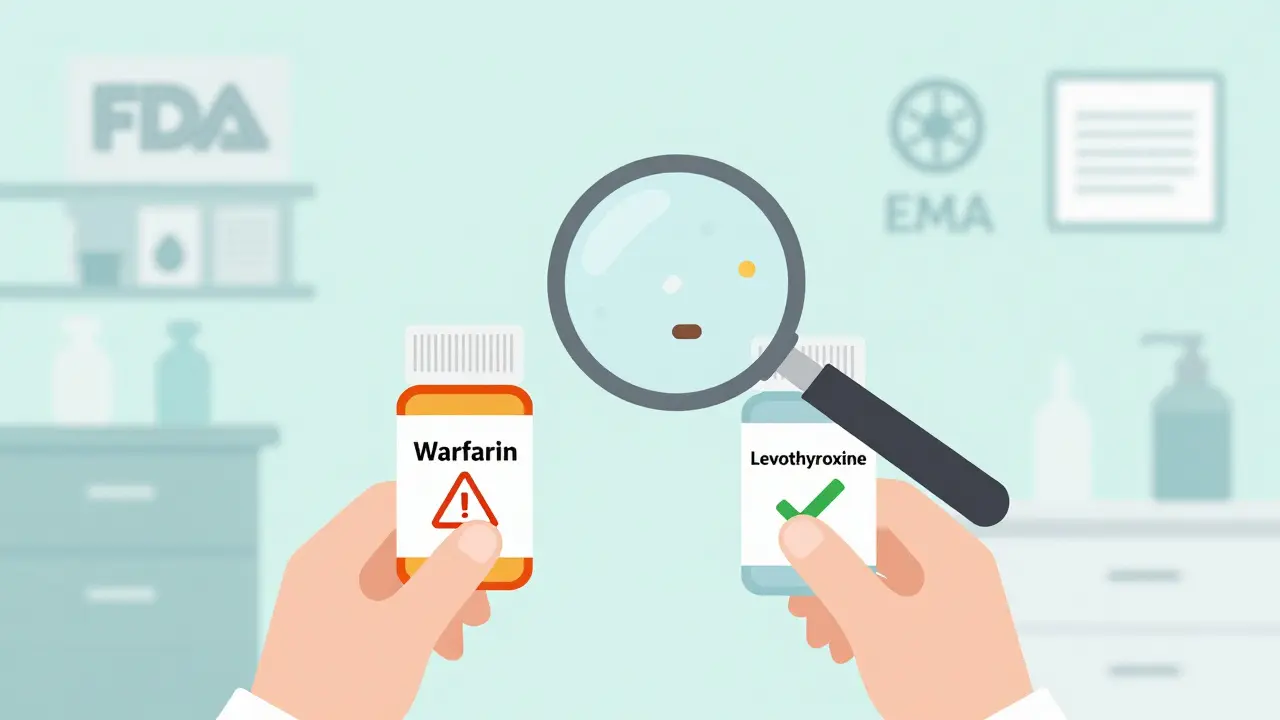
When a patient takes a drug like warfarin, phenytoin, or levothyroxine, the difference between it working and causing harm can be as small as a fraction of a milligram. These are NTI drugs - Narrow Therapeutic Index medications - where even minor changes in blood levels can lead to serious consequences: seizures, blood clots, or thyroid failure. That’s why regulators around the world treat their generic versions differently than regular generics. It’s not just about cost. It’s about safety.
What Makes NTI Drugs So Different?
NTI drugs have a razor-thin margin between the dose that works and the dose that’s toxic. For example, a 10% increase in blood concentration of phenytoin can trigger toxicity, while a 10% drop can cause seizures. The FDA defines NTI drugs as those where small variations in dose or blood concentration may lead to serious therapeutic failure or adverse reactions. That’s why simply proving a generic is "bioequivalent" isn’t enough. The standard 80-125% bioequivalence range used for most generics is too wide for NTI drugs.
Instead, regulators require tighter limits. In the U.S., the FDA uses a bioequivalence range of 90-111% for NTI drugs - much narrower than the 80-125% used for others. Quality control is stricter too: assay limits are 95-105% for NTI drugs, compared to 90-110% for non-NTI. This means every pill must be nearly identical in strength and how it releases into the body.
How the FDA Handles NTI Generics
The FDA has been clear since 2010: NTI generics need special handling. Their guidance for warfarin set the tone. Since then, they’ve issued over 100 drug-specific guidelines for NTI products. The agency requires more rigorous testing - often using healthy volunteers instead of patients to remove variability from disease states. They also demand multi-point dissolution profiles to ensure the drug behaves the same way under different conditions, like in the stomach with or without food.
Approval takes longer and costs more. Developing an NTI generic typically takes 18-24 months and $5-7 million, compared to 12-18 months and $2-4 million for regular generics. The FDA also rejects 22% more NTI applications than non-NTI ones, mostly because of bioequivalence issues. In 2023, they introduced GDUFA III, which adds enhanced post-market monitoring for NTI generics. This means companies must track real-world outcomes after approval - not just lab results.
Europe’s Patchwork System
In Europe, the picture is more complex. The European Medicines Agency (EMA) offers three paths: the Centralized Procedure (CP), National Procedure (NP), and Mutual Recognition. The CP, which leads to approval across all EU states, takes about 210 days. But most NTI generics still go through national routes, where rules vary by country.
Unlike the U.S., the EMA doesn’t have a single bioequivalence range for NTI drugs. Instead, it uses a case-by-case approach, often requiring reference-scaled average bioequivalence (RSABE) - a method that adjusts limits based on the variability of the brand drug. This gives regulators flexibility but creates inconsistency. One country might accept a 90-110% range; another might demand 95-105%.
Price controls add another layer. In 24 of 27 EU countries, generic prices are capped relative to the brand. Spain, for example, forces the first generic to be priced at least 40% lower than the brand. Subsequent generics must match or undercut that price. This drives down costs but can discourage manufacturers if profit margins are too tight.

Canada, Japan, and the Global Patch
Canada takes a pragmatic approach. It allows foreign reference products - like U.S. or EU brand versions - in bioequivalence studies if they match the local product in solubility, formulation, and physical properties. This helps manufacturers avoid redundant testing. Japan’s PMDA has detailed guidelines for topical NTI drugs, recognizing that skin absorption is harder to standardize than oral absorption.
But many countries lack specific NTI guidance. Brazil, Mexico, Singapore, and South Korea have minimal public standards. This creates a global imbalance. A generic approved in the U.S. might not be accepted in India or Nigeria, not because it’s unsafe, but because regulators there don’t have the tools or data to evaluate it.
The IGDRP and the Push for Harmonization
In 2012, regulators from the U.S., EU, Canada, Japan, and others launched the International Generic Drug Regulators Pilot (IGDRP). Its goal? Align standards. They’ve made progress. The ICH M9 guideline, adopted in 2023, helps determine when a drug can skip bioequivalence testing using its biopharmaceutics classification - a big win for NTI drugs with predictable absorption.
But full harmonization is still far off. The U.S. focuses on strict limits and post-market surveillance. Europe balances price control with regulatory flexibility. Canada prioritizes efficiency. Japan emphasizes detailed technical documentation. These differences aren’t just bureaucratic - they affect patient access.
Real-World Impact: Prescribers and Pharmacists
Behind every regulatory rule are real people. A 2019 U.S. survey found 67% of pharmacists get calls from doctors asking them not to substitute NTI generics. Levothyroxine is the top concern - 78% of pharmacist-reported substitution issues involve it. One pharmacist on Reddit shared three cases in a single year where patients had thyroid level swings after switching generics - even though the FDA deemed them equivalent.
In Europe, 58% of hospital pharmacists said they’re confused about substitution rules across borders. A drug approved under the EMA’s Centralized Procedure might be treated differently in Germany than in Portugal. Some states in the U.S. require explicit patient consent before substituting NTI generics. North Carolina, Connecticut, Idaho, and Illinois all have extra rules for anti-epileptic drugs.
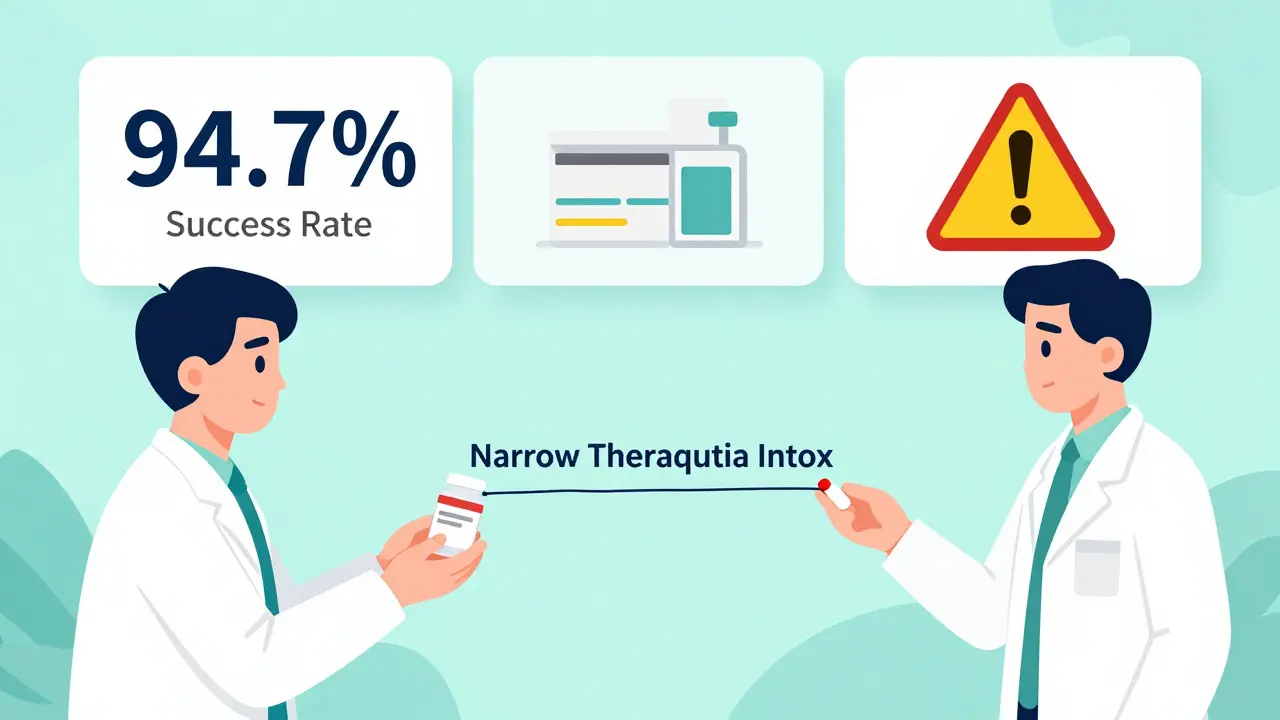
But it’s not all fear. A 2021 study of 12,500 patients across 15 European countries found that when strict bioequivalence criteria were followed, 94.7% had identical clinical outcomes with generics. That’s powerful evidence - if the system works, it’s safe.
Market Trends and Who’s Leading
The global NTI generics market hit $48.7 billion in 2022 and is projected to grow to $72.3 billion by 2027. The U.S. leads with 42% of sales, Europe with 34%. Teva holds 18.7% of the market, followed by Mylan, Sandoz, and Hikma. But market share doesn’t tell the full story. Penetration varies wildly: 92% of U.S. warfarin prescriptions are generic, but only 67% for levothyroxine. Why? Prescriber hesitation.
Manufacturers are adapting. Companies now use predictive modeling and stress testing early in development to avoid recalls - like the 2021 nitrosamine contamination that pulled antihypertensive generics off shelves. Engaging with regulators early through FDA or EMA scientific advice programs can cut approval time by 30-45 days.
What’s Next?
The future of NTI generics hinges on two things: better science and better coordination. The FDA plans to adopt population bioequivalence methods by 2025 - a shift from testing single volunteers to modeling how entire groups respond. This could make trials more predictive and less prone to variability.
Meanwhile, the EMA is moving toward the Centralized Procedure. In 2018, only 42% of new generic applications used it. By 2022, that jumped to 68%. More centralization means fewer country-by-country delays.
Experts agree: global collaboration through IGDRP could cut approval times by 25-30% over the next decade. But until regulatory philosophies align - especially on modified-release formulations, which make up 23% of the market - patients will still face uneven access. The goal isn’t just cheaper drugs. It’s safer, more reliable drugs - no matter where you live.
What does NTI stand for in generic drugs?
NTI stands for Narrow Therapeutic Index. It refers to drugs where the difference between a safe, effective dose and a toxic or ineffective dose is very small. Examples include warfarin, phenytoin, levothyroxine, and digoxin. Even slight changes in blood concentration can lead to serious side effects or treatment failure, which is why regulators apply stricter standards to their generic versions.
Why are NTI generics harder to approve than regular generics?
NTI generics require tighter bioequivalence standards. While regular generics must be within 80-125% of the brand drug’s absorption, NTI generics must stay within 90-111% (in the U.S.) or even narrower ranges elsewhere. This means manufacturers must prove their product behaves almost identically to the brand - not just in average performance, but across all conditions. Testing is more complex, requiring multiple dissolution profiles, healthy volunteer studies, and advanced modeling. The margin for error is tiny, so failure rates are higher.
Do all countries regulate NTI generics the same way?
No. The U.S. FDA uses fixed, tighter bioequivalence limits. The EMA uses a flexible, case-by-case approach with reference-scaled methods. Canada accepts foreign reference products under certain conditions. Japan has detailed guidelines for topical NTI drugs. Many countries, like Brazil and Mexico, lack specific NTI guidance. This lack of global alignment means a generic approved in the U.S. might be rejected elsewhere - not because it’s unsafe, but because the standards don’t match.
Can generic NTI drugs be as safe as brand-name ones?
Yes - when they meet strict regulatory standards. A 2021 study of 12,500 patients across 15 European countries found that 94.7% had identical clinical outcomes when switching from brand to generic NTI drugs, as long as bioequivalence criteria were tightly enforced. The problem isn’t the generics themselves - it’s inconsistent regulation, poor monitoring, and prescriber mistrust. When the science is followed, generics are safe.
Why do some doctors refuse to allow generic substitution for NTI drugs?
Many doctors have seen patients experience unexpected side effects or treatment failure after switching - especially with levothyroxine or anti-seizure drugs. While studies show most switches are safe, individual variability exists. Some patients are more sensitive to small changes. Also, inconsistent labeling and state laws in the U.S. (like requiring consent in North Carolina) fuel caution. Until global standards are fully aligned and post-market data proves consistent safety, many clinicians prefer to stick with the brand.
phyllis bourassa
March 6, 2026 AT 06:09Okay but let’s be real - if your thyroid meds switch brands and suddenly you’re exhausted, sweating like a sauna, and crying over cat videos for no reason? Yeah, that’s not "just stress."
Pharmacists don’t get it. Doctors don’t get it. Regulators act like bioequivalence is a magic spell.
I’ve had three switches in two years. Three. Each time, my TSH went nuclear.
They say "94.7% are fine" - cool, but I’m in the 5.3%. And guess who pays? Me.
My paycheck? Gone. My mental health? Crumbling.
Why is safety just a statistic to them?
It’s not a math problem. It’s my life.
Adebayo Muhammad
March 6, 2026 AT 07:39Let me ask you this: if a pill is supposed to be identical, why does it behave like a different person every time you swallow it?
Regulation is a farce.
Corporate interests dictate the thresholds.
They don’t care about you - they care about profit margins.
And now they want to standardize globally?
Ha.
What’s next? A global pill that works the same in Lagos as in LA?
Reality check: in Nigeria, we get expired generics with no testing - and they call it "access."
Harmonization? More like exploitation with a PowerPoint.
Pranay Roy
March 6, 2026 AT 18:49Did you know the FDA’s 90-111% range is based on a 1990s study of 12 healthy white males?
That’s not science - that’s colonialism in a lab coat.
Genetic differences in drug metabolism across populations? Ignored.
Asian populations metabolize levothyroxine 22% faster on average.
But the FDA doesn’t test non-white subjects.
So when a 65-year-old Indian woman in Chicago gets a "bioequivalent" generic and her heart starts fluttering - it’s her fault?
Or is it that the system was designed for someone who doesn’t look like her?
They call it precision medicine - but only if you’re white and rich.
Joe Prism
March 6, 2026 AT 21:52NTI drugs aren’t about generics vs brand.
They’re about trust.
Patients don’t trust the system.
Doctors don’t trust the system.
Pharmacists don’t trust the system.
And honestly?
Neither should we.
Bridget Verwey
March 7, 2026 AT 04:24Oh honey, the FDA’s 90-111% range is cute.
Like saying "I’m 5’9"" when you’re 5’6" in heels.
Meanwhile, in real life, my neighbor’s husband switched generics and had a seizure.
He’s fine now. But his insurance says "no issues found."
So what do we do?
Stop pretending this is about science.
It’s about who gets to be safe - and who gets to be a statistic.
Weston Potgieter
March 7, 2026 AT 06:42Regulators are just corporate lawyers with fancy titles
NTI = No Trust Intended
They approve generics then vanish when people die
Profit first
Safety later
Always later
And don’t even get me started on the "post-market monitoring"
That’s just a PR stunt with a spreadsheet
Ian Kiplagat
March 9, 2026 AT 05:27EMA’s case-by-case approach is messy - but it’s honest.
One size doesn’t fit all.
Especially when you’re dealing with a drug that can kill you in 3 days.
Flexibility > false uniformity.
🌍
Amina Aminkhuslen
March 9, 2026 AT 09:15Let’s not sugarcoat this - the entire NTI system is a rigged game.
Big Pharma sells the brand.
Big Generic sells the cheap version.
Regulators? They’re the bouncers who let everyone in… as long as the money’s clean.
And patients?
We’re the collateral damage in their monopoly dance.
Tim Hnatko
March 10, 2026 AT 16:55I’ve worked in pharmacy for 18 years.
I’ve seen patients cry because they couldn’t afford the brand.
I’ve seen them panic because their new generic made them feel like a ghost.
I don’t hate generics.
I hate that we force people to choose between affordability and safety.
There’s a third way.
We just refuse to build it.
Andrew Poulin
March 11, 2026 AT 11:25Stop pretending this is about science
It’s about control
Big Pharma owns the brand
Big Generic owns the market
Regulators own the paperwork
Patients own the side effects
And nobody owns the truth
That’s why this keeps happening
And nobody’s getting fired