
How to Use an Epinephrine Auto-Injector for Medication Anaphylaxis
The Clock Is Ticking
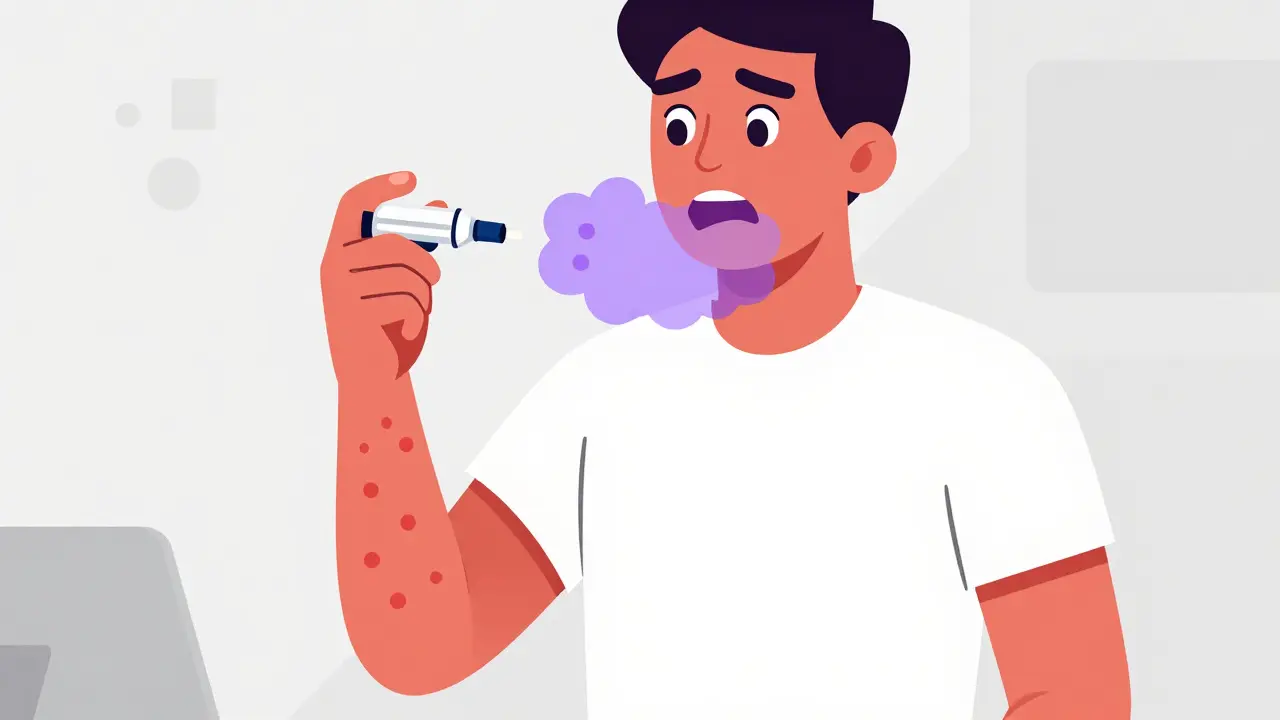
Anaphylaxis does not wait for you to finish reading the label. When your body reacts severely to a medication, food, or insect sting, your airway tightens and blood pressure plummets. In these moments, seconds count more than anything else. According to data from St. Louis Children's Hospital, untreated anaphylaxis can become fatal within minutes. That is why knowing exactly how to handle an Epinephrine Auto-Injector is a non-negotiable skill for anyone managing severe allergies.
You likely have access to a device like an EpiPen, Auvi-Q, or the newer Neffy nasal spray. But do you really know how they work under pressure? Panic makes fine motor skills disappear. Research shows that real-world administration rates are far lower than training simulation success because users freeze or forget steps. We are breaking down the exact mechanics so that when the worst happens, muscle memory takes over.
Recognizing the Emergency
Before you grab the device, you must confirm you are dealing with anaphylaxis and not a mild side effect. While mild rashes do not require a shot, anaphylaxis affects multiple systems simultaneously. The American Academy of Allergy, Asthma & Immunology defines anaphylaxis by symptoms occurring after exposure to a known allergen. Look for the ABCs: Airway obstruction (throat swelling), Breathing difficulty (wheezing), and Circulation issues (dizziness, blue lips).
If a person experiences hives alongside breathing trouble, or vomiting combined with dizziness, do not hesitate. Studies indicate that delaying treatment increases the risk of hospitalization by nearly half. The presence of respiratory or cardiovascular compromise mandates immediate injection. You cannot afford to call ahead and wait for advice. Inject the medicine, then call for help.
Step-by-Step Administration Guide
This procedure applies to most standard models, though you should familiarize yourself with your specific brand beforehand. The goal is to deliver Epinephrine (Adrenaline)Epinephrine directly into the muscle quickly.
- Position the Patient: Have the person lie flat or sit with legs fully extended. Standing is dangerous because the sudden rise in heart rate could cause fainting. If they are unconscious, place them in the recovery position.
- Locate the Device: Grab your injector. Check the expiration date if time permits, but never refuse to use an expired device in a true life-or-death emergency.
- Remove Safety Cap: Pull off the blue safety cap on EpiPen models. Some devices like Auvi-Q reveal the tip automatically when held. Do not touch the orange needle shield.
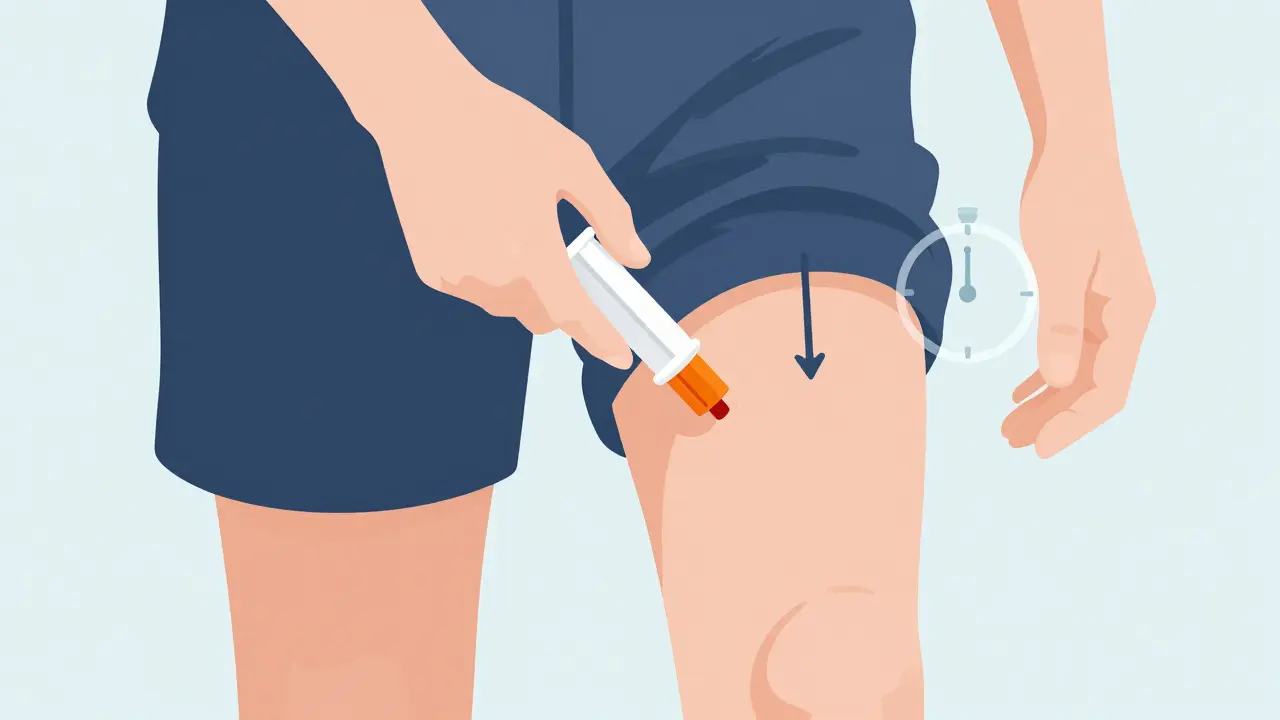
- Aim for the Outer Thigh: Place the device halfway between the hip and knee on the outer thigh. It is safe to inject through clothing if necessary.
- Push Hard and Hold: Press firmly until you hear a click. This activates the mechanism. Keep the device pressed against the skin for exactly three seconds. Biomechanical testing confirms this duration is required for full dose delivery.
- Remove and Massage: Pull away and rub the area for ten seconds to help absorption.
- Call 911 Immediately: Dial emergency services before doing anything else. Tell them you have administered epinephrine.
A critical mistake documented by patient surveys involves pulling the device out too soon. Many users inject and walk away instantly. Holding the device ensures the needle penetrates the vastus lateralis muscle deep enough to release the solution. For children, grip their leg firmly to prevent kicking during the process.
Choosing Between Available Devices
The market offers several options, and understanding the differences can save confusion during a crisis. While EpiPen remains the most recognizable name, alternatives exist that might suit specific needs better.
| Device Brand | Key Feature | Typical Cost (Cash) | User Error Risk |
|---|---|---|---|
| EpiPen (Viatris) | Spring-loaded manual push | $678.88 | Higher (37% error rate) |
| Auvi-Q (Kaléo) | Voice-guided activation | $4,229.00 | Lower (89% correct use) |
| Adrenaclick | Manual trigger mechanism | $194.99 | Moderate |
| Neffy (Spray) | Nasal delivery (No needle) | Varying | Moderate (Technique dependent) |
Auvi-Q stands out for its audible instructions. During a panic response, hearing a calm voice tell you "Pull the gray cap" reduces hesitation. However, EpiPen remains popular due to insurance formulary acceptance and familiarity. The newer Neffy spray offers a needle-free alternative, useful for those with needle phobia, but requires precise nasal placement. If your child struggles with needles, ask your doctor about switching to a nasal formulation.
Managing Aftercare and Risks
Injecting the drug is only step one. Your job isn't finished until you reach the hospital. Epinephrine wears off relatively quickly, sometimes within 10 to 20 minutes. This creates a risk of a Biphasic Reaction, where symptoms return hours later. Medical teams at Cleveland Clinic recommend a second dose after five minutes if symptoms persist.
Patients often fear side effects. Yes, your heart will race, and hands may shake. One study noted tachycardia (fast heartbeat) occurred in 92% of users. These effects are temporary and harmless compared to anaphylactic shock. Never delay the shot to avoid trembling. Always carry two doses. If you only inject once and symptoms worsen, the second unit is necessary before help arrives.
Storage and Maintenance Protocols
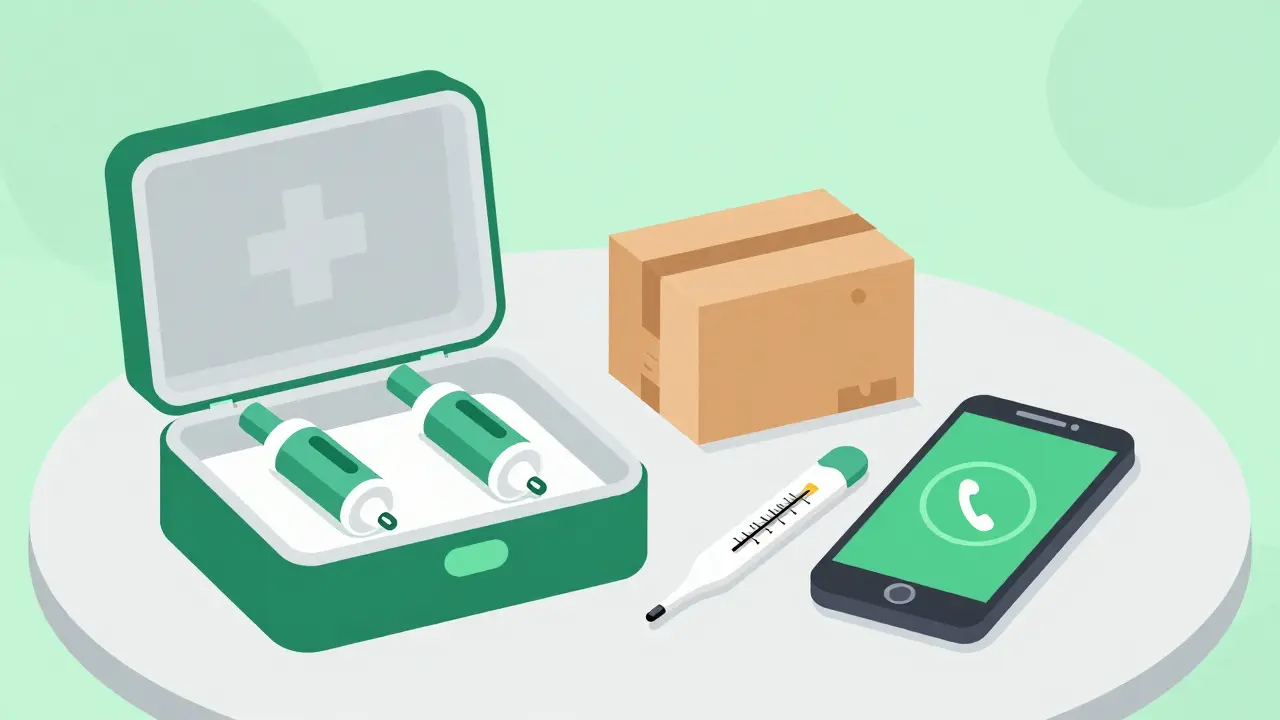
Even the best tool fails if stored improperly. Temperature control is vital. Guidelines from the Illinois Department of Public Health state units must stay between 15°C and 30°C (59°F-86°F). Leaving a device in a hot car can degrade the solution inside. Keep it in the original cardboard box to protect it from light.
Check the expiration date monthly. Most manufacturers set a shelf life of 18 months. Once expired, the fluid turns brown. Clear or slightly yellow liquid is acceptable. Brown means stop. Schools and workplaces must follow stricter protocols, ensuring trainers complete certification every year. Simulation studies show people need at least four practice sessions with trainer units to achieve 90% accuracy. Real devices look heavy and mechanical; practicing with the mock-up builds confidence.
Frequently Asked Questions
Can I use an expired auto-injector in an emergency?
Yes. While not ideal, using an expired device is safer than receiving no treatment at all. Just ensure the liquid inside is still clear or yellow. If it looks brown or contains particles, discard it and find another option.
What parts of the body are safe for injection?
The outer mid-thigh is the only approved site. Do not inject into buttocks, arms, or veins. The device is designed to penetrate clothing, so keep your pants on unless the material is excessively thick like denim.
Should I take antihistamines before using the injector?
No. Antihistamines are too slow and do not fix airway closure. Experts warn that delaying epinephrine for allergy pills increases death risk significantly. Use the injector first, then take other meds as directed.
How many doses should I carry?
You should always carry two doses. Severe reactions sometimes require a second injection within 15 minutes if symptoms do not improve or return while waiting for ambulance arrival.
Does weight affect which injector I buy?
Weight dictates dosage. Kids under 66 pounds typically need 0.15mg, while adults and larger children need 0.3mg. Pediatric doses are available specifically for lower weight requirements.
Austin Oguche
March 27, 2026 AT 12:43Temperature control is something most folks overlook until its too late
Monique Ball
March 29, 2026 AT 10:31It really scares me how often people freeze during these moments!
I always tell my friends to practice with the trainer unit every single month.
You cannot rely on just reading the box instructions when your airway is closing!
The fear of needles is real but not nearly as bad as suffocating from swelling.
Have you ever considered the cost difference between brands?
Some insurances cover the cheaper ones but stockpile them anyway!
My cousin actually had to give her sister a shot through jeans during camp.
She said the sound of the click was the loudest noise she ever heard. 😱
But honestly saving a life is worth that little jumpiness in your heart rate later.
I keep mine in my bag and checked recently and the liquid was perfectly clear.
Yellow tint is totally fine but brown is an instant toss in the trash bin.
Please remember to massage the site for ten full seconds after pulling away.
Absorption is key and rushing means you might get half the dose needed.
Calling 911 should happen right after the injection happens immediately!
Don't wait around hoping symptoms disappear because they absolutely will return!
Stay safe everyone and share this vital info with family members too! ❤️💉🏥
Aaron Olney
March 31, 2026 AT 02:16I haaate seeing prices go up like that annd forget teh expiration dates matter!!
Sabrina Herciu
April 1, 2026 AT 17:10The biomechanics of the needle depth are crucial!!
Ensure you hold for three seconds exactly!!!
Eva Maes
April 3, 2026 AT 10:36Your fixation on timing ignores the visceral chaos of panic.
Physiologic collapse doesn't care about your stopwatch calibration.
Jordan Marx
April 4, 2026 AT 10:56We need to understand the pharmacodynamics deeply.
Epinephrine acts as a vasoconstrictor which reverses hypotension quickly.
Alpha-adrenergic stimulation opens the airway simultaneously.
Beta-adrenergic effects increase cardiac output despite the tachycardia.
This dual action is why antihistamines are insufficient alone.
H1 blockers do not reverse laryngeal edema fast enough.
Practicing muscle memory overrides sympathetic freeze responses.
Simulation training reduces latency significantly in clinical studies.
Always carry two doses for biphasic reaction management.
If respiratory compromise occurs again, administer immediately.
Maintain a cool storage environment to preserve potency.
Do not leave devices in direct sunlight or extreme cold.
Review the expiration date monthly without fail.
Clear fluid indicates stability while discoloration signals degradation.
Medical supervision remains necessary after administration regardless of improvement.
Philip Wynkoop
April 5, 2026 AT 00:54Thanks for the detailed breakdown :)
gina macabuhay
April 5, 2026 AT 12:38You imply we should trust simulation over instinct which is laughable.
Jeannette Kwiatkowski Kwiatkowski
April 7, 2026 AT 01:39EpiPen pricing is absurd compared to generics.
Why pay premium for brand loyalty?
Sophie Hallam
April 8, 2026 AT 17:53Insurance formularies vary widely by region and plan type.
Focusing on availability might be more practical than price debates.
Richard Kubíček
April 10, 2026 AT 14:03Preparedness is a mindset as much as a tool.
Knowing the device empowers us to face uncertainty calmly.
We owe ourselves the confidence to act when seconds count.
Sharing knowledge creates ripples of safety in our communities.
Stay vigilant and informed.