
How to Read Prescription Labels When Traveling or Crossing Time Zones
Getting sick while traveling is stressful enough. But when your medication label doesn’t make sense in a new time zone, or customs officers question your pills, it turns into a full-blown emergency. You’re not alone. Thousands of travelers get delayed, fined, or even hospitalized every year because they didn’t understand their own prescription labels. The good news? It’s not complicated - if you know what to look for.
What’s Actually on Your Prescription Label?
Your prescription label isn’t just a reminder to take your pills. It’s your legal and medical passport abroad. Every label should have seven key pieces of information. If any are missing, ask your pharmacist to add them before you leave.- Patient name - Must match your passport exactly. No nicknames. No initials. Full legal name only.
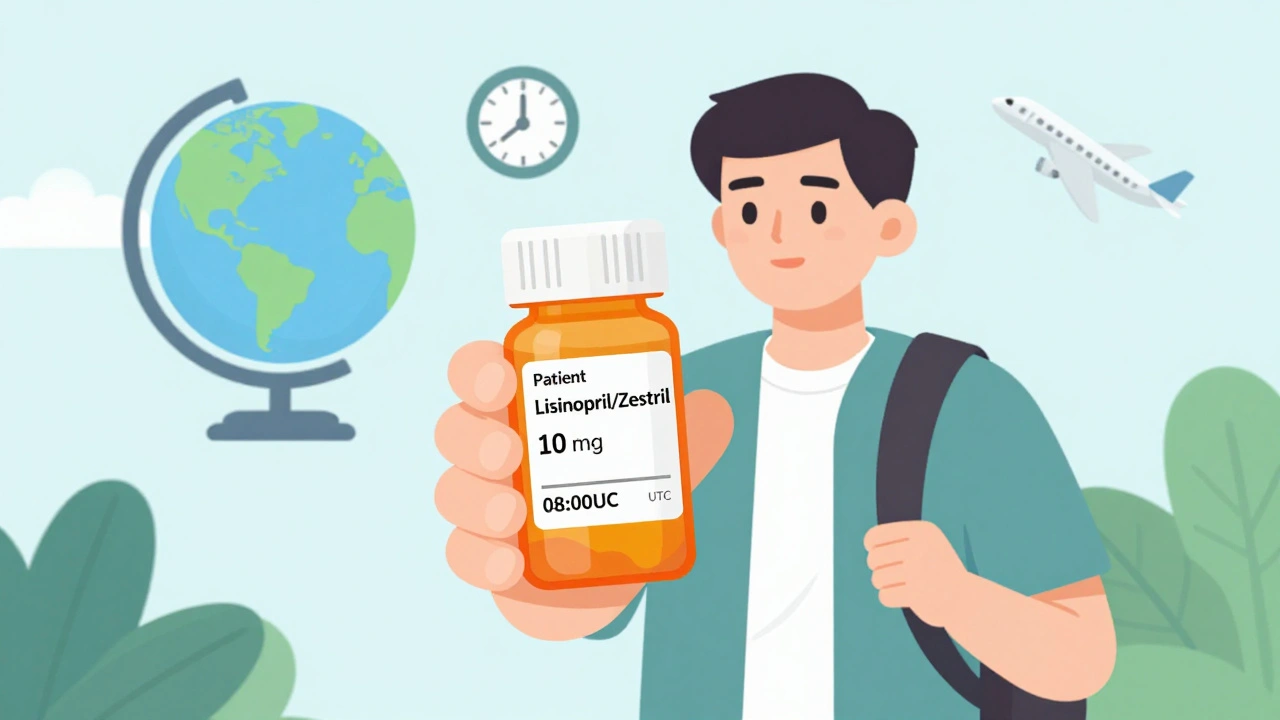
- Medication name - Both brand and generic. For example: "Lisinopril (Zestril)". Many countries only recognize the generic name.
- Dosage strength - Like "10 mg" or "500 mg". Don’t assume "one tablet" means the same everywhere.
- Directions for use - This is the most important part when crossing time zones. Look for terms like "q24h" (every 24 hours), "q12h" (every 12 hours), or "q8h" (every 8 hours). Avoid labels that say "take in the morning" - they’re too vague.
- Prescribing doctor’s name and contact - Some countries require this to verify the prescription is real.
- Pharmacy details - Name, address, and license number. This helps customs confirm it’s a legitimate prescription.
- Prescription number - For tracking. Keep this number handy if you need to refill abroad.
Most U.S. pharmacies now offer to add a UTC time reference on the label. Ask for it. Example: "Take one tablet at 08:00 UTC (03:00 EST)." This simple addition prevents 90% of time zone errors.
Why Time Zones Break Your Medication Schedule
You think you’re just flying from New York to Tokyo. But your body doesn’t care about time zones - it cares about when your blood levels of medicine rise and fall. Missing a dose by a few hours can drop your drug levels by 40%, especially with critical meds like insulin, warfarin, or seizure drugs.Here’s how it breaks down:
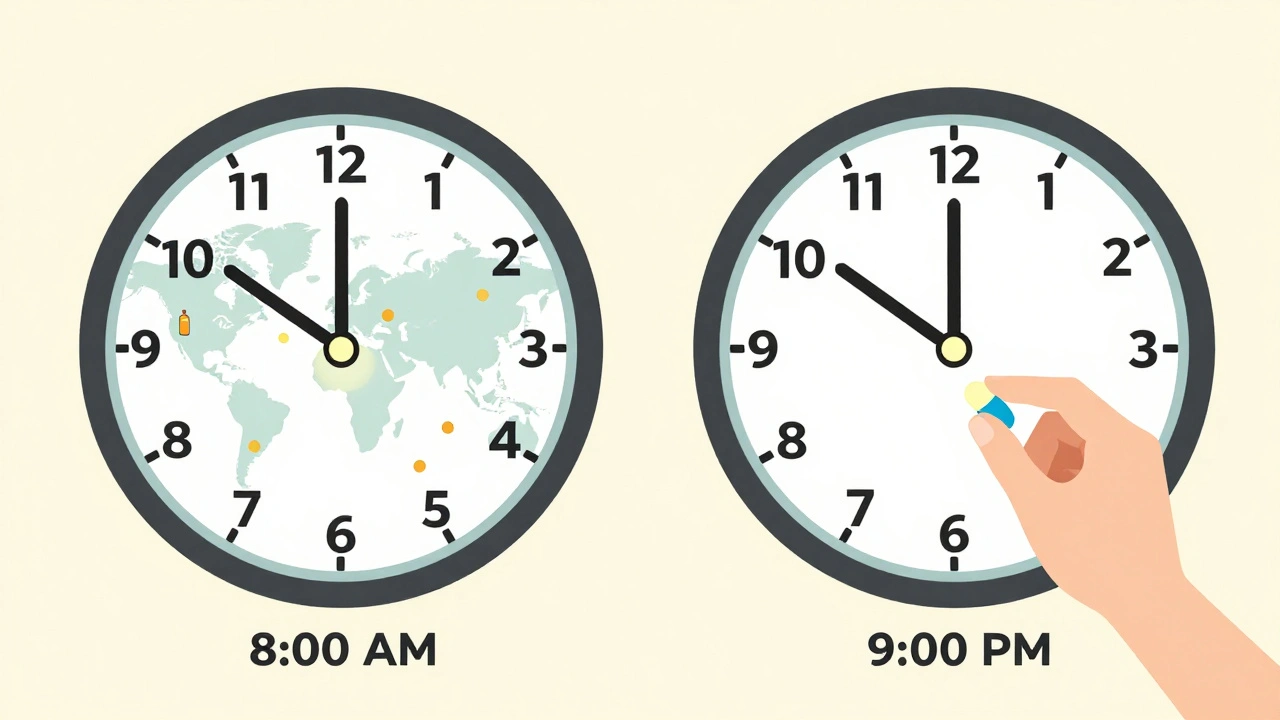
- Short half-life meds (like antibiotics or insulin) - Need exact timing. If you’re on a 12-hour schedule, you can’t just take it at 8 a.m. local time. You need to calculate UTC. A 12-hour gap in Tokyo is still 12 hours in New York - even if it feels like 10 p.m. when it’s 10 a.m. at home.
- Long half-life meds (like levothyroxine or some antidepressants) - You can often stick to your home time zone for the first 2-3 days. Your body adjusts slowly.
- Time-sensitive meds (like bisphosphonates) - Must be taken on an empty stomach with plain water. If you’re jet-lagged and eating breakfast at 7 a.m. local time, but your body thinks it’s 3 a.m., you risk side effects or reduced absorption.
Dr. Susan Pisani, a pharmacist at Memorial Sloan Kettering, says: "The biggest mistake travelers make? Ignoring the half-life. If your drug lasts 24 hours, you can wing it. If it lasts 4 hours, you’re playing Russian roulette with your health."
Global Label Rules You Can’t Ignore
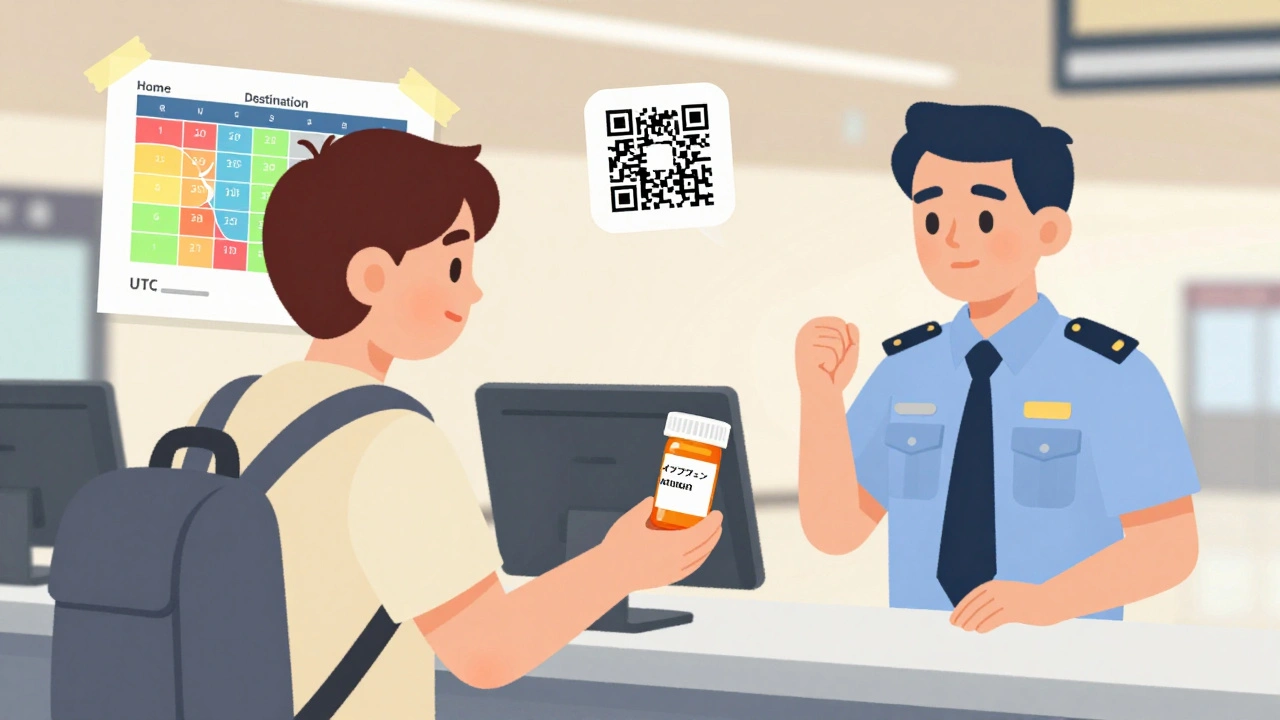
Your U.S. prescription won’t fly everywhere. Countries have their own rules - and they’re not always obvious.- Japan - Requires kanji characters for active ingredients. If your label says "ibuprofen," you’ll get detained at Narita. You need the Japanese name: イブプロフェン.
- Thailand - Must have both English and Thai on the label. Many travelers get fined $500-$5,000 for not having this.
- Saudi Arabia - Arabic name of the active ingredient is mandatory. English-only labels are confiscated.
- European Union - Standardized format, but patient name must be in the local language if you’re staying long-term.
- Caribbean nations - Many require English and Spanish. If you’re going to Jamaica or the Dominican Republic, your label should have both.
Japan alone seized 1,247 medication packages at airports in 2023 - 68% of them because of labeling errors. You’re not breaking the law. You’re just unprepared.
What to Do Before You Leave
Don’t wait until the airport. Start 4-6 weeks before departure.- Ask your pharmacist to add UTC timing to your label. Most major chains (CVS, Walgreens, Rite Aid) do this for free if you ask.
- Get a doctor’s note on letterhead. It should list your medications, dosages, and why you need them. Even if you’re not asked, it helps at customs.
- Use the WHO Medication Time Zone Converter app - Download it. It’s free. It lets you input your meds, time zone, and schedule, then shows you exactly when to take them in your destination.
- Print a color-coded schedule - Make a chart with your home time, destination time, and UTC. Color-code each dose. Tape it inside your passport cover.
- Carry meds in original bottles - TSA says you don’t have to, but customs officers in 63 countries do. Don’t risk it. Keep them in their labeled bottles.
One traveler on Reddit took double doses of levothyroxine because she thought "take on empty stomach" meant morning - not realizing her stomach was still on East Coast time. She ended up in a Prague hospital. A simple chart would’ve prevented it.
What to Do When You Arrive
Don’t switch your schedule the second you land. Here’s the smart way:- For meds with a half-life under 12 hours - Adjust immediately. Take your next dose at the correct UTC time, even if it’s 3 a.m. local time. Your body needs the consistency.
- For meds with a half-life over 24 hours - Stay on home time for 2-3 days. Then gradually shift. This avoids spikes or drops in your blood levels.
- For insulin or blood thinners - Consult your doctor before you go. These aren’t DIY adjustments. You need a transition plan.
Most travelers who use UTC-based schedules report zero issues. Those who guess? Half end up with side effects, missed doses, or worse.
The Future Is Here - But Don’t Wait for It
New tech is coming. Airlines are rolling out the Universal Medication Travel Card - a QR code that links to your meds, local laws, and timing rules. Singapore and Dubai are testing AR labels that change timing based on your GPS. But these aren’t everywhere yet. In 2025, you still need to do the work yourself.Dr. Robert Steffen, a global health expert, warns: "Without mandatory labeling standards, medication errors during travel will rise 22% each year. By 2027, we could see 15,000+ preventable hospitalizations."
That’s not a future threat. It’s happening now.
What If You Run Out?
Don’t panic. But don’t improvise.- Carry a 10-15% extra supply. Always.
- Know the generic name. That’s what foreign pharmacies use.
- Call your U.S. pharmacy. Many can fax or email a copy of your prescription to a local pharmacy abroad.
- Never buy meds overseas unless you’re certain of the source. Counterfeit drugs are common in 30+ countries.
There’s no shortcut. But there is a system. Learn it. Use it. Your body will thank you.
Do I need to keep my pills in the original bottle when flying?
Yes, for international travel. While TSA in the U.S. allows pills in pill organizers, most foreign customs agencies require original labeled bottles. Countries like Japan, Saudi Arabia, and Thailand will confiscate meds in unlabeled containers. Always keep them in their original pharmacy bottles with the label intact.
Can I bring liquid medications on a plane?
Yes, and they’re exempt from the 3.4-ounce liquid rule. But you must declare them at security. Keep them in their original labeled containers, and bring a doctor’s note if you’re carrying more than a 30-day supply. The label must include the active ingredient concentration per milliliter - this is required by IATA guidelines and helps security verify it’s legitimate medicine.
What if my prescription label doesn’t have UTC time?
Ask your pharmacist to add it - most U.S. pharmacies will do it for free. If they can’t, use the WHO Medication Time Zone Converter app. Input your medication schedule, your home time zone, and your destination. The app will give you exact UTC times to follow. Print that out and carry it with your prescription.
How do I know if a medication has a short or long half-life?
Check the medication’s information sheet or ask your pharmacist. Short half-life meds (under 12 hours) include antibiotics, insulin, and blood thinners like warfarin. Long half-life meds (over 24 hours) include levothyroxine, some antidepressants, and statins. If you’re unsure, assume it’s short half-life and adjust timing carefully - it’s safer.
Can I get my prescription filled abroad?
Sometimes - but it’s risky. Many countries don’t recognize U.S. prescriptions. Even if they do, the medication may have a different name, strength, or formulation. Always carry extra supply. If you must refill abroad, bring your original label, doctor’s note, and generic name. Only use licensed pharmacies. Avoid street vendors or unregulated clinics.
What’s the biggest mistake travelers make with prescription labels?
Assuming "take in the morning" or "take with food" means the same everywhere. Time zones change when you eat, sleep, and feel hungry. A label saying "take at 8 a.m." means nothing if you’re in Tokyo and your body thinks it’s 3 a.m. Always convert to UTC. Use the exact timing from your label - not what feels right.
Yatendra S
December 13, 2025 AT 05:24Himmat Singh
December 13, 2025 AT 11:31kevin moranga
December 13, 2025 AT 23:02Alvin Montanez
December 15, 2025 AT 10:40Lara Tobin
December 16, 2025 AT 00:10Bruno Janssen
December 16, 2025 AT 23:42Scott Butler
December 17, 2025 AT 18:42Emma Sbarge
December 19, 2025 AT 08:29Tommy Watson
December 21, 2025 AT 05:43Richard Ayres
December 22, 2025 AT 17:56