
Heavy Menstrual Bleeding on Blood Thinners: What Works and What to Ask Your Doctor
Blood Thinner Comparison Tool
Blood Thinner Risk Comparison
This tool helps you understand how different blood thinners affect menstrual bleeding risk based on medical research.
Why This Matters
Research shows about 70% of menstruating women on oral anticoagulants experience bleeding so heavy it disrupts their lives.
Based on 2022 study in Blood showing 66-70% of women experienced HMB within months of starting anticoagulants.
Your Options Compared
When you start taking a blood thinner-whether it’s for a blood clot, atrial fibrillation, or another condition-you’re told about the big risks: strokes, clots, internal bleeding. But no one talks about your period.
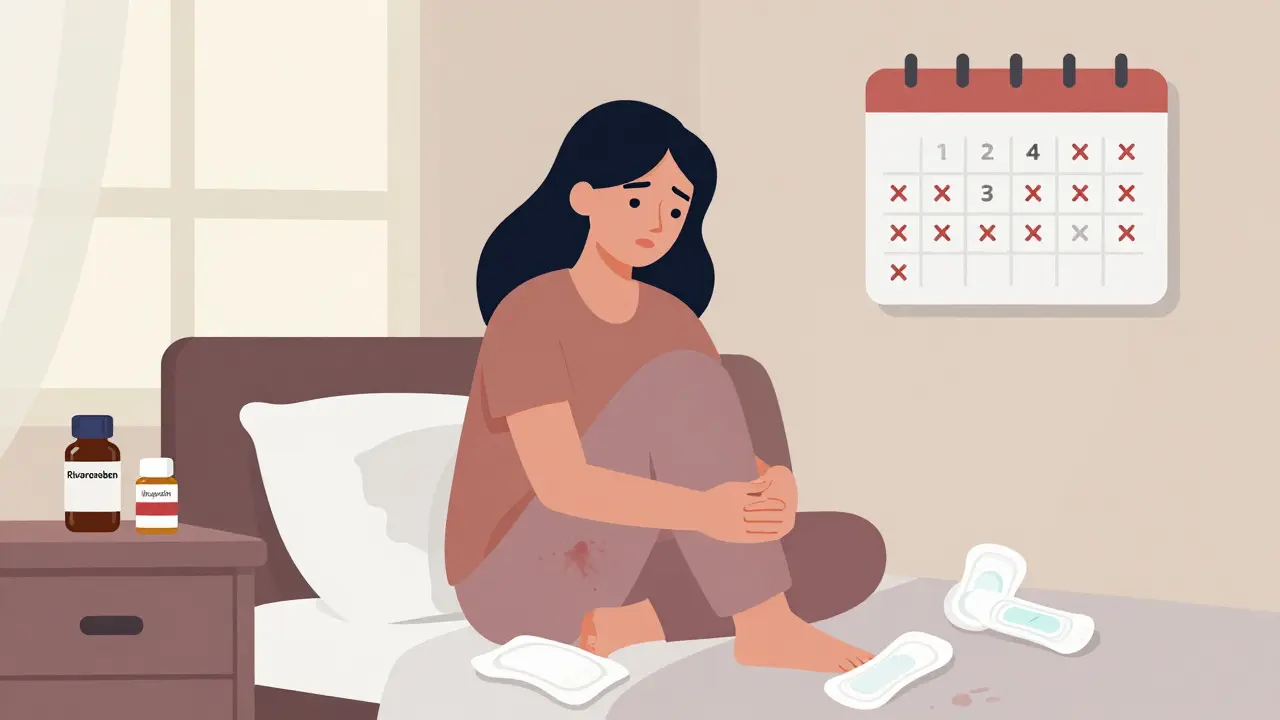
Yet for women of reproductive age, heavy menstrual bleeding (HMB) is one of the most common side effects of blood thinners. In fact, about 70% of menstruating women on oral anticoagulants experience bleeding so heavy it disrupts their lives. That’s not rare. That’s the norm. And most doctors don’t ask about it.
You might be changing pads or tampons every 30 minutes. You might be leaking through your clothes. You might be skipping work, avoiding social plans, or carrying emergency changes in your bag. If this sounds familiar, you’re not alone-and you’re not imagining it. This isn’t just "normal period stuff." It’s a medical issue tied directly to your medication.
Why Blood Thinners Make Periods Heavier
Blood thinners, also called anticoagulants, work by slowing down your body’s ability to form clots. That’s great when you’re trying to prevent a dangerous clot in your lung or brain. But it also means your uterus can’t stop bleeding as efficiently during your period.
Normally, about 10% to 30% of women experience heavy periods. But when you start a blood thinner? That number jumps to 66%-70%. A 2022 study in Blood found that two out of every three women had abnormally heavy bleeding within months of starting anticoagulant therapy. And the worst part? Many women had never had heavy periods before. This wasn’t a pre-existing issue-it was caused by the drug.
It’s not just about volume. It’s about disruption. Women report having to plan their entire day around their period. One woman on Reddit said she stopped going to the gym because she was afraid of leaking. Another missed five days of work each month. A third said she cried in the bathroom because she didn’t have enough pads to get through the day.
This isn’t "minor bleeding." The National Blood Clot Alliance calls it "patient-relevant bleeding"-meaning it doesn’t kill you, but it ruins your life.
Which Blood Thinners Cause the Most Bleeding?
Not all blood thinners are the same when it comes to menstrual bleeding. Research shows some are much more likely to cause heavy periods than others.
Among the direct oral anticoagulants (DOACs), rivaroxaban is linked to the highest risk of HMB. Studies show women on rivaroxaban are significantly more likely to need medical help for bleeding than those on other DOACs.
On the other end of the spectrum, apixaban and dabigatran carry a lower risk. That doesn’t mean they’re safe-many women still experience heavy bleeding on these drugs-but the odds are better.
Warfarin, the older blood thinner, also causes heavy periods, but because it’s harder to control and requires frequent blood tests, many doctors now switch patients to DOACs. Still, even with newer drugs, bleeding risk remains high.
If you’re on rivaroxaban and your periods have become unbearable, talk to your hematologist about switching. It’s not a sign you’re being difficult. It’s a sign you’re being smart.
First-Line Treatments: Hormonal Options That Work
The good news? You don’t have to suffer. There are safe, effective treatments that won’t interfere with your blood thinner.
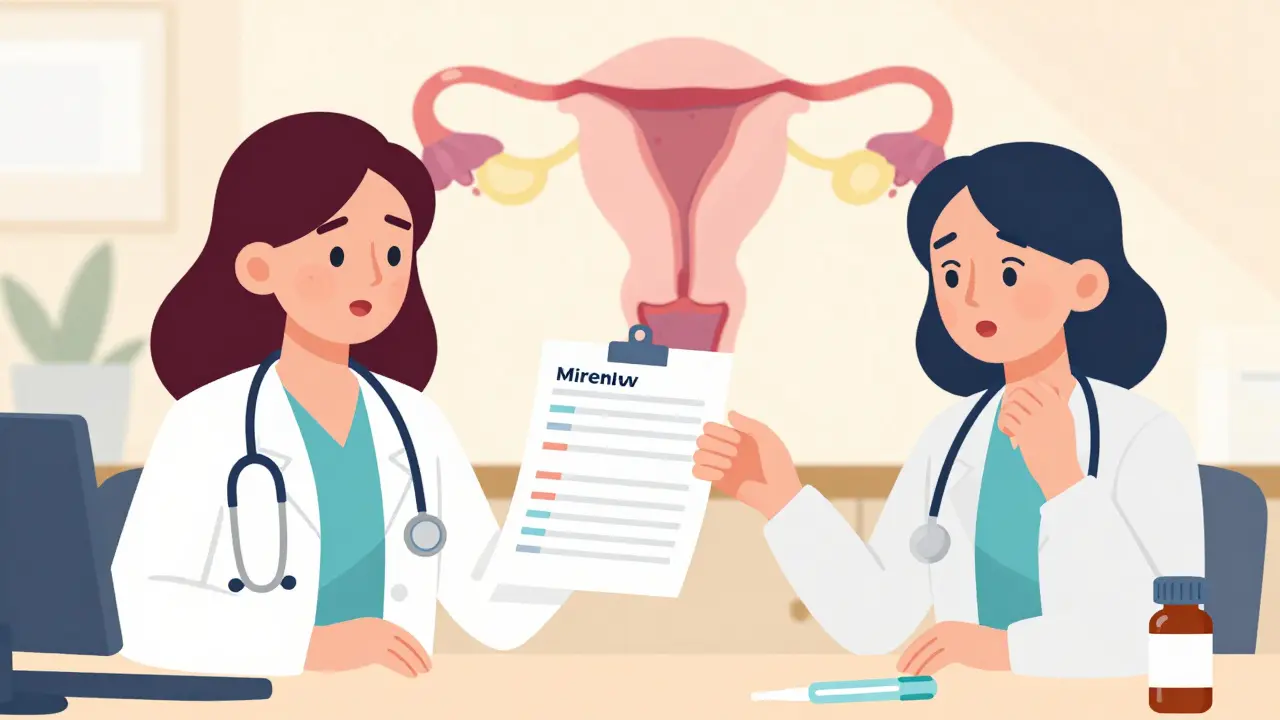
The most powerful option is the levonorgestrel intrauterine system-better known as the Mirena or Kyleena IUD. This small device releases a low dose of progesterone directly into your uterus. It doesn’t affect your blood thinner. It doesn’t increase clot risk. And it works.
Studies show the levonorgestrel IUD reduces menstrual bleeding by 70% to 90% within 3 to 6 months. Many women report their periods becoming light or stopping entirely. One woman on the r/anticoag subreddit said: "After getting Mirena while staying on Eliquis, my periods went from ER visits to nearly nonexistent. I got my life back."
Other hormonal options include:
- Subdermal implants (like Nexplanon)-also progesterone-based, effective for reducing bleeding
- Progestin-only pills-taken daily, can help regulate flow
- High-dose progestin therapy (norethisterone 5 mg three times daily for 21 days)-recommended by the American Society of Hematology for acute control
Combined estrogen-progesterone birth control (pills, patch, ring) is also an option for women who don’t have contraindications to estrogen. These can reduce bleeding by 40%-60% and are safe to use alongside most anticoagulants.
Important: Don’t stop your blood thinner to start hormonal therapy. These treatments work together. Your hematologist and gynecologist can coordinate care.
Non-Hormonal Options: Tranexamic Acid and NSAIDs
If you don’t want hormones-or can’t use them-there are other choices.
Tranexamic acid is a prescription medication that helps your blood clot locally in the uterus. You take it only during your period-usually 1-2 tablets every 8 hours for up to 5 days. Clinical trials show it reduces bleeding by 30% to 50%. It’s not a long-term fix, but it’s great for managing acute episodes.
One caveat: Take it at the same time every day during your period. Don’t mix it with NSAIDs unless your doctor says it’s safe. Timing matters.
NSAIDs like ibuprofen or naproxen can reduce menstrual bleeding by 20%-40%. But here’s the catch: they also thin the blood. Taking them with anticoagulants can increase bleeding risk. If you use NSAIDs, stick to the lowest effective dose and avoid long-term daily use. Ask your doctor if it’s safe for you.
Aspirin? Skip it. It’s a blood thinner too. Adding it to your regimen is like pouring gasoline on a fire.
What Doesn’t Work (and What’s Dangerous)
Some women try to fix heavy bleeding by skipping or cutting back on their blood thinner. That’s a dangerous mistake.
Stopping your anticoagulant-even for a few days-can increase your risk of a recurrent blood clot by up to five times. That’s not a gamble worth taking. You’re trading one risk for a much bigger one.
Another common mistake: assuming endometrial ablation is safe. This procedure burns or removes the uterine lining to stop bleeding. It works well for many women-but not for those on blood thinners. The risk of uncontrolled bleeding during or after the procedure is too high. Even if you’re told you’re "a good candidate," your hematologist must approve any surgery. Bridging with heparin adds complexity and risk.
And don’t wait for your doctor to bring it up. Studies show 68% of hematologists never ask female patients about menstrual changes after starting anticoagulation-even though 72% of those women have problems.

What to Ask Your Doctor
If you’re on a blood thinner and your period has changed, here’s what to say:
- "My periods have gotten much heavier since I started [drug name]. Is this expected?"
- "What are my options for reducing bleeding without stopping my anticoagulant?"
- "Can we switch to a different blood thinner with lower bleeding risk?"
- "Can you refer me to a gynecologist who understands anticoagulant-related bleeding?"
- "Should I be tested for iron deficiency or anemia?"
Bring this data with you: "I’m changing pads every 30 minutes. I’ve missed work. I’m exhausted. I think this is related to my medication."
Doctors are trained to think about strokes and clots. They’re not always trained to think about periods. You have to be the advocate for your own body.
Iron Deficiency Is Common-and Treatable
Heavy bleeding over time drains your iron. You might not feel it right away, but symptoms like fatigue, dizziness, shortness of breath, or cold hands aren’t just "being tired." They’re signs of anemia.
The National Blood Clot Alliance recommends that all premenopausal women on anticoagulants get a simple blood test for ferritin and hemoglobin. If your iron is low, you’ll need supplements. Oral iron can cause stomach upset, so some women need IV iron-especially if bleeding is ongoing.
Treating anemia doesn’t fix the bleeding, but it helps you feel better while you work on the root cause.
The Bigger Picture: Why This Isn’t Being Fixed
Here’s the frustrating truth: there are no official guidelines for how to screen for heavy bleeding in women on anticoagulants. No checklist. No standard question. No training.
Only 22% of hematology clinics routinely ask about menstrual changes, according to a 2023 survey. That’s not negligence-it’s ignorance. The medical system hasn’t caught up to the reality that millions of women are on blood thinners, and most of them are still menstruating.
But change is coming. In 2024, the American Society of Hematology and the American College of Obstetricians and Gynecologists announced they’re developing joint guidelines for managing this issue. They’re expected to be released in mid-2025.
Until then, you’re on your own. And that’s unfair. But you’re not powerless.
Heavy periods on blood thinners are common. They’re treatable. And you deserve to live without fear, shame, or exhaustion.
doug b
January 28, 2026 AT 23:18If you're on a blood thinner and your period is wrecking your life, you're not crazy. Talk to your doctor about switching to apixaban. I switched from rivaroxaban and my bleeding dropped by 80%. No more leaks, no more emergency pad changes. It’s not magic-it’s science.
Mel MJPS
January 29, 2026 AT 14:15I was so relieved to read this. I thought I was just "bad at periods" until I started anticoagulants. Got Mirena last year and honestly? I forgot what a heavy flow felt like. My hematologist was shocked I’d never been offered it. You deserve better than suffering in silence.
Katie Mccreary
January 30, 2026 AT 15:53Why are women still expected to just deal with this? It’s not a side effect-it’s a failure of medical systems to care about female bodies.
Anna Lou Chen
January 30, 2026 AT 19:38Let’s deconstruct the epistemological framework of pharmaceutical hegemony here. The medical-industrial complex commodifies reproductive health while pathologizing natural bodily processes under the guise of "risk mitigation." The levonorgestrel IUD isn’t a solution-it’s a neoliberal containment strategy disguised as empowerment. We must interrogate the biopolitical control embedded in hormonal interventions, even when they "work."
Meanwhile, the real issue is that anticoagulant prescribing protocols were designed by men for men, and women’s bleeding is treated as an inconvenient variable rather than a core clinical outcome.
Tranexamic acid? It’s just a band-aid on a systemic wound. The real fix? Decentralize care. Dismantle the hematologist-gynecologist silo. Reimagine patient autonomy beyond pill-pushing.
And yes-I’ve been on Eliquis for AFib. My periods are still a monthly war zone. But now I know it’s not me. It’s the system.
So yes, switch drugs. Yes, get the IUD. But don’t stop there. Demand structural change. Or you’re just optimizing within a broken cage.
Mindee Coulter
February 1, 2026 AT 15:51Just got my Mirena last month and I’m already feeling like a new person. No more panic attacks before leaving the house. No more hiding pads in my purse like contraband. If you’re on a blood thinner and bleeding like a stuck pig-do it. It’s not a big deal. Your body will thank you.
Bryan Fracchia
February 3, 2026 AT 14:32I’m not a woman, but I have a sister who’s been on Xarelto for years. She cried telling me she missed her best friend’s wedding because she was afraid of leaking through her dress. That’s not normal. That’s not okay. This post saved her life. Thank you for writing it.
She switched to apixaban and got the IUD. Now she’s hiking again. Traveling. Laughing. That’s the real win-not just less bleeding, but more living.
To every doctor reading this: ask the question. Even if it feels awkward. Even if it’s not in your training. Someone’s life is hanging in the balance.
fiona vaz
February 4, 2026 AT 21:49Iron levels matter. I didn’t realize I was anemic until my hands were always cold and I passed out in the grocery store. Ferritin was 8. Got IV iron and now I can actually get out of bed. Don’t wait until you’re dizzy to ask for the test.
Sue Latham
February 5, 2026 AT 04:29Ugh. So many women just accept this. I had a friend on warfarin who refused the IUD because she "didn’t want a foreign object"-then she bled for 17 days straight. She didn’t even know tranexamic acid existed. It’s not just medical ignorance-it’s personal laziness.
Mark Alan
February 6, 2026 AT 14:22THIS IS WHY WOMEN AREN’T TAKEN SERIOUSLY IN MEDICINE. 🤬 I’m so sick of being told "it’s just your period" when I’m soaking through two tampons in an hour. I’m not exaggerating. I’m surviving.
Switched to apixaban. Got Kyleena. Now I can wear white pants again. Fuck yes.
Amber Daugs
February 7, 2026 AT 16:27Anyone who doesn’t get the IUD after reading this is choosing suffering. You don’t get to be a martyr to your fear of devices. This isn’t a lifestyle choice-it’s a medical necessity. Get it done.
Robert Cardoso
February 8, 2026 AT 17:39Let’s be clear: the entire premise is flawed. The 70% statistic is cherry-picked from a single cohort in a retrospective study with no control for baseline bleeding patterns. Many women had prior menorrhagia masked by undiagnosed von Willebrand disease or fibroids. The real issue isn’t anticoagulants-it’s the lack of pre-treatment endometrial screening. You’re treating symptoms, not root causes. And tranexamic acid? It’s not just a clot stabilizer-it’s a fibrinolytic inhibitor with potential thrombotic risk in high-risk patients. Are you aware that the FDA issued a black box warning for tranexamic acid in 2020 for thromboembolic events in high-risk populations? Yet here we are, pushing it like it’s Advil. This isn’t patient advocacy. It’s dangerous oversimplification.
And yes-I’m a hematologist. I’ve seen the data. The real problem isn’t that doctors aren’t asking about periods. It’s that they’re being told to treat bleeding with hormonal interventions without addressing coagulopathies or uterine pathology first. You’re not empowering women. You’re enabling a cascade of iatrogenic harm.
Apixaban is better? Fine. But don’t pretend it’s a cure-all. The solution isn’t more drugs or devices. It’s better diagnostics. More research. Less anecdote. More rigor.
And for the love of science-stop treating women’s bleeding like a Reddit meme. This is life-or-death medicine. Not a lifestyle hack.