
Generic Drug Patents: How Exclusivity Periods Vary Across Countries
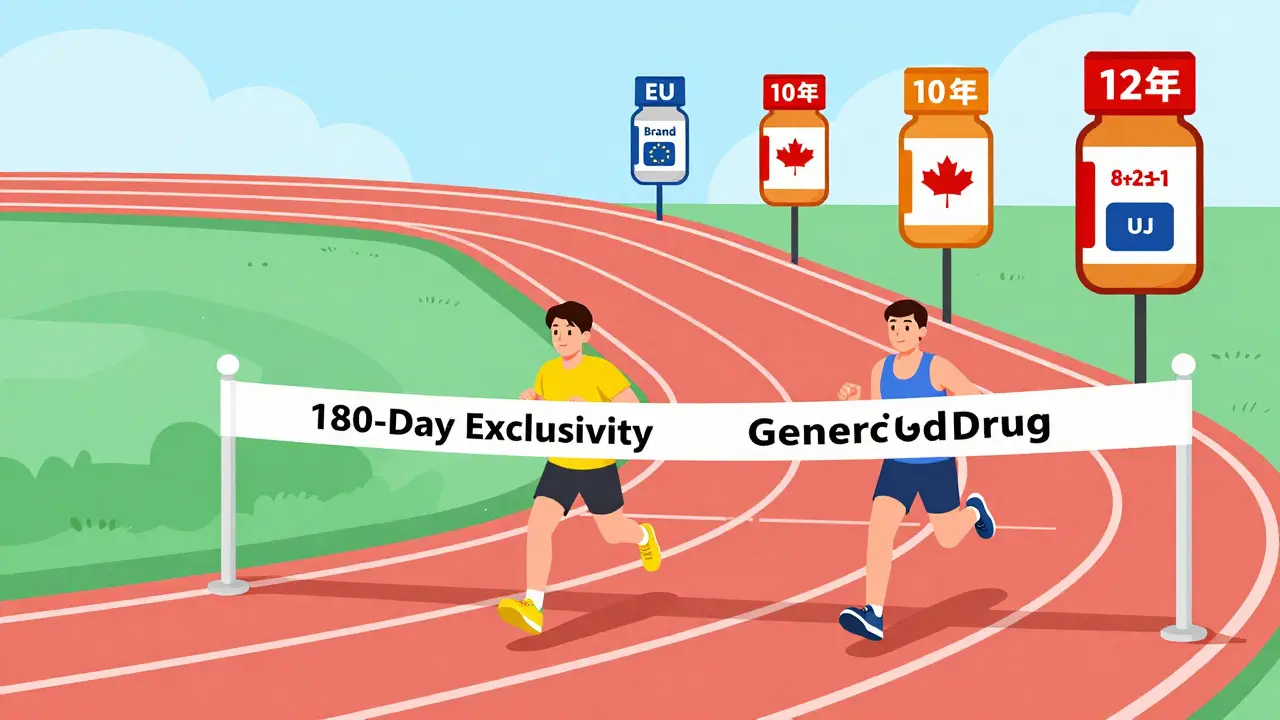
When a brand-name drug hits the market, it doesn’t stay alone for long. Behind the scenes, a complex legal race is already underway - one that determines when cheaper generic versions can appear and who gets to profit from them. The rules aren’t the same everywhere. In the U.S., a generic company might win 180 days of exclusive sales just for challenging a patent. In the EU, they can’t even look at the original drug’s data for eight years. And in some countries, those rules don’t exist at all.
Why Does This Even Matter?
Imagine a life-saving drug that costs $10,000 a year. Then, two years later, a generic version hits the market for $300. That’s not magic. It’s the result of patent and exclusivity rules. These systems are meant to balance two things: giving drugmakers enough time to recover their massive R&D costs (around $2.3 billion per approved drug, according to Tufts), and letting generics step in to make medicines affordable. But in practice, the balance is tilted - and it varies wildly by country.
Patents vs. Exclusivity: What’s the Difference?
People often mix up patents and exclusivity. They’re not the same thing. A patent protects the invention - the chemical structure, the way it’s made, or how it’s used. It lasts 20 years from the filing date, no matter where you are, thanks to the TRIPS Agreement. But here’s the catch: drug development takes 10-12 years. So by the time a drug gets approved, you might only have 6-10 years of real patent life left.
Exclusivity is different. It’s a regulatory shield, not a patent. It stops generic companies from using the original drug’s clinical trial data to get approval - even if the patent has expired. This is where the real battle happens. Countries use exclusivity to control when generics can enter. Some give it for 5 years. Others for 12. And some don’t give it at all.
How the U.S. System Works (And Why It’s Complicated)
The U.S. system was shaped by the Hatch-Waxman Act of 1984. It created a roadmap for generics but also opened the door for brand companies to extend their dominance. Here’s how it breaks down:
- New Chemical Entity (NCE) exclusivity: 5 years. No generic can even apply during this time.
- Orphan Drug Exclusivity: 7 years for drugs treating rare diseases (under 200,000 patients in the U.S.).
- 3-year exclusivity: For new clinical studies - not new drugs, but new uses or formulations.
- Patent Term Extension (PTE): Up to 5 extra years can be added to a patent to make up for delays in FDA approval. But the total market time after approval can’t go past 14 years.
- 180-day exclusivity: The biggest prize. The first generic company to successfully challenge a patent gets to be the only generic on the market for six months. No one else can enter. This is why generic companies spend millions on lawsuits.
The problem? This system invites games. Brand companies pile on dozens of patents - sometimes 100 or more - covering tiny changes like pill color or packaging. The FDA’s Orange Book lists these patents, and generic makers must challenge them one by one. According to Teva’s CEO, the average drug now has 142 patents listed. That’s not innovation. That’s legal obstruction.
And then there’s ‘pay-for-delay.’ Brand companies pay generics to stay off the market. The FTC called it anti-competitive. The Supreme Court agreed in 2013. But it still happens. In 2023, 78% of U.S. pharmacists reported delays in generic availability because of these settlements.

Europe’s 8+2+1 Rule - Simpler, But Still Restrictive
The EU doesn’t have a 180-day exclusivity prize. No legal showdowns for the first mover. Instead, they use a structured timeline called ‘8+2+1’:
- 8 years of data exclusivity: Generic companies can’t use the brand’s clinical data to get approval.
- 2 years of market exclusivity: Even if the generic gets approved, it can’t be sold.
- 1-year extension: If the brand company adds a new, significant indication during the first 8 years.
On top of that, the EU offers Supplementary Protection Certificates (SPCs), which can extend patent life by up to 5 years - but the total time from drug approval can’t exceed 15 years. That’s less flexible than the U.S. system, but also more predictable. Generic makers know exactly when they can enter. No lawsuits. No surprises.
But here’s the catch: trade deals like CETA and EU-Canada agreements force developing countries to adopt similar data exclusivity rules - even when patents have expired. That’s delayed HIV drug access in South Africa by up to 11 years, according to Health Action International.
Other Countries: What’s Happening Elsewhere?
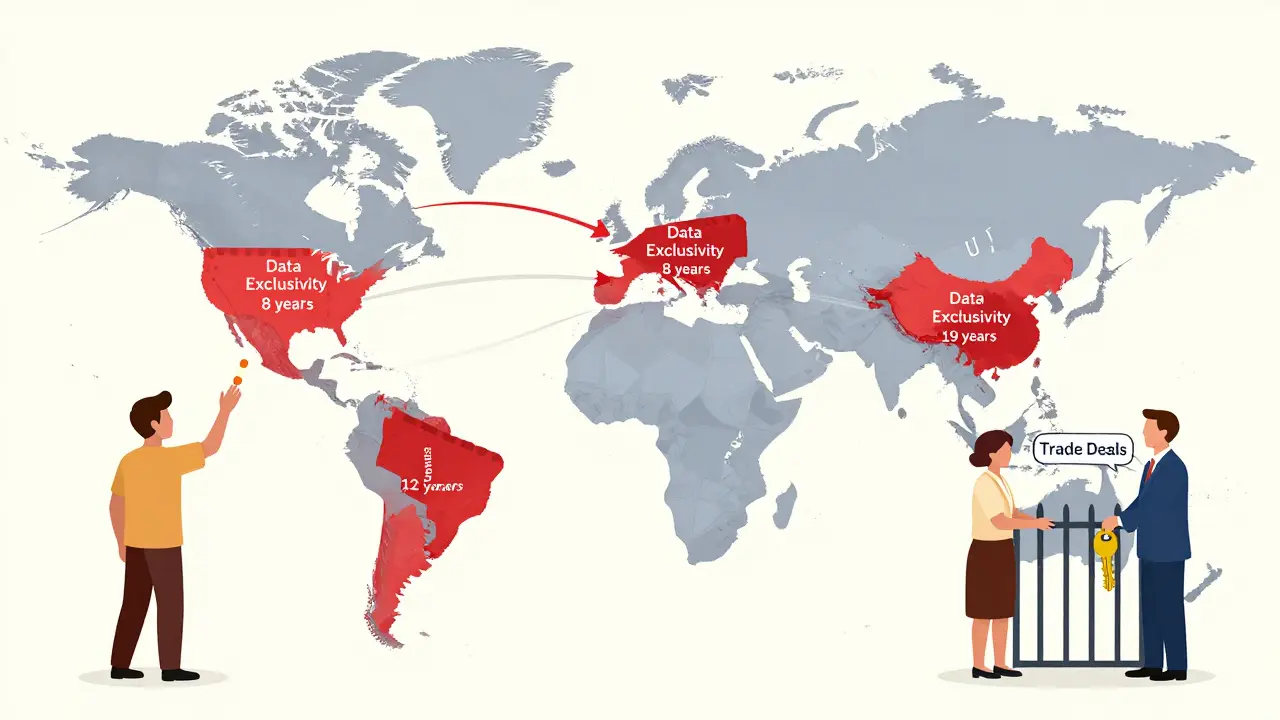
Canada mirrors the EU: 8 years data exclusivity, 2 years market exclusivity. Japan gives 8 years of data protection and 4 years of market exclusivity for new chemical entities. China raised its data exclusivity from 6 to 12 years in 2020. Brazil jumped to 10 years in 2021.
These aren’t random changes. They’re responses to pressure from big pharma and trade agreements. The goal? To keep drug prices high longer. But the impact on access is real. The WHO found that in low-income countries, it takes nearly 7 years longer for generics to arrive after patent expiry - mostly because of data exclusivity rules copied from rich nations.
Who Wins? Who Loses?
Brand companies win. Merck extended Keytruda’s effective exclusivity from 8.2 to 12.7 years through patent stacking and exclusivity tricks. That’s billions in extra revenue.
Generic companies win too - but only if they survive the legal minefield. Mylan challenged 6 out of 12 patents on EpiPen and won. They got to market. But it cost them millions. Most small generics can’t afford it.
Patients lose when generics are delayed. A drug that drops 80-90% in price after generic entry can mean the difference between treatment and no treatment. The Congressional Research Service found that regulatory exclusivity often lasts longer than patents alone - sometimes up to 12 years.
And then there’s the global divide. High-income countries get generics after 12.7 years on average. Low-income countries wait 19.3 years. That’s not a coincidence. It’s policy.
The Future: Will This System Change?
Pressure is building. The U.S. is trying to ban ‘pay-for-delay’ with the Preserve Access to Affordable Generics Act. The EU is proposing to shorten data exclusivity for some drugs to 5 years. Japan is streamlining its patent system to speed up generics.
But the industry fights back. PhRMA says without these protections, innovation would collapse. And maybe they’re right - if you believe that every drug costs $2.3 billion to develop. But experts like Dr. Aaron Kesselheim at Harvard say most drugs get 38 extra patents after approval. That’s not innovation. That’s exploitation.
The World Health Organization says it’s time to rebalance. Exclusivity should match real R&D costs - not corporate profits. For essential medicines, the public health need should come first.
For now, the system stays. And the race continues. The next big drug will have a patent. But the real battle? It’s in the exclusivity rules. And they’re different everywhere you look.
How long does patent protection last for drugs in the U.S.?
The standard patent term is 20 years from the filing date, but because drug development takes 10-12 years, most drugs only have 6-10 years of market exclusivity after approval. The U.S. allows Patent Term Extension (PTE) of up to 5 years to compensate for FDA review delays, but the total exclusivity after approval can’t exceed 14 years.
What is the 180-day exclusivity period for generics in the U.S.?
The 180-day exclusivity is a reward given to the first generic manufacturer that successfully challenges a brand-name drug’s patent through a Paragraph IV certification. During this time, no other generic can enter the market - even if their application is approved. This incentive drives litigation, but it’s also been exploited through ‘pay-for-delay’ deals where brand companies pay generics to delay entry.
Does the EU have a similar system to the U.S. Hatch-Waxman Act?
No. The EU doesn’t have a patent linkage system or 180-day exclusivity. Instead, it uses an ‘8+2+1’ model: 8 years of data exclusivity, 2 years of market exclusivity, and a possible 1-year extension for significant new indications. Generic companies can’t rely on the brand’s data for approval during this time, but they don’t need to sue to enter the market.
Why do some countries have longer exclusivity periods than others?
It’s often due to trade agreements and political pressure from pharmaceutical companies. Countries like China, Brazil, and South Korea have extended data exclusivity to 10-12 years, partly to attract drugmakers. But this delays generic access. Low-income countries, which can’t afford to negotiate strong protections, end up with even longer delays - sometimes over 19 years from patent filing to generic entry.
Can a generic drug enter the market before a patent expires?
Yes - but only under specific conditions. In the U.S., a generic company can file for approval before the patent expires if it certifies that the patent is invalid or won’t be infringed (Paragraph IV). If they win in court, they can launch before the patent ends. In the EU, generics can’t use the originator’s data until exclusivity ends, but they can develop their own data and apply for approval - though they can’t sell until the 8+2+1 period is over.
What’s the impact of data exclusivity on global access to medicines?
Data exclusivity blocks generic manufacturers from using existing clinical trial data to prove safety and effectiveness. This forces them to run expensive new trials - something most can’t afford. In developing countries, this has delayed access to HIV, hepatitis, and cancer drugs by over a decade, even after patents expired. Critics call it a hidden barrier to affordable medicines.
Sinéad Griffin
December 15, 2025 AT 00:52Rulich Pretorius
December 15, 2025 AT 06:55Thomas Anderson
December 16, 2025 AT 21:11Dwayne hiers
December 18, 2025 AT 05:06Jonny Moran
December 18, 2025 AT 19:16Alexis Wright
December 20, 2025 AT 08:19jeremy carroll
December 20, 2025 AT 10:12Natalie Koeber
December 21, 2025 AT 02:54