
Fertility and Immunosuppressants: What You Need to Know Before Getting Pregnant
Immunosuppressant Pregnancy Safety Checker
Medication Safety Assessment
Your Safety Assessment
Recommendations
Key Risks
When you're managing a chronic autoimmune disease or have had an organ transplant, staying healthy often means taking immunosuppressants daily. But if you're thinking about starting a family, these same medications can raise serious questions: Can I get pregnant safely? Will my baby be at risk? Should I stop my meds? The answers aren't simple, and waiting until you're already pregnant is too late. The truth is, many people on immunosuppressants do have healthy babies-but only if they plan ahead.
Not All Immunosuppressants Are Created Equal
There's no one-size-fits-all answer when it comes to fertility and pregnancy. Different drugs have wildly different effects. Some are relatively safe, others carry clear risks, and a few should be avoided entirely if you're trying to conceive.
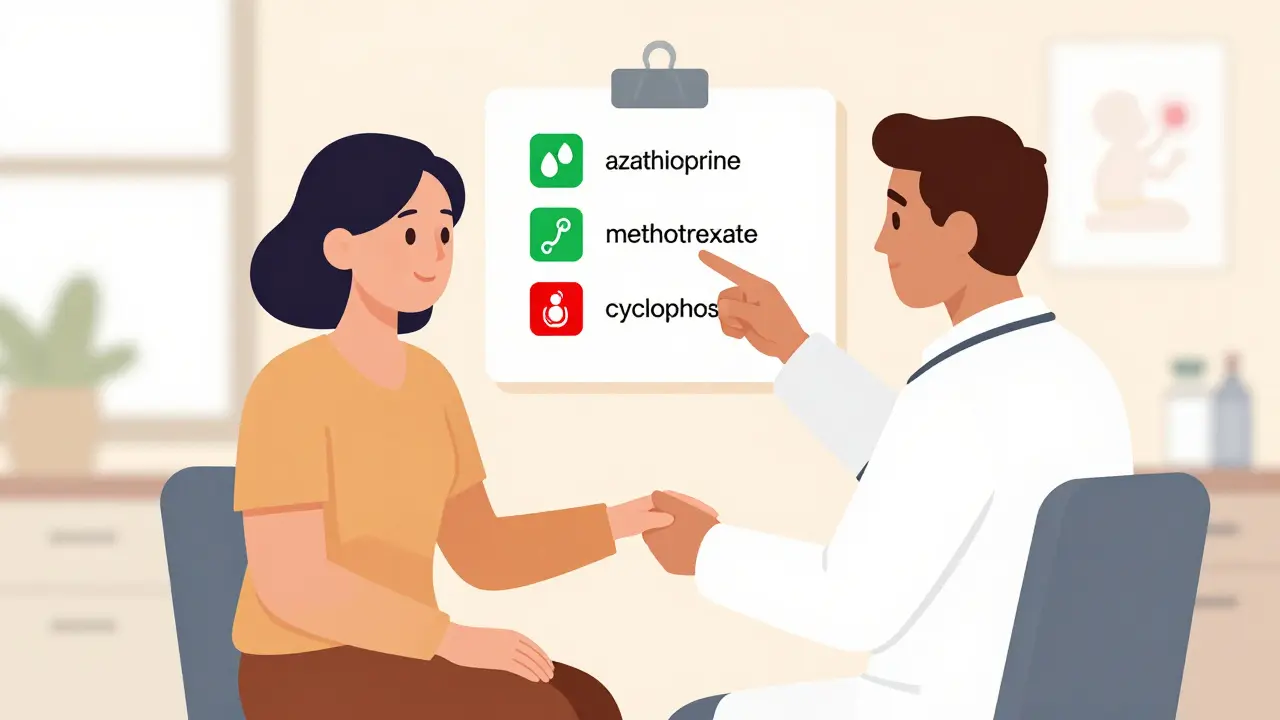
Azathioprine stands out as one of the safest options. Over 1,200 documented pregnancies in women taking this drug showed no increase in birth defects or miscarriage rates, according to a major 2000 study in JAMA Internal Medicine. It's often the go-to choice for women with lupus or rheumatoid arthritis who want to get pregnant.
On the other end of the spectrum, cyclophosphamide is a known fertility killer. In women, it can cause permanent ovarian damage-up to 70% of those who take cumulative doses over 7 grams per square meter of body surface lose their ability to conceive naturally. In men, it can lead to irreversible azoospermia (zero sperm count) in about 40% of cases. If you're on this drug and thinking about having kids, fertility preservation like egg or sperm freezing should be discussed before you start treatment.
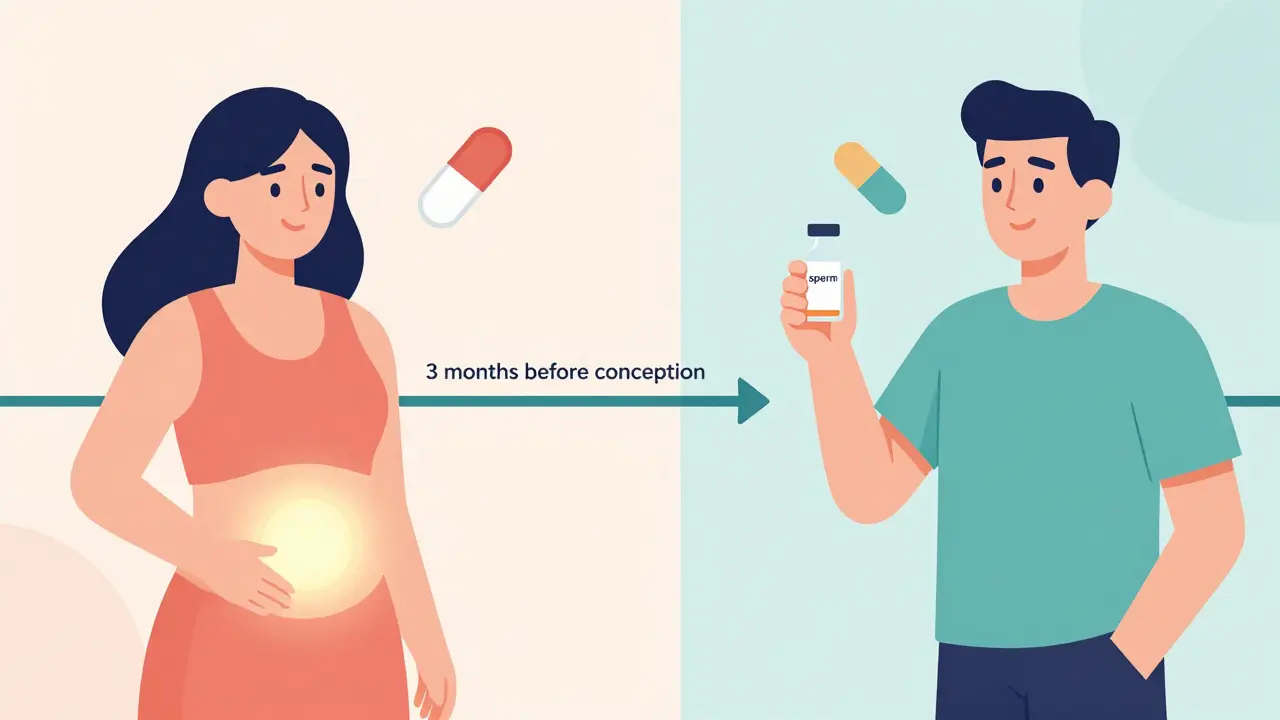
Methotrexate, commonly used for psoriasis or rheumatoid arthritis, is embryotoxic. It can cause severe birth defects if taken during pregnancy. The rule? Stop it at least three months before trying to conceive. Even a single dose during early pregnancy can be dangerous.
For men, sulfasalazine is a surprise culprit. It cuts sperm counts by 50-60%, but here's the good news: the effect is reversible. Once you stop taking it, sperm numbers usually bounce back within three months. No need to panic-but do get a semen analysis if you've been on it for over a year.
Steroids, Transplant Drugs, and Hidden Risks
Corticosteroids like prednisone are often continued during pregnancy because stopping them can trigger disease flares. But they're not harmless. They can interfere with ovulation and sperm production, and they raise the risk of premature rupture of membranes by 15-20%. Still, for most patients, the benefits outweigh the risks when used at the lowest effective dose.
For transplant patients, drugs like ciclosporine and tacrolimus are common. Ciclosporine increases the chance of prematurity by about 25%. Tacrolimus? It bumps up the risk of gestational diabetes by 30-40%. Neither causes birth defects, but they require close monitoring during pregnancy. Blood sugar checks, frequent ultrasounds, and extra prenatal visits become part of the routine.
Sirolimus is another story. It's currently contraindicated during pregnancy. Early reports include seven pregnancies with three miscarriages and one baby born with structural abnormalities. There's not enough data to say it's safe-and the risks are too high to gamble on.
Chlorambucil, used in rare autoimmune cases, is even more concerning. The FDA classifies it as Category D, meaning there's clear evidence of fetal harm. Studies show it's linked to kidney malformations (8% of exposed babies), ureter defects (12%), and heart problems (15%). Breastfeeding is also off-limits if you're on this drug.
What About Newer Drugs? Belatacept and Beyond
The landscape is changing. Newer immunosuppressants like belatacept, used after kidney transplants, have shown promising early results. So far, three documented pregnancies in women taking belatacept led to healthy babies with no birth defects. But with only three cases, we can't call it safe yet. It's not recommended as a first-line option for those planning pregnancy-but for someone who can't tolerate other drugs, it might be an option under strict supervision.
One big problem: many older drugs were approved before regulators required testing for reproductive side effects. The FDA and EMA didn't demand studies on male fertility until recently. That means we're still playing catch-up. For example, we don't have solid data on how mycophenolate affects sperm quality long-term, or whether newer drugs like voclosporin impact fetal development.
Preconception Counseling Isn't Optional-It's Essential
You can't wing this. Waiting until you miss a period to talk to your doctor is a recipe for stress, uncertainty, and possibly harm. Experts agree: start the conversation at least 3-6 months before you plan to conceive.
Here’s what that conversation should include:
- Review every medication you're taking, including over-the-counter supplements
- Switch to safer alternatives if possible-azathioprine over cyclophosphamide, for instance
- For women: check ovarian reserve with AMH and FSH blood tests if you're over 30 or on high-risk drugs
- For men: get a semen analysis if you've been on sulfasalazine, cyclophosphamide, or similar drugs for over a year
- Ensure your disease is stable. Flares during pregnancy are dangerous for both you and the baby
- Discuss fertility preservation: egg freezing, sperm banking, or embryo cryopreservation
For transplant patients, coordination between your transplant team, rheumatologist, and fertility specialist is critical. One doctor can't manage everything. You need a team that talks to each other.
Monitoring During Pregnancy
If you do get pregnant, you're not off the hook. You'll need more frequent checkups. For kidney transplant patients, creatinine levels above 1.3 mg/dL before pregnancy raise the risk of preeclampsia. Monthly kidney function tests are standard.
Babies born to mothers on immunosuppressants may have lower B- and T-cell counts in their first year, making them more vulnerable to infections. That doesn't mean you shouldn't vaccinate them-just that you should work with your pediatrician to monitor their immune response. Live vaccines like MMR may need to be delayed.
For men: if you're on immunosuppressants, your partner doesn't need to avoid pregnancy. There's no evidence that sperm carrying these drugs causes birth defects. But if you're on drugs like cyclophosphamide, it's still wise to wait at least three months after stopping before trying to conceive-just to let new sperm develop.

What About Breastfeeding?
Some drugs pass into breast milk. Chlorambucil? Absolutely not. Cyclophosphamide? Only if you wait 3-4 hours after taking it. Azathioprine? Generally considered safe. Prednisone? Low doses are fine. Always check with your doctor before nursing. The key is timing: take your dose right after feeding, not before.
Long-Term Gaps in Knowledge
We know a lot more than we did in 2000, but there are still big blind spots. We don't have long-term data on how children exposed to newer drugs like belatacept or voclosporin develop mentally or immunologically. We don't have enough studies on paternal exposure. And we still lack registries that track outcomes systematically.
That's why experts are pushing for better research: national pregnancy registries, standardized sperm testing protocols, and longer follow-up studies on exposed children. Until then, caution and careful planning remain your best tools.
Bottom Line: Plan Early, Stay Informed
Fertility isn't off-limits if you're on immunosuppressants-but it requires strategy. You can't rely on luck or hope. You need a plan, a team, and accurate information. Whether you're a woman with lupus, a man on sulfasalazine, or a transplant recipient, your path to parenthood is possible. But it starts with a conversation-long before you stop using birth control.
Can I get pregnant while taking immunosuppressants?
Yes, many people do. But it depends on which drug you're taking. Azathioprine and corticosteroids are generally safe. Drugs like cyclophosphamide, methotrexate, and sirolimus carry serious risks and should be stopped before conception. Always consult your doctor before trying to get pregnant.
How long before pregnancy should I stop my immunosuppressants?
It varies. Methotrexate needs to be stopped at least 3 months before conception. Cyclophosphamide may require 6 months or more, especially if fertility preservation is needed. For azathioprine or prednisone, you may not need to stop at all. Always follow your doctor's timeline based on your specific medication and condition.
Do immunosuppressants cause birth defects?
Some do, some don't. Cyclophosphamide, chlorambucil, and methotrexate are linked to serious birth defects. Azathioprine has been studied in over 1,200 pregnancies with no increased risk. Sirolimus and mycophenolate are considered high-risk. Always check the safety profile of your specific drug before getting pregnant.
Can men taking immunosuppressants father healthy children?
Yes. Most immunosuppressants don't harm sperm DNA or cause birth defects through paternal exposure. Sulfasalazine can lower sperm count temporarily, but fertility returns after stopping. Cyclophosphamide can cause long-term infertility in men, so sperm banking before treatment is recommended. No evidence suggests that taking these drugs affects the baby's health if the father is the one on medication.
Is breastfeeding safe while on immunosuppressants?
It depends. Azathioprine and prednisone (at low doses) are considered safe. Chlorambucil and cyclophosphamide are not. For drugs with unclear safety, wait 3-4 hours after taking your dose before nursing to let the drug clear from your system. Always check with your doctor before breastfeeding.
What if I'm already pregnant and taking immunosuppressants?
Don't panic. Contact your doctor immediately. If you're on methotrexate, cyclophosphamide, or sirolimus, your team will likely switch you to a safer drug like azathioprine. Never stop your medication without medical guidance-uncontrolled disease can be more dangerous than the drugs themselves.
Liam Crean
February 20, 2026 AT 21:23Just wanted to say this post saved my life. I was on methotrexate for RA and had no idea it was a teratogen until I started thinking about kids. Went to my rheumatologist, switched to azathioprine, and six months later-pregnant. No complications. Seriously, if you're on anything long-term and thinking about family, don't wait. Talk to someone. Now.
Also, shoutout to the guy who mentioned sperm banking for sulfasalazine. That was a lightbulb moment. I didn't even know men could be affected.
Hariom Sharma
February 21, 2026 AT 10:41Bro, this is why we need more awareness in developing countries. In India, most doctors just tell you to 'try naturally' and don't even mention drug risks. I know a girl who got pregnant on mycophenolate and lost the baby at 14 weeks. No one told her. Please, share this. Save someone.
Marie Crick
February 22, 2026 AT 19:12Stop trying to get pregnant if you're on immunosuppressants. It's selfish.
James Roberts
February 23, 2026 AT 14:06Oh wow, Marie, you're the reason people think doctors are monsters. 'Selfish'? You're the one who thinks a woman's body is a liability, not a miracle. I've seen moms on azathioprine raise healthy kids. You'd rather they stay childless because you're scared of complexity? Grow up.
Ellen Spiers
February 24, 2026 AT 20:43While the general thrust of this article is commendable, it exhibits a conspicuous lack of quantitative risk stratification. The assertion that 'azathioprine is safe' is empirically unsupported without confidence intervals, absolute risk differentials, or meta-analytic weighting of the JAMA cohort. Moreover, the omission of pharmacokinetic data on placental transfer-particularly for tacrolimus-constitutes a critical knowledge gap in clinical counseling. One cannot responsibly advise reproductive planning on anecdotal case series.
Jeremy Williams
February 25, 2026 AT 06:03As a transplant nephrologist in Boston, I’ve managed over 30 pregnancies in patients on calcineurin inhibitors. The data is messy, yes-but the outcomes? Mostly excellent. What’s missing from this piece is the emotional toll. Patients don’t just need drug profiles-they need reassurance. We should be normalizing these conversations, not just listing risks. Also, I’ve never seen a baby with a birth defect from paternal azathioprine exposure. Ever.
Davis teo
February 26, 2026 AT 11:46I’m a guy on prednisone for ulcerative colitis. My wife and I tried for 2 years. I stopped the meds cold turkey because I read online it ‘hurts sperm.’ We got pregnant in 3 months. Then I had a flare. I had to go back on it. Now I’m 3 months postpartum and still on it. My kid’s fine. But I lost 40 lbs. I almost died. This whole thing is a nightmare. Why does no one warn us about the mental health part? Nobody talks about the guilt. The fear. The crying in the shower.
Nina Catherine
February 27, 2026 AT 16:04OMG I’m so glad I found this!! I’m on azathioprine and just found out I’m pregnant!! I was terrified I’d messed up everything. My doc said it was fine but I didn’t believe her. Now I feel so much better. Also-can someone confirm if it’s okay to take folic acid with azathioprine? I’m taking 5mg but I’m not sure if that’s too much? Thanks!!
Caleb Sciannella
February 27, 2026 AT 17:08While the article provides a broadly accurate overview of immunosuppressive agents and their reproductive implications, it fails to adequately contextualize the role of disease activity as a confounding variable. In patients with systemic lupus erythematosus, for instance, the risk of fetal loss from an uncontrolled flare exceeds the teratogenic potential of azathioprine by a factor of three. Therefore, the emphasis on medication substitution without concurrent assessment of disease stability constitutes a clinically incomplete narrative. Furthermore, the assertion that 'no evidence suggests paternal exposure causes birth defects' overlooks emerging epigenetic research implicating altered sperm methylation patterns in men exposed to cyclophosphamide, even after recovery of sperm count. The literature is evolving, and public education must evolve with it.
Chris Beeley
February 28, 2026 AT 08:20Let me tell you something, America. In Nigeria, we don’t have access to azathioprine. We have chlorambucil. We have methotrexate. And we have women who get pregnant anyway. No doctors. No counseling. Just faith. And guess what? Most of those babies are fine. You people sit here debating pharmacokinetics while we’re just trying to survive. This article is rich. Privileged. Out of touch. You want to help? Send drugs. Not more lectures.
Arshdeep Singh
February 28, 2026 AT 19:52It's ironic how we obsess over drugs and ignore the real issue: the collapse of the natural order. Modern medicine has detached reproduction from biology. We're not meant to be on immunosuppressants and conceive. The body knows. That's why miscarriages happen. It's not about the drugs-it's about the soul rejecting artificial harmony. You can't engineer life through pill swapping. There's a reason ancient cultures had rituals before conception. We lost that. And now we're paying the price in anxiety, IVF, and guilt.
Jonathan Rutter
March 2, 2026 AT 08:16Wait. So if you're on prednisone and get pregnant, you're just supposed to keep taking it? What if you're one of those people who gets moon-faced and diabetic? What if your blood sugar spikes and your kid gets macrosomia? And you're telling me to 'wait three months' before trying? What if you're 38 and your clock is ticking? You're not living in real life. This is all theoretical. Real people are scared, broke, and desperate. And no one tells them how to survive this.
Tommy Chapman
March 2, 2026 AT 14:23This is why socialism is failing. You're telling people to take drugs that might hurt babies? That's not healthcare-that's eugenics with a prescription pad. If you can't have kids naturally, don't. End of story. We used to have values. Now we just pump chemicals into people and call it progress. Shame.
Danielle Gerrish
March 3, 2026 AT 04:38I’m a mom of two. Both conceived while I was on azathioprine. I cried the whole first trimester. Every time I took my pill, I thought: ‘Am I killing them?’ I Googled until my eyes bled. I had panic attacks. I didn’t tell anyone. Not even my husband. Then my OB said, ‘You’re fine.’ And I believed her. But no one told me how lonely it feels. No one told me the guilt doesn’t go away. Even now, when my kids run around, I still wonder: was it the drug? Or was it just luck? I wish someone had said: ‘It’s okay to be scared. You’re not alone.’