
Doctor's Letter for Controlled Substances During International Travel: What You Need to Know
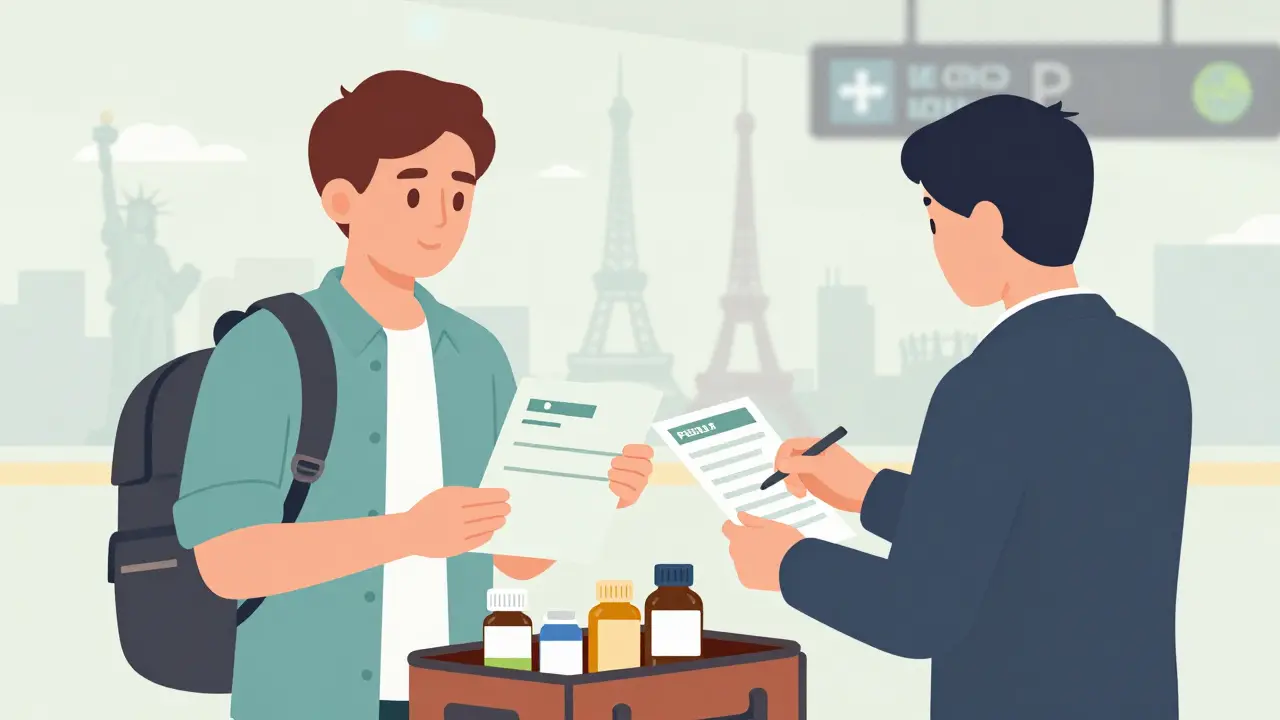
Carrying prescription medications across international borders isn’t as simple as tossing them in your suitcase. If you’re taking controlled substances-like opioids, stimulants, benzodiazepines, or ADHD medications-you could face detention, fines, or even arrest if you don’t have the right paperwork. This isn’t a rare scenario. In 2022, over 127 travelers were detained worldwide just because their medical documentation was incomplete or missing. The good news? With the right letter from your doctor, you can avoid all of this.
Why You Need a Doctor’s Letter
International drug control treaties, like the 1961 Single Convention on Narcotic Drugs and the 1971 Convention on Psychotropic Substances, give countries the power to restrict what drugs can enter their borders. But they also allow exceptions for travelers with legitimate medical needs. That’s where the doctor’s letter comes in. It’s your proof that you’re not smuggling drugs-you’re managing a health condition. Without it, even a small bottle of oxycodone or Adderall can look like contraband. Customs agents don’t know your medical history. They see a Schedule II substance and follow protocol. The CDC reports that 68% of all medication-related travel incidents happen because travelers didn’t bring proper documentation. That’s not a small risk. It’s the #1 reason people get stuck in foreign jails.What Must Be in the Letter
A valid doctor’s letter isn’t just a note saying “Patient needs meds.” It has to meet specific standards. Here’s what every letter must include:- Your full name and date of birth (exactly as it appears on your passport)
- The prescribing doctor’s full name, license number, title, clinic address, and phone number
- The generic name of each medication (not the brand name-brand names vary by country)
- The exact dosage, frequency, and route of administration (e.g., “10 mg oral tablet, once daily”)
- A clear statement of the medical condition being treated (e.g., “chronic pain due to spinal injury,” “ADHD diagnosed in 2020”)
- A formal request that you be permitted to carry these medications for personal use during your trip
- The doctor’s handwritten or digital signature
- The letter must be printed on official letterhead
Quantity Limits and Packaging Rules
You can’t just pack a six-month supply and hope for the best. Most countries allow only a 90-day supply for personal use. The FDA and U.S. Customs and Border Protection (CBP) both enforce this rule strictly. If you’re traveling for longer, you’ll need to arrange for refills at your destination-or risk running out. Medications must be in their original, labeled containers. That means the pharmacy label with your name, the drug name, and the prescribing doctor’s info must still be on the bottle. If you use a pill organizer, you must carry the original bottles alongside your doctor’s letter. CBP explicitly states that transferring medications to organizers without the original packaging increases the risk of seizure. For Schedule II-V controlled substances (like oxycodone, Adderall, Xanax), the DEA requires you to carry both the doctor’s letter and the original prescription. A letter alone isn’t enough. You need both.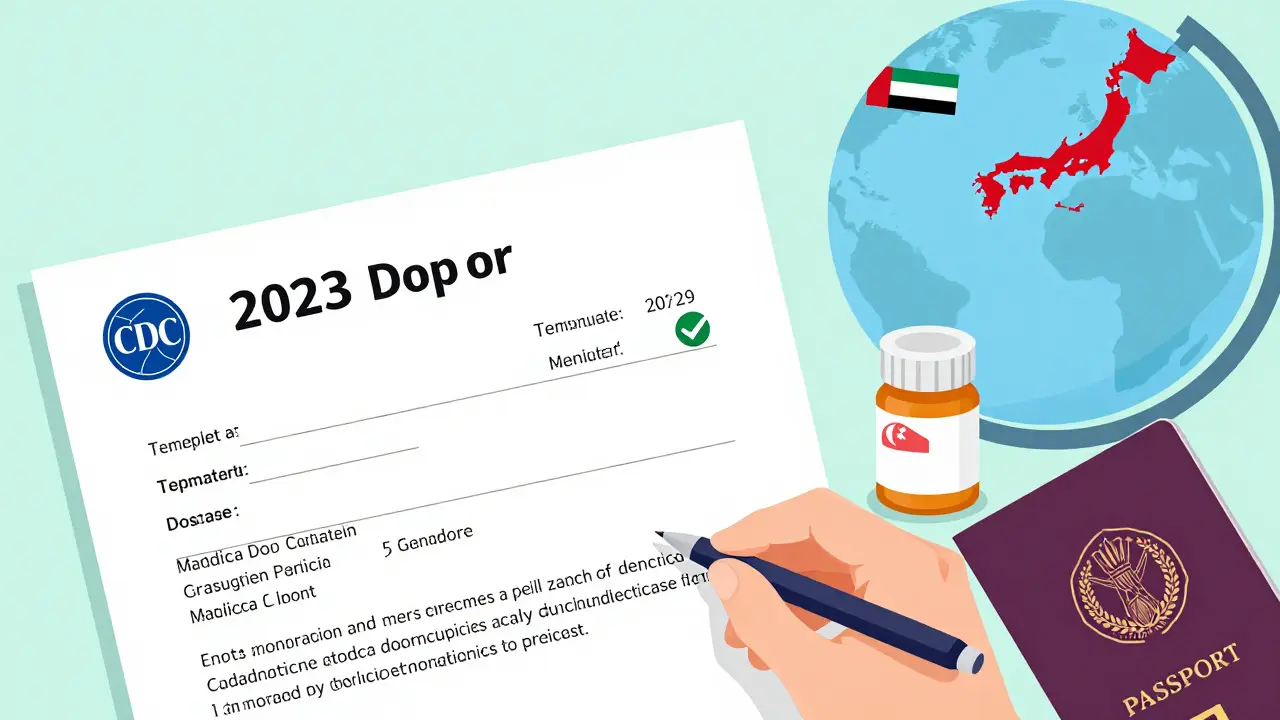
Country-by-Country Differences
Not all countries treat medication the same way. Some are strict. Others are flexible. Here’s what you need to know:- Japan: Adderall, Ritalin, and other amphetamine-based ADHD meds are banned-even with a doctor’s letter. You cannot bring them in. If you need treatment, you must find a local doctor who can prescribe alternatives.
- United Arab Emirates: You need advance approval from the Ministry of Health before arrival. Submit your letter and prescription at least 30 days ahead. Failure to do so can lead to immediate detention.
- Singapore and Malaysia: Even with perfect documentation, carrying more than a 30-day supply is a criminal offense. Penalties include jail time.
- European Union: Most EU countries accept doctor’s letters from other member states. A letter in English is usually fine. No advance approval needed for a 90-day supply.
- Canada: Accepts doctor’s letters alone for personal quantities under 100 dosage units. No prescription required.
- United States: You must have both a doctor’s letter and the original prescription to re-enter with controlled substances.
Language and Translation
If your doctor’s letter isn’t in English, most countries require a certified translation. The FDA mandates this for all medications entering the U.S. Many other countries require it too. A Google Translate printout won’t cut it. You need a professional translation service with a signed statement verifying accuracy. Some embassies offer translation services-call ahead.What to Do Before You Leave
Don’t wait until the day before your flight. Here’s your checklist:- Make a list of all your medications, including generic names, dosages, and why you take them.
- Call your doctor at least two months before departure. Ask them to write a letter using the CDC’s 2023 template.
- Verify the legal status of each medication in your destination country. Use official government websites, not travel blogs.
- Call the embassy or consulate of your destination country and confirm their requirements.
- Keep original prescriptions and bottles with you at all times.
- Carry extra copies of your letter and prescriptions. Leave one with a trusted person at home.
- If you’re taking ADHD meds, be extra careful. 89% of countries require special documentation for these drugs.
What If You’re Already Abroad and Run Out?
If you lose your meds or run out while overseas, don’t panic-but don’t try to buy them locally either. Many countries have strict controls, and pharmacies won’t sell you controlled substances without a local prescription. Your best move: contact your country’s embassy. They can help you find a local doctor who can evaluate you and write a new prescription. In some cases, they can even help arrange for a replacement shipment from home, though this can take weeks.What’s Changing in 2025
The International Narcotics Control Board is rolling out a digital medical certificate for travelers, currently being tested in 12 European countries. By 2025, this could replace paper letters in many places. The European Union is also funding a $2.4 million project to create a unified digital system for medication travel documentation. But until then, paper is still king. Don’t assume digital records or telehealth prescriptions will be accepted everywhere. The FDA updated its guidelines in May 2023 to allow telemedicine prescriptions-but only if they’re printed, signed, and accompanied by the doctor’s letter. If your appointment was virtual, make sure you got a physical copy.Final Reminder
This isn’t about bureaucracy. It’s about safety-for you and for others. Controlled substances are tightly regulated because they can be misused. A doctor’s letter doesn’t just protect you from legal trouble. It protects you from being mistaken for a drug trafficker in a foreign country where the penalties are severe. Take the time to get it right. Your trip depends on it.Do I need a doctor’s letter for over-the-counter medications?
No, you don’t need a doctor’s letter for over-the-counter drugs like ibuprofen, antihistamines, or acid reducers. But if the OTC medication contains a controlled substance-like codeine in some cough syrups-you’ll need documentation. Always check the active ingredients.
Can I use a telemedicine prescription for my doctor’s letter?
Yes, if the telehealth provider is licensed in your state and the prescription is printed, signed, and accompanied by a letter on official letterhead. The FDA accepts telemedicine prescriptions as long as they meet the same standards as in-person ones. But some countries still require an in-person signature-call the embassy to confirm.
What if my medication isn’t available in the country I’m visiting?
Some medications simply don’t exist in other countries. For example, Adderall isn’t sold in Japan or the UAE. In these cases, you must either bring enough for your entire trip or consult a local doctor before you run out. Your embassy can help you find a provider who can prescribe an alternative. Never try to buy from unlicensed pharmacies abroad.
Is it okay to carry my medication in my checked luggage?
No. Always carry controlled substances in your carry-on bag. Checked luggage can be lost, delayed, or opened without your knowledge. If customs finds your meds without documentation, you’ll have no way to prove they’re yours. Keep them with you at all times.
Do I need a letter for each medication?
Yes. Each controlled substance requires its own letter. One letter covering five different drugs won’t be accepted. The DEA and FDA require separate documentation for each substance. This isn’t optional-it’s the law.
Can my pharmacist write the doctor’s letter?
No. Only the prescribing physician can write the letter. Pharmacists can provide a printout of your prescription, but it doesn’t count as medical documentation. The letter must come from the doctor who diagnosed your condition and prescribed the medication.
Amit Jain
February 4, 2026 AT 06:27Just got back from Thailand with my ADHD meds. Had the CDC letter, original bottles, and prescription. No issues. Seriously, don't skip the letter. I saw a guy get pulled aside because he had Adderall in a pill organizer. No paperwork. Total nightmare.
Bring everything. Even if you think it's overkill.
Keith Harris
February 5, 2026 AT 19:13Oh please. This whole ‘doctor’s letter’ thing is just bureaucratic theater. I’ve flown to 17 countries with oxycodone in my pocket and never once got questioned. You’re not a criminal just because you have pain. The system’s rigged to scare people into compliance. Real travelers don’t need paperwork-they have guts.
Also, the CDC? Please. They don’t know what’s happening on the ground. Talk to real people, not bureaucrats.
Alec Stewart Stewart
February 5, 2026 AT 20:37Hey, I just want to say thank you for writing this. I’m a chronic pain patient and I was terrified to travel after reading some horror stories online. This guide actually made me feel like it’s doable.
My doctor didn’t even know about the CDC template-I printed it out and gave it to them. They were impressed. Took 10 minutes to fill out.
You’re helping people stay safe, not just legal. Big love. 🙏
Geri Rogers
February 7, 2026 AT 00:06Okay but can we talk about how wild it is that Japan bans ADDERALL? 😱 Like, it’s literally the #1 prescribed ADHD med in the US. And they’re like ‘nah, nope, not even if you’re a doctor’s patient?’
My cousin had to switch to methylphenidate there-found a local doc who was chill. But she cried for a week. This system is broken. Bring your meds, sure-but also demand better policies. 🌍💊
Samuel Bradway
February 8, 2026 AT 00:15Just a heads-up-don’t forget to check if your meds are banned in transit countries too. I flew through Dubai with Xanax, had the letter, thought I was fine. Turned out their customs scans every bag-even if you’re not stopping. They flagged it. Took 3 hours to clear.
Always check the entire route, not just the final destination.
pradnya paramita
February 8, 2026 AT 18:44From a clinical pharmacy standpoint, the 90-day supply limit is rooted in WHO guidelines on controlled substance diversion risk mitigation. The DEA’s 100-unit threshold for Schedule II-V substances is codified under 21 CFR §1306.22, and non-compliance triggers automatic seizure under the Controlled Substances Act.
Moreover, the 2023 CDC template aligns with the INCB’s Model Letter for International Travelers, which supersedes all prior formats. Pharmacies cannot issue legal documentation-only prescribers have authority under the Hague Protocol.
Pro tip: Always carry the original Rx AND the letter. One without the other is legally insufficient in 83% of jurisdictions.
Jamillah Rodriguez
February 10, 2026 AT 11:56Ugh. I read all this and now I’m just… exhausted. 😩 Like, why does everything have to be this complicated? I just want to go on vacation without feeling like I’m smuggling nuclear codes.
Can’t we just… have a global app? Like, ‘MedPass’? Why do I need 7 pieces of paper and a notarized affidavit just to take my anxiety pills to Cancun?
I’m just here for the margaritas, not the legal drama.
Roshan Gudhe
February 10, 2026 AT 20:46This isn’t just about rules-it’s about dignity. Imagine being a person who needs medicine to function, and then being treated like a criminal because you’re trying to live your life.
These laws were written in fear, not compassion. But we’re human beings, not data points in a customs database.
Maybe the real solution isn’t more paperwork-but a world that trusts people instead of policing them. Until then, yes, do the letter. But don’t forget to breathe through it.
Rachel Kipps
February 12, 2026 AT 06:28thank you for this post. i had no idea about the original bottle thing. i always put my meds in a pill organizer for convenience. i just checked my bag and i have 3 different prescriptions. i’ll print the letter tomorrow. also, i think i misread the part about the embassy. i thought they just helped with passports. i’ll call them now. 😅