
Constipation: Causes, Laxatives, and Long-Term Management
Constipation isn’t just about not going to the bathroom often-it’s about struggle. Hard stools, straining, feeling like you didn’t fully empty your bowels, or going fewer than three times a week. If this sounds familiar, you’re not alone. About 33.3% of people in clinical settings experience it, and over 2.5 million Americans see a doctor for it every year. The good news? Most cases can be managed without surgery. The key is understanding what’s really going on and what actually works long-term.
What’s Really Causing Your Constipation?
Constipation happens when stool moves too slowly through your colon, and too much water gets absorbed. The result? Dry, hard lumps that are tough to pass. But why does this happen? It’s rarely just one thing. For many, it’s lifestyle. Not enough fiber-most Americans eat only 15 grams a day, but the recommendation is 25 to 30 grams. Not enough water. Sitting all day. Skipping meals. These are the usual suspects. But there’s more. Medications play a huge role. Opioids cause constipation in 40% to 95% of users. Calcium channel blockers like verapamil, tricyclic antidepressants, and even iron supplements can slow things down. If you started a new drug and noticed changes in your bowel habits, that’s a red flag. Medical conditions are also major players. Diabetes affects nearly 60% of people with the disease, slowing nerve signals to the gut. Hypothyroidism cuts your metabolism, including gut motility. Neurological diseases like Parkinson’s, multiple sclerosis, and spinal cord injuries disrupt the brain-gut connection. In fact, 50% to 80% of Parkinson’s patients deal with constipation as a core symptom. And then there are the less obvious factors. Women are more likely to have it-67% of patients are female. Age matters too. After 60, prevalence jumps to over 30%. Chronic kidney disease, stroke, COPD, and heart disease all increase your risk. If you have one of these, constipation isn’t just a nuisance-it’s a sign something deeper is off.Types of Constipation: Not All Are the Same
Not everyone with constipation has the same problem. Doctors classify it into four main types, and treatment changes based on which one you have. Normal transit constipation (about 60% of cases) means your colon moves stool at a normal speed, but you still feel blocked, strain, or feel incomplete. This is often tied to pelvic floor issues or poor bowel habits. Slow transit constipation (15% to 30%) means stool moves too slowly through the colon-sometimes taking more than 72 hours. Your colon just isn’t contracting well. This is common in older adults and people with diabetes. Defecatory disorders affect 20% to 50% of chronic cases. Here, the muscles in your pelvic floor don’t relax properly when you try to poop. Instead of pushing stool out, they tighten. It’s like trying to squeeze a tube of toothpaste while clenching your fist. Diagnosis requires a balloon expulsion test or anorectal manometry. Refractory constipation is when nothing seems to work. You’ve tried fiber, laxatives, water, and still-nothing. About 15% to 20% of people fall into this group. Often, it’s a mix of slow transit, pelvic floor dysfunction, and visceral hypersensitivity (where the gut is overly sensitive to normal movements).Laxatives: What Actually Works (and What Doesn’t)
Laxatives get a bad rap, but they’re not all dangerous. The problem isn’t using them-it’s using the wrong kind, for too long, or without addressing the root cause. Bulk-forming laxatives like psyllium (Metamucil) or methylcellulose (Citrucel) are great for normal transit constipation. They soak up water and make stool softer and bigger, which triggers natural contractions. But here’s the catch: you need to drink at least 8 ounces of water with each dose. Skip that, and you risk a blockage. Start slow-5 grams a day, then increase every 3 to 4 days. Too much too fast? Bloating and gas are almost guaranteed. Osmotic laxatives like polyethylene glycol (PEG 3350, or MiraLAX) are the first-line treatment for most people. They pull water into the colon without irritating it. Studies show 65% to 75% of people respond well. One 17-gram dose daily is safe for months-even years. It’s the gold standard. Stimulant laxatives like senna or bisacodyl work fast. They make your intestines contract harder. Great for short-term relief-think a few days after surgery or a trip. But using them longer than 12 weeks? Risky. They can damage the nerves in your colon, leading to cathartic colon: a sluggish, unresponsive gut. The American Gastroenterological Association warns against using them for more than 3 months. Stool softeners like docusate sodium? Don’t bother alone. Studies show they’re barely better than a placebo. They’re often included in combo products, but they don’t fix the problem. Prescription options like lubiprostone, linaclotide, and plecanatide are for when everything else fails. They work by increasing fluid secretion in the gut. Linaclotide, for example, helps 45% to 60% of people with irritable bowel syndrome and constipation. But they’re expensive-hundreds of dollars a month-and not first-line.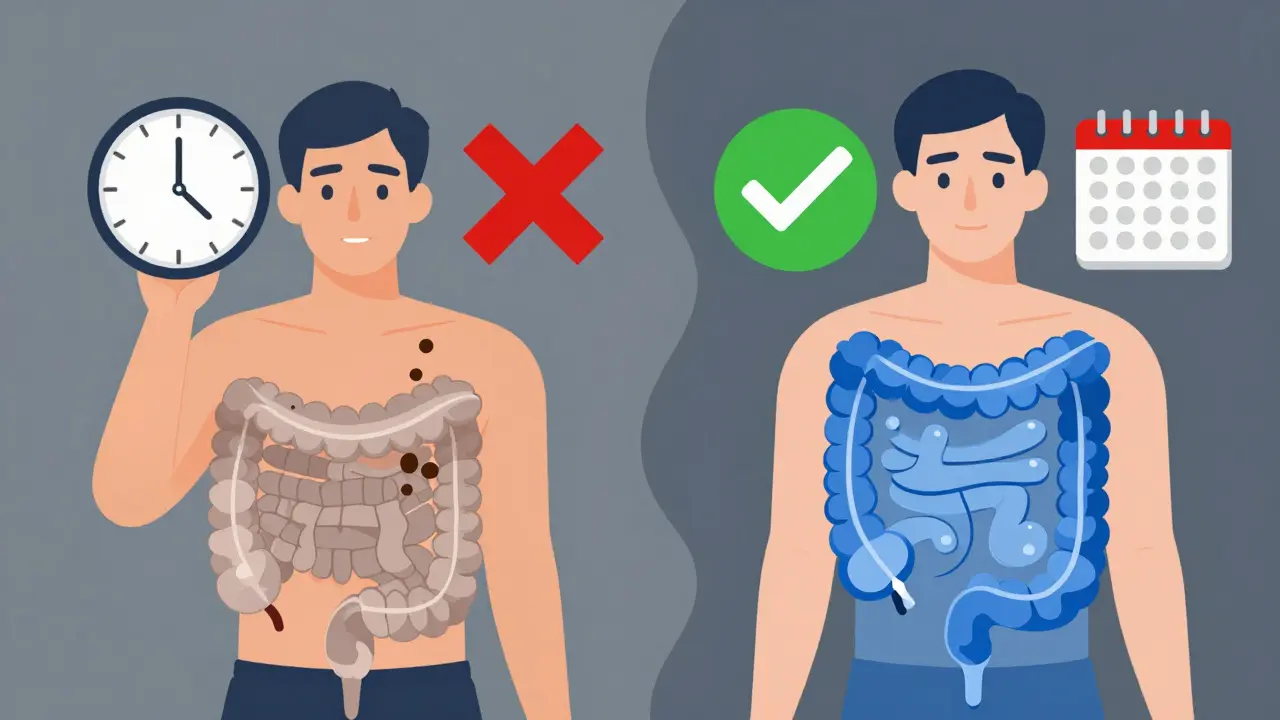
Long-Term Management: Beyond Pills
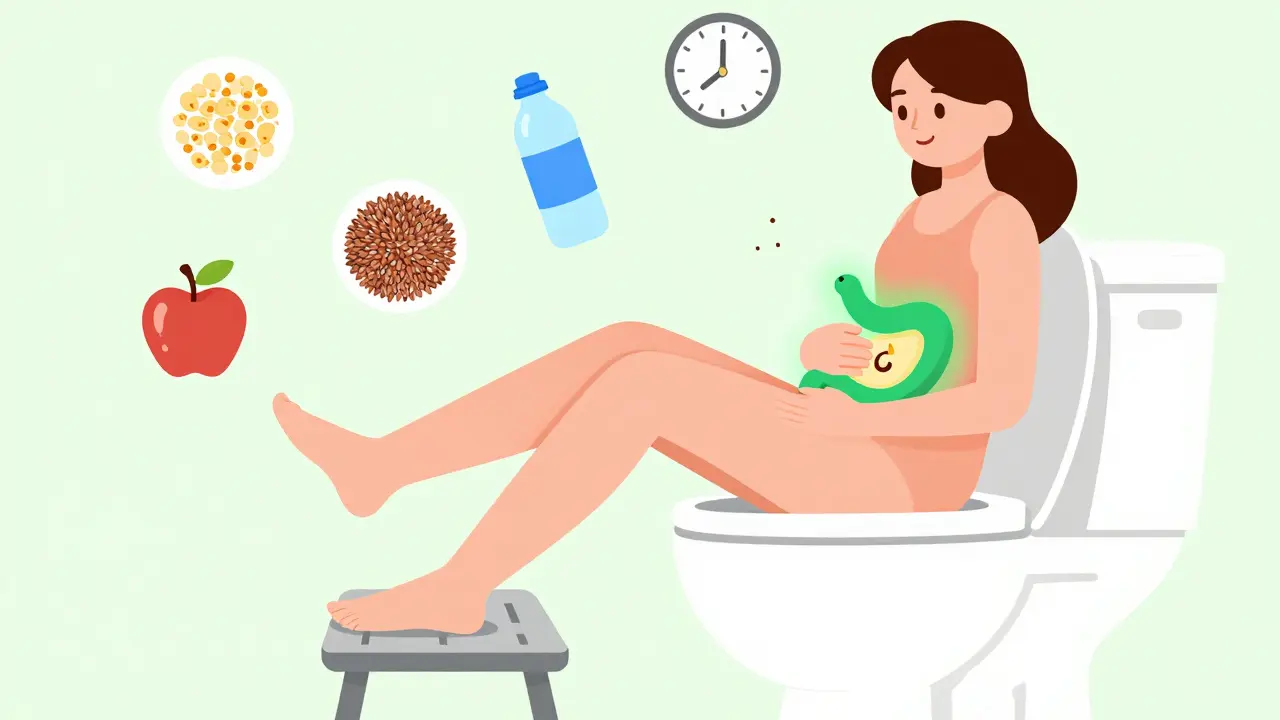
The real fix isn’t a pill. It’s a routine. Diet: Aim for 25 to 30 grams of fiber daily. Focus on soluble fiber: oats, beans, apples, flaxseeds. It holds water and softens stool better than insoluble fiber like bran. Gradually increase your intake. Jumping from 15g to 30g overnight? You’ll be bloated for weeks. Water: Drink 1.5 to 2 liters a day. Add 250 to 500 mL for every 5 grams of fiber you add. No water? Fiber just turns into a cement-like mass. Timing and posture: Try sitting on the toilet for 10 to 15 minutes after breakfast. That’s when your gastrocolic reflex is strongest-your gut naturally wakes up after eating. Elevate your feet with a small stool so your knees are higher than your hips. This 35-degree hip angle straightens the rectum and cuts straining by 60%. It’s that simple. Biofeedback therapy: If you’ve been diagnosed with pelvic floor dysfunction, this is your best shot. Six to eight 45-minute sessions with a trained therapist teach your muscles to relax when you need to poop. Success rates? 70% to 80%. It’s not cheap-$100 to $150 per session-but it’s life-changing for those who’ve tried everything else. Exercise: Walking 30 minutes a day improves gut motility. No need for intense workouts. Just move.When to Worry: Alarm Symptoms
Not every case of constipation is harmless. If you have any of these, see a doctor immediately:- Unintentional weight loss of 10 pounds or more
- Rectal bleeding or dark, tarry stools
- Change in bowel habits lasting more than 6 weeks
- Family history of colorectal cancer
- New constipation after age 50

What Real People Are Doing Right
On Reddit’s r/Constipation community, users report success with magnesium citrate (250-350 mg daily) for 65% to 70% of respondents. Some swear by coffee in the morning-it triggers the gastrocolic reflex. One woman, 52, fixed her chronic constipation by combining:- 25g of psyllium husk daily
- 2 liters of water
- 10 minutes of squatting after breakfast
- Regular morning coffee
Why Most People Fail
The biggest reason long-term management fails? Expectations. People think laxatives should work overnight. But osmotic laxatives like MiraLAX take 48 to 72 hours. Fiber takes weeks to build up. Biofeedback needs 6 sessions before you feel results. Another issue? Inadequate education. One survey found 35% of patients got less than 5 minutes of counseling. Doctors prescribe a laxative and send you on your way. But constipation isn’t a quick fix. It’s a lifestyle reset. And then there’s adherence. Only 45% of people refill their laxative prescriptions consistently. They give up because they don’t see instant results. Or they stop fiber because they’re bloated. They don’t realize bloating is temporary-and the fix is patience.What’s Next?
New treatments are on the horizon. Tenapanor (Ibsrela), approved in 2022, blocks sodium absorption in the gut to increase fluid. Early results show 45% of users get adequate relief. Meanwhile, researchers are studying gut bacteria. The Microbiome Constipation Project found that people with constipation often have low levels of Bacteroides uniformis. Future probiotics might target this. AI is also stepping in. A team at Augusta University built a smartphone app that analyzes how you push during bowel movements. It correctly identifies pelvic floor dysfunction 85% of the time. No expensive tests needed. But none of this matters if you skip the basics. Fiber. Water. Posture. Routine. These are still the most powerful tools we have.Can constipation be caused by stress?
Yes. Stress activates the fight-or-flight response, which slows digestion. Many people notice constipation during high-stress periods like job changes, exams, or grief. Managing stress through mindfulness, walking, or therapy can help improve bowel function, even without changing diet or medication.
Is it safe to take laxatives every day?
Osmotic laxatives like PEG 3350 (MiraLAX) are safe for daily use for months or even years. They don’t damage the colon. Stimulant laxatives like senna or bisacodyl should not be used daily for more than 3 months-they can cause nerve damage and dependency. Always start with osmotic options and only use stimulants short-term.
Why does fiber sometimes make constipation worse?
Fiber needs water to work. If you add fiber without drinking enough fluids, it can harden stool and make constipation worse. Also, increasing fiber too fast-more than 5g per day-can cause bloating and gas. Slowly increase over weeks, and drink 2 liters of water daily.
Can constipation lead to hemorrhoids?
Yes. Straining during bowel movements increases pressure in the rectal veins, causing them to swell. This leads to hemorrhoids. If you’re straining often, improving stool consistency with fiber and water, and using a footstool to reduce pressure, can prevent or improve hemorrhoids.
Should I take probiotics for constipation?
Some evidence suggests certain strains-like Bifidobacterium lactis and Lactobacillus acidophilus-can improve stool frequency and consistency, especially in IBS-C. But results vary. Probiotics aren’t a first-line treatment. Focus on fiber, water, and posture first. If those don’t help, try a probiotic with at least 10 billion CFUs daily for 4 to 6 weeks.
Sneha Mahapatra
February 26, 2026 AT 20:37It's funny how we treat constipation like it's a moral failing. Like if you're not pooping regularly, you're somehow lazy or broken. But the body isn't a machine you can just oil up and restart. It's a delicate ecosystem shaped by stress, sleep, hormones, even the weather. I've watched friends go from regular to blocked after divorce, job loss, trauma. No laxative fixes grief. It's not about willpower. It's about listening.
And yet, we keep prescribing pills like they're candy. We ignore the quiet signals: the bloating, the fatigue, the way your gut feels heavy after coffee. Maybe we need to stop trying to 'fix' it and start honoring what it's trying to tell us.
Also, the footstool thing? Game changer. I didn't believe it until I tried it. Suddenly, no more straining. Just... ease. Who knew posture could be that powerful?
Katherine Farmer
February 28, 2026 AT 08:22Oh please. Another 'fiber and water' sermon. As if the solution to chronic constipation is just... more oatmeal? The article mentions neurological causes, medication side effects, pelvic floor dysfunction-and yet the entire conclusion is a Pinterest board of wellness clichés.
Let me guess: you're the type who thinks magnesium citrate is a 'spiritual cleanse' and squatting is 'ancient wisdom.' Newsflash: 80% of people with refractory constipation have tried all this. And failed. The real issue? Medicine has abandoned patients with complex GI disorders. We're left with Reddit advice and a $120 bottle of 'gut probiotics' from Amazon.
Also, 'coffee triggers the gastrocolic reflex'? Yes. And sunlight triggers vitamin D synthesis. That doesn't mean you should stand in a field for 8 hours a day. Context matters.
Full Scale Webmaster
March 2, 2026 AT 00:04Y’all are missing the REAL issue here. This whole ‘fiber and hydration’ thing is a BIG PHARMA scam. You think they want you to heal naturally? Nah. They make BILLIONS off laxatives. Look at MiraLAX-$20 a bottle, and it’s just PEG? That’s industrial antifreeze with a fancy label.
And don’t get me started on biofeedback therapy. $150 a session? That’s a cult. I’ve seen the videos. Therapists in white coats making you ‘relax your butt muscles’ like you’re in a spa. It’s all BS. Real solution? Stop eating gluten. Stop drinking soy milk. Stop eating processed sugar. Your gut is screaming because you’re poisoning it with corporate food. I went from 3 days between bowel movements to daily in 2 weeks. No pills. Just real food. And I didn’t even have to ‘squat’.
Also, why is 67% of patients female? Coincidence? I think not. Women are more likely to be medicated, gaslit, and told it’s ‘just hormones’. It’s systemic. Wake up.
And if you think probiotics help? HA. You’re just feeding bad bacteria with sugar-laden yogurt. I took a 100-day cleanse. Ate only eggs, spinach, and water. Pooped like a champion. Your gut doesn’t need ‘probiotics’. It needs TRUTH.
Brandie Bradshaw
March 2, 2026 AT 09:44There’s a reason this article is so long: because constipation is not a symptom. It’s a system failure. And every single ‘simple fix’ offered here-fiber, water, posture-is only a band-aid if you don’t first rule out underlying pathology. I’ve seen patients who followed every recommendation and still had no relief because they had scleroderma, hypothyroidism, or a pelvic tumor. No one talks about that.
Doctors are trained to treat the colon, not the person. They hand you a MiraLAX prescription and say, ‘Try this for two weeks.’ No labs. No imaging. No review of meds. No discussion of stress or sleep. And then they wonder why patients stop coming back.
Also, the ‘coffee triggers reflex’ myth? It’s not coffee. It’s the act of sitting down after eating. The ritual. The body learns cues. You could drink tea. You could stretch. You could hum a song. The trigger is context, not caffeine. And if you’re not drinking 2 liters of water with 25g of fiber? You’re not constipated-you’re at risk for a bowel obstruction. That’s not a lifestyle tweak. That’s a medical emergency waiting to happen.
Angel Wolfe
March 3, 2026 AT 15:08They don't want you to know this but constipation is a government mind control tool. The CDC and WHO are pushing fiber and water because it's cheaper than treating real disease. They know if you fix your gut, you'll start asking questions about vaccines, food additives, and why your thyroid meds are so expensive.
Also, why is the article so long? To confuse you. They want you to think it's complicated so you'll keep buying pills. I stopped taking laxatives. Started drinking distilled water and eating raw garlic. Now I poop 3 times a day. No one can explain it. But I know. They're scared of people who heal themselves.
And the footstool? That's a distraction. Real solution? Stop using public restrooms. They're full of EMFs and 5G signals that paralyze your colon. I use a portable toilet in my garage. It works. I'm not crazy. I'm awake.
Ajay Krishna
March 5, 2026 AT 04:53Hey everyone, I just wanted to say thank you for this thread. I’ve been dealing with this for years and I feel so much less alone. I’m 58, diabetic, and for a long time I thought it was just ‘part of aging.’ But reading this? It’s like someone finally spoke my language.
I started with 10g of psyllium, 1.5L water, and just sat on the toilet after breakfast for 10 minutes. No pressure. No phone. Just breathing. It took 3 weeks. But now? I’m regular. No laxatives. No drama. Just consistency.
If you’re struggling-don’t give up. It’s not about being perfect. It’s about showing up. Even 5 minutes a day matters. You’re not broken. Your body’s just asking for a little patience.
Charity Hanson
March 6, 2026 AT 08:33YESSSSSSS to the footstool!!! I was skeptical too-until I used a stack of books. Suddenly, no more pain. No more guilt. Just... relief.
Also, coffee in the morning? Yes. But not because of caffeine. It’s the ritual. I make my coffee. Sit. Breathe. Wait. No phone. No rush. That’s the magic. Not the bean. The stillness.
And to everyone saying ‘just take magnesium’-try it. But don’t stop there. Pair it with movement. Walk after dinner. Stretch in the morning. Your gut is connected to your nervous system. If your body is in fight-or-flight 24/7? It’s not gonna poop. You gotta calm it down. Slow down. Breathe. I’m not a doctor. But I’ve been there. You got this 💪
Brandon Vasquez
March 7, 2026 AT 00:00I appreciate the depth here. Most posts reduce this to ‘eat more fiber.’ But this? This is what real care looks like.
I’m a nurse. I’ve seen patients on stimulant laxatives for 15 years. Their colon is basically asleep. They don’t feel the urge anymore. They just take another pill. It’s heartbreaking.
But here’s the thing: people don’t fail because they’re lazy. They fail because they’re overwhelmed. No one taught them how to start. No one said, ‘Start with 5g of fiber. Add water. Sit for 10 minutes. Wait. Repeat.’
Small steps. Consistency. Patience. That’s the treatment. Not the pill. Not the app. Not the biofeedback. Just showing up. Every day.
Vikas Meshram
March 8, 2026 AT 08:26Correction: The article says 25-30g of fiber daily. But WHO recommends 25g minimum for adults. Also, psyllium husk is not 'soluble fiber'-it's a mix. Soluble fiber includes pectin, beta-glucan. Insoluble is cellulose. Don't mislead people. Also, MiraLAX is PEG 3350, not 'PEG 3350 (MiraLAX)'-it's the same compound. Brand name doesn't change chemistry.
And biofeedback? Success rate is 60-70%, not 70-80%. Source: American Journal of Gastroenterology 2021. Also, squatting increases rectal angle by 35 degrees? That's inaccurate. It's 15-20 degrees. Don't exaggerate. Accuracy matters.
Ben Estella
March 9, 2026 AT 08:50Why is everyone so nice? This isn't a yoga retreat. This is a medical crisis. People are suffering. You can't 'be patient' when your colon is a brick wall.
And why are we all pretending this is just about 'lifestyle'? What about the 30% of people who have NO lifestyle issues? Who eat kale, drink water, squat, and still can't go? What then? Just give up? Take more pills?
And don't get me started on 'coffee helps'. That's like saying 'sunlight helps depression'. Yes. But what if you're in a basement? What if you're on 12-hour shifts? What if you're in a nursing home? This advice is for people who have time, money, and privilege. The rest of us? We're just trying to survive.
Jimmy Quilty
March 9, 2026 AT 13:09Did you know that the FDA approved MiraLAX without long-term safety studies? And yet we’re told it’s ‘safe for years’? That’s not science. That’s corporate lobbying.
Also, the microbiome study? Bacteroides uniformis? That’s from a single 2020 pilot study with 47 people. It’s not replicated. But now it’s on Reddit like gospel.
And biofeedback? It’s expensive because it’s a racket. Therapists are trained by companies that sell the machines. It’s a closed loop. I’ve seen it. I work in medtech. This isn’t healing. It’s profit.
Real solution? Fasting. 16-hour fasts. Your gut resets. No fiber. No laxatives. Just silence. I did it. I’m fine. You’re not listening because you’re scared of the truth.
Miranda Anderson
March 10, 2026 AT 02:16I’ve had chronic constipation since I was 19. Tried everything. Fiber made me bloated. Laxatives made me dependent. Biofeedback felt like therapy for my butt.
Then I started doing yoga. Not the intense kind. Just gentle twists and forward folds before bed. Every night. No expectations. Just movement.
Three months in, I started noticing something. My body felt lighter. My gut felt... responsive. Not because of fiber. Not because of water. Because I finally stopped fighting it.
I don’t sit on the toilet for 10 minutes anymore. I just breathe. And sometimes, it happens. Not because I made it. Because I let it.
I don’t have answers. But I have peace. And that’s more than I had before.