
Cold Sores vs. Pimples: How to Tell Them Apart and Treat Each Correctly
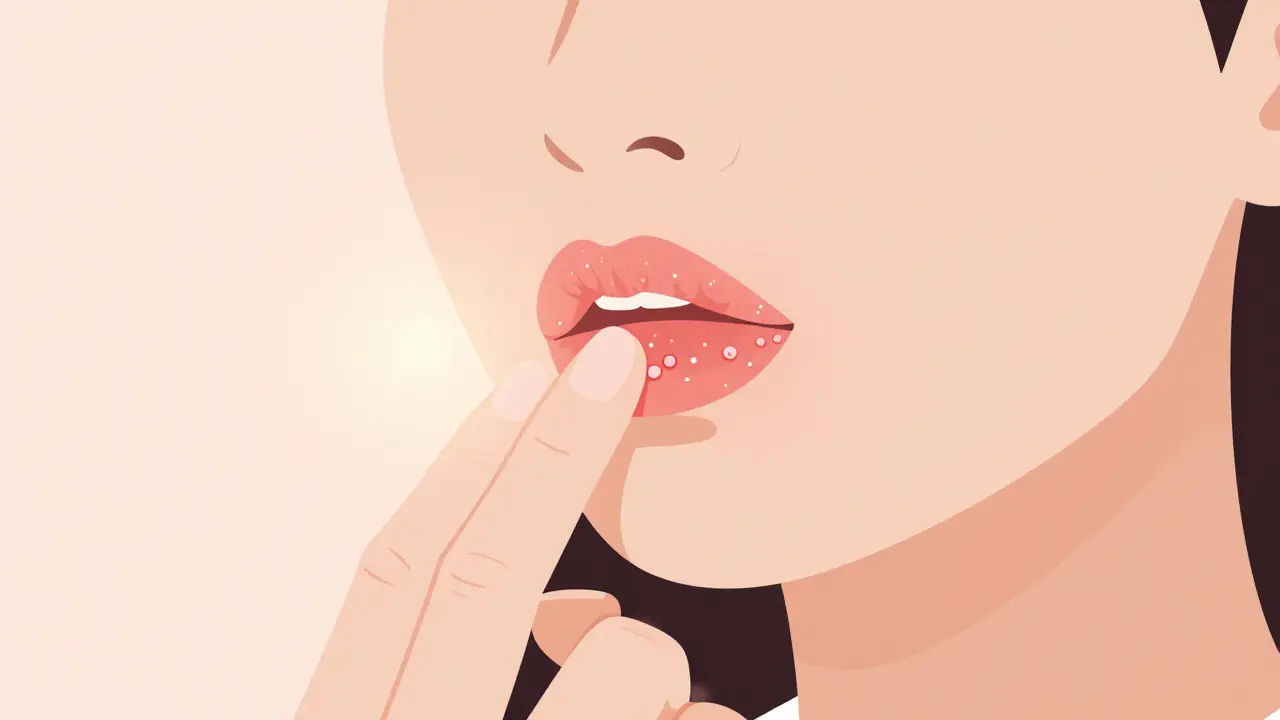
It’s easy to panic when you see a small bump near your lip. Is it a pimple? Or is it a cold sore? You might reach for your acne spot treatment, only to find it makes things worse. Or worse-you accidentally spread the infection to someone else. Cold sores and pimples look similar at first glance, but they’re completely different conditions with different causes, treatments, and risks. Getting it wrong can delay healing, increase pain, or even pass on a lifelong virus.
What Exactly Is a Cold Sore?
A cold sore, also called herpes labialis, is caused by the herpes simplex virus type 1 (HSV-1). This virus doesn’t just appear out of nowhere-it’s been in your body for years, often since childhood, and stays dormant in nerve cells. When something triggers it-like stress, sun exposure, or a weakened immune system-it wakes up and travels to your skin, causing a blister.
Cold sores don’t just pop up overnight. They follow a clear five-stage pattern:
- Prodrome: You feel tingling, burning, or itching on your lip-sometimes 12 to 48 hours before anything shows up.
- Blisters: Small, fluid-filled bumps form, usually in a cluster of 2 to 5.
- Ulceration: The blisters break open, leaking clear fluid that turns cloudy.
- Scabbing: A yellow or brown crust forms over the sore.
- Healing: The scab flakes off, and the skin returns to normal.
This whole process takes 7 to 14 days without treatment. The key sign? That early tingling. If you catch it then, you can cut the outbreak short.
What Exactly Is a Pimple?
A pimple is a type of acne lesion. It forms when hair follicles get clogged with oil (sebum), dead skin cells, and bacteria-mostly Cutibacterium acnes. Unlike cold sores, pimples aren’t caused by a virus. They’re a result of your skin’s natural processes going off track.
Pimples can show up anywhere on your face-even on your lip surface, because your lips have hair follicles too. But they don’t cluster like cold sores. A typical pimple is a single raised bump with a white or yellow center filled with pus. It might be tender to the touch, but you won’t feel tingling or burning before it appears.
Minor pimples heal in 3 to 7 days. Deeper, cystic ones can last weeks. Unlike cold sores, pimples don’t follow a set timeline. Their duration depends on how inflamed they are and how you treat them.
Key Differences at a Glance
Here’s how to tell them apart, fast:
| Feature | Cold Sore | Pimple |
|---|---|---|
| Location | Always on or right at the lip border | Anywhere on face, including lip surface |
| Appearance | Cluster of tiny blisters | Single bump with white/yellow head |
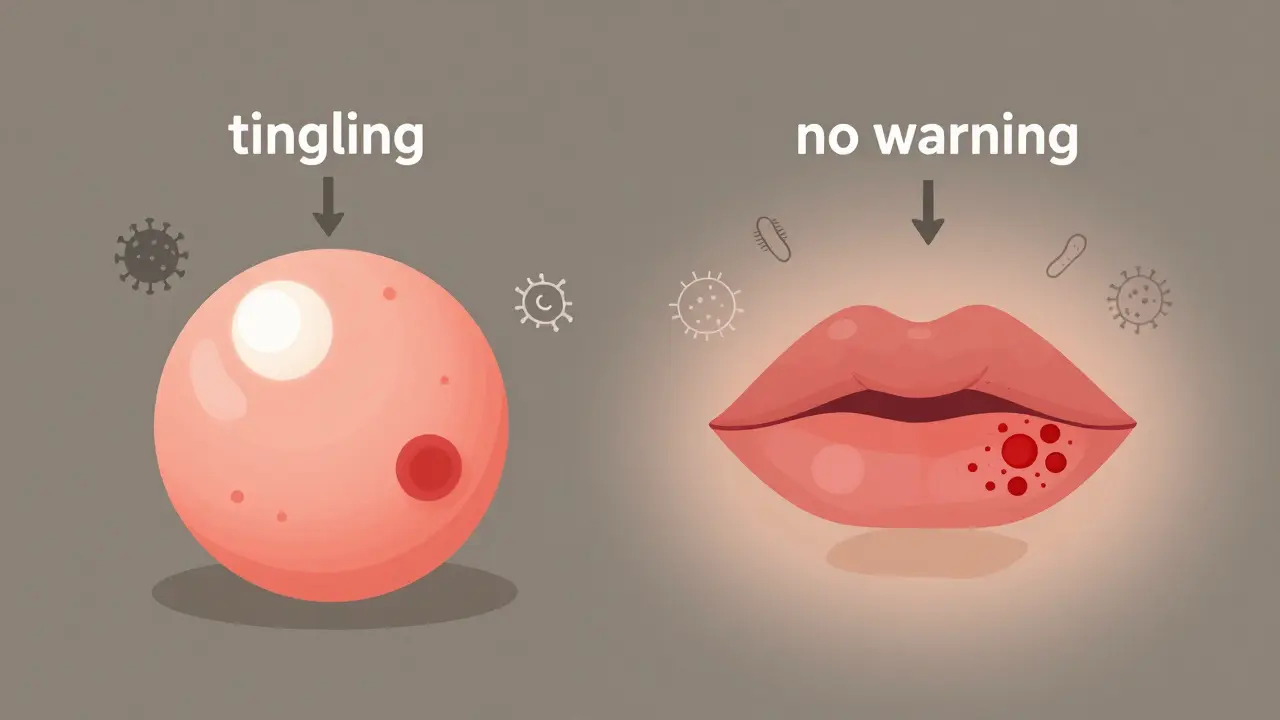
| Sensation Before | Tingling, burning, itching (12-48 hrs before) | No warning-just appears |
| Pain Type | Throbbing or burning | Tender or sore to touch |
| Contagious? | Yes-spread by direct contact | No-not infectious |
| Healing Time | 7-14 days (5-7 with treatment) | 3-7 days (weeks if cystic) |
Location is the biggest clue. If it’s right on the edge of your lip-where the pink skin meets your face-it’s almost certainly a cold sore. If it’s on the center of your lip or cheek, it’s more likely a pimple.
Treatment: What Works and What Doesn’t
Here’s the critical part: treating a cold sore like a pimple makes it worse. And treating a pimple like a cold sore does nothing.
Cold sore treatments:
- Antiviral creams: Penciclovir (Denavir) or acyclovir (Zovirax). Apply every 2 hours while awake during the first 4 days. This can shorten healing by 1-2 days if started early.
- Oral antivirals: Valacyclovir (Valtrex) or famciclovir. These work faster than creams and are often prescribed for frequent outbreaks.
- Over-the-counter: Docosanol (Abreva) can reduce symptoms by 50% if used daily for 4-5 days.
Pimple treatments:
- Benzoyl peroxide (2.5-10%): Kills bacteria and reduces inflammation. A 2.5% concentration is just as effective as 10% but less irritating.
- Salicylic acid (0.5-2%): Clears out clogged pores. Best for blackheads and whiteheads.
- Retinoids: Prescription options like adapalene help prevent future breakouts by keeping pores clear.
Never use acne treatments like benzoyl peroxide or salicylic acid on a cold sore. They dry out and irritate the skin, which can rupture blisters and spread the virus. Same goes for toothpaste, baking soda, or alcohol-popular home remedies that actually make cold sores worse.
What People Get Wrong (And How to Avoid It)
Real-world mistakes are common-and costly.
- Popping the blister: This is the #1 error. People treat cold sores like pimples and squeeze them. Result? The virus spreads to nearby skin, or to others through shared towels, lip balm, or kissing. Healing time increases by 3-5 days.
- Sharing lip products: If you have a cold sore, don’t use the same lipstick, chapstick, or lip gloss as someone else. Studies show 41% of partners get infected this way.
- Ignoring the tingling: Most people wait until the blister shows up to act. But the best time to treat a cold sore is during the prodrome stage. Antivirals are most effective when used early.
- Skipping sun protection: UV exposure triggers 32% of outbreaks. Use a lip balm with SPF 30+ daily, even in winter.
On the flip side, people who catch the tingling early and start antiviral cream immediately report 30-50% shorter outbreaks. That’s the difference between 10 days and 5-7.
Prevention: Stopping the Next Outbreak
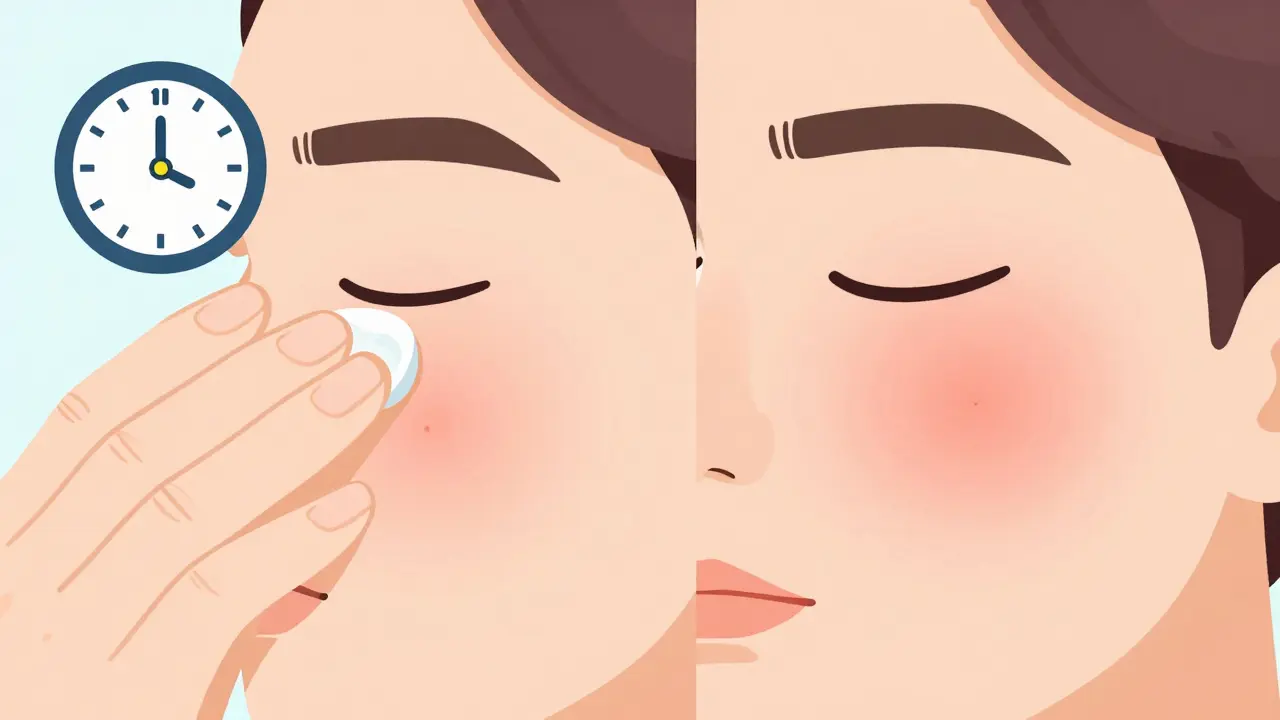
Cold sores can’t be cured-but you can reduce how often they come back.
- Manage stress: Stress triggers 28% of outbreaks. Sleep, breathing exercises, and regular movement help.
- Protect from sun: UV light is the top trigger. Use SPF lip balm every day.
- Boost immunity: Illness, fatigue, or hormonal shifts can wake up the virus. Eat well, stay hydrated, and don’t ignore sleep.
- Don’t touch: Wash your hands often, especially after touching your face. Avoid rubbing your eyes after touching a cold sore-you can get herpes in your eyes.
- Use separate items: During an outbreak, use your own towel, pillowcase, and utensils. Wash them in hot water.
For acne, prevention is about consistency:
- Wash your face twice a day with a gentle cleanser.
- Use non-comedogenic moisturizers and sunscreen.
- Don’t pick or squeeze-this causes scarring and more breakouts.
- Change pillowcases twice a week.
When to See a Doctor
You don’t need to see a doctor for every cold sore or pimple. But call one if:
- Your cold sore lasts longer than 2 weeks.
- You get them more than 5 times a year.
- The sore spreads to your eyes, nose, or fingers.
- You have a weakened immune system (from illness, chemo, or medications).
- A pimple is very large, painful, or leaves a scar.
- Over-the-counter acne treatments haven’t helped after 8 weeks.
Doctors can prescribe stronger antivirals for frequent cold sores or oral antibiotics and isotretinoin for severe acne. There are also new treatments on the horizon-like pritelivir, an experimental antiviral that reduces viral shedding by 70% in trials.
Final Takeaway
Cold sores and pimples look alike-but they’re not the same. One is a viral infection that spreads. The other is a blocked pore that doesn’t. Mistaking one for the other doesn’t just waste time-it can make things worse.
Remember: cold sores tingle first, cluster on the lip edge, and need antivirals. pimples appear suddenly, are single bumps, and respond to benzoyl peroxide or salicylic acid.
If you’re unsure, wait for the tingling. If it comes, treat it like a cold sore. If it doesn’t, and it’s just a red bump with a head, treat it like acne. When in doubt, see a dermatologist. Your skin-and your lips-will thank you.
Can you get a cold sore from a pimple?
No, you cannot get a cold sore from a pimple. Cold sores are caused by the herpes simplex virus (HSV-1), which is spread through direct contact with an active sore or infected saliva. Pimples are caused by clogged pores and bacteria, not a virus. You can’t catch HSV-1 from acne.
Can you pop a cold sore like a pimple?
Never pop a cold sore. Unlike a pimple, a cold sore contains infectious viral fluid. Popping it releases the virus, which can spread to other parts of your skin or to other people. It also increases healing time by 3-5 days and raises the risk of scarring or secondary infection.
Does toothpaste help cold sores?
No, toothpaste doesn’t help cold sores. Some people use it because it contains drying agents like sodium lauryl sulfate, but it irritates the skin, burns the area, and delays healing. It does nothing to fight the virus. Stick to proven antiviral treatments like acyclovir or docosanol.
Why do I keep getting cold sores on my lip?
You likely have HSV-1 in your body, and certain triggers reactivate it. Common triggers include sun exposure (32% of cases), stress (28%), illness, hormonal changes, or fatigue. Once you’ve had HSV-1, the virus stays in your nerves for life. Managing triggers and using antivirals early can reduce how often outbreaks happen.
Can you get a pimple on your lip?
Yes, you can get a pimple on your lip. The red part of your lip (vermillion border) has hair follicles, which can get clogged with oil and dead skin. These pimples look like small, red bumps with a white head and are not contagious. They’re treated the same way as other acne-topical benzoyl peroxide or salicylic acid.
How long do cold sores last with treatment?
With early antiviral treatment (started during the tingling stage), cold sores typically heal in 5-7 days. Without treatment, they last 10-14 days. Prescription creams like penciclovir and oral antivirals like valacyclovir are the most effective options. Over-the-counter docosanol (Abreva) can reduce healing time by about 1-2 days if used consistently.
Andy Heinlein
December 31, 2025 AT 21:09Bobby Collins
January 1, 2026 AT 23:04Layla Anna
January 2, 2026 AT 06:10Heather Josey
January 2, 2026 AT 10:55Donna Peplinskie
January 3, 2026 AT 13:48Lee M
January 5, 2026 AT 02:05Bryan Anderson
January 5, 2026 AT 05:15Matthew Hekmatniaz
January 6, 2026 AT 10:08Liam George
January 7, 2026 AT 07:25sharad vyas
January 9, 2026 AT 03:13Dusty Weeks
January 10, 2026 AT 17:13