
CGM and Diabetes Medications: How to Adjust Doses Using Trend Arrows
CGM Insulin Dose Adjustment Tool
Suggested Adjustment:
Imagine you're looking at your screen and your glucose is 120 mg/dL-perfectly in range. But then you notice a double-down arrow. In fifteen minutes, that "perfect" number could be a dangerous crash. This is the gap between traditional finger-prick tests and Continuous Glucose Monitoring (CGM). While a standard meter gives you a snapshot of the past, a CGM gives you a movie of your future. The real magic happens when you stop using the CGM just to watch your numbers and start using it to change how you take your CGM dose adjustment strategies to prevent side effects before they even start.
The Problem with Static Dosing
Most people are taught to dose insulin based on where their blood sugar is right now. If you're at 180 mg/dL, you take a correction dose. But if you're at 180 mg/dL and crashing fast, that same dose could send you into a severe hypoglycemic event. This is why many patients struggle with "insulin stacking" or frequent lows; they are reacting to a number rather than a trend.
The Endocrine Society stepped in to fix this. They developed a system that moves away from vague percentage changes (like "increase your dose by 10%") and instead provides specific unit adjustments based on trend arrows. This approach turns the CGM from a monitoring tool into a predictive guidance system, specifically designed to mitigate the two biggest side effects of insulin therapy: dangerous hypoglycemia and persistent hyperglycemia.
Understanding the Language of Trend Arrows
Before you can adjust your meds, you have to speak the language of the arrows. Most systems, including the Dexcom G5 and newer models, use a set of eight directional markers. These tell you not just which way you're heading, but how fast you're getting there.
- Double-Up Arrows: Glucose is rising rapidly. This is a red flag for upcoming hyperglycemia.
- Single-Up Arrow: Glucose is rising.
- Flat Arrow: Glucose is stable. No adjustment needed.
- Single-Down Arrow: Glucose is falling.
- Double-Down Arrows: Glucose is dropping fast. This is the critical warning for hypoglycemia.
The goal is to use these arrows to tweak your pre-meal bolus or your correction dose (if it's been more than three hours since your last meal). By adjusting the dose based on the arrow, you're essentially "steering" your glucose levels to stay within the target range of 70-180 mg/dL.
How to Calculate Your Dose Adjustments
To make this work, you need to know your Correction Factor (CF). This is the specific value that tells you how many mg/dL one unit of insulin will lower your blood glucose. For example, if your CF is 1:50, one unit drops your sugar by 50 mg/dL.
Instead of doing complex math in your head while you're trying to eat, the Endocrine Society guidelines provide clear unit adjustments. For an adult with a 1:50 CF, the logic looks like this:
| Trend Arrow | Dose Adjustment | Goal |
|---|---|---|
| Double-Up (Fast Rising) | +1.2 units | Prevent High Spike |
| Single-Up (Rising) | +0.8 units | Smooth Out Rise |
| Flat (Stable) | No change | Maintain Stability |
| Single-Down (Falling) | -0.8 units | Prevent Dip |
| Double-Down (Fast Falling) | -1.2 units | Avoid Hypoglycemia |
For parents managing children, these numbers are slightly lower (e.g., +1.0 for double-up and -1.0 for double-down) to account for the higher sensitivity of pediatric patients. This removes the guesswork and reduces the cognitive load on the user, making it much harder to make a calculation error during a stressful moment.
Comparing CGM-Guided Dosing vs. Traditional Meters
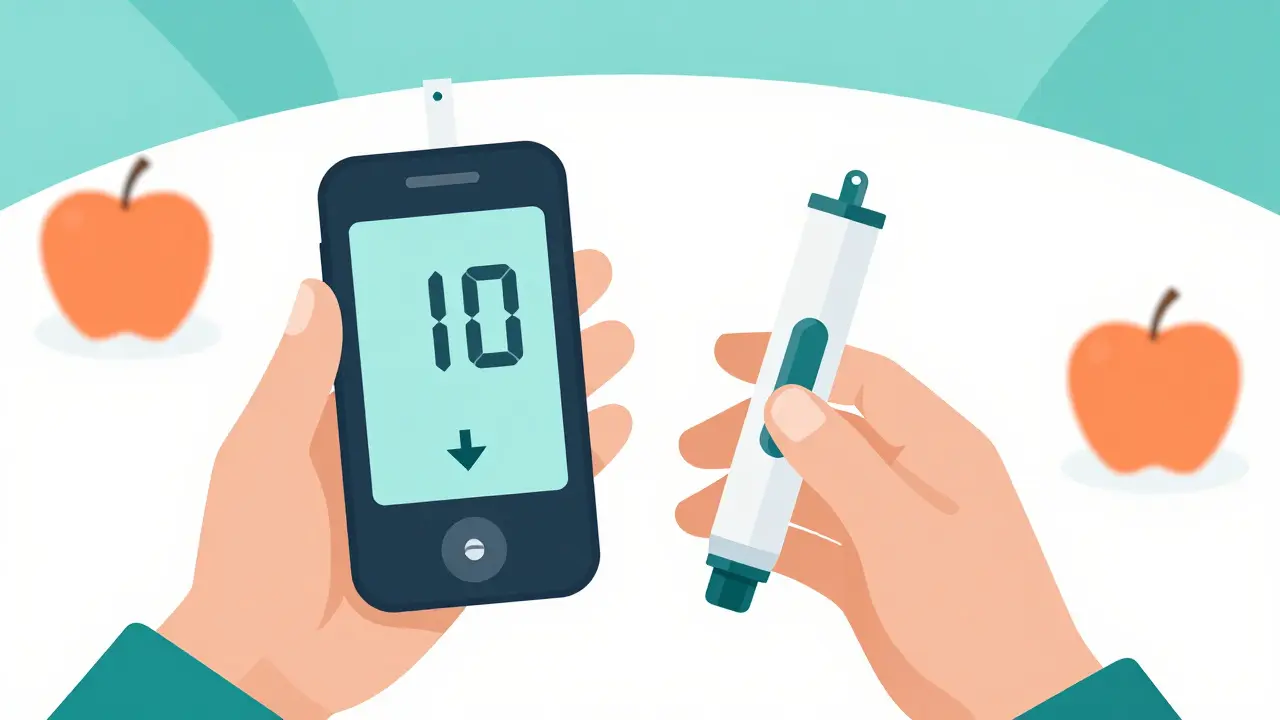
Does this actually work better than the old way? The data says yes. A study published in Diabetes Technology & Therapeutics found that people using trend arrow adjustments had 28% fewer hypoglycemic events (glucose below 70 mg/dL) and spent 17% more time in their target range compared to those using a standard blood glucose meter (BGM).
The reason is simple: BGM is reactive, while CGM is proactive. If you only check your sugar every few hours, you only see where you are. With a CGM, you see where you are going. This predictive power allows you to catch a "crash" 15 to 30 minutes before it happens, giving you time to eat fast-acting carbs or reduce an insulin dose.
The Dangers of Over-Correction and "Trend Paralysis"
It's not all smooth sailing. There is a real risk called "insulin stacking." This happens when you see a double-up arrow, add extra insulin, and then see another up arrow ten minutes later and add more insulin before the first dose has even peaked. Because rapid-acting insulins usually peak between 60 and 90 minutes, you can accidentally create a massive overdose that leads to a severe low.
Then there is "trend arrow paralysis." About 25% of new users report feeling overwhelmed by the constant stream of data, unable to decide whether to trust the arrow or their gut. It's also important to remember that CGMs have a slight lag because they measure interstitial fluid, not blood. If your sugar is changing extremely rapidly, the CGM might be a few minutes behind your actual blood levels.

Beyond Insulin: Other Medications and AI
While most of the focus is on insulin, this predictive approach is expanding. The 2024 ADA/EASD consensus report now suggests adjusting SGLT2 inhibitors when a CGM shows signs of euglycemic ketosis-where glucose looks normal (under 180 mg/dL) but ketones are dangerously high. This is a lifesaver because, without a CGM and ketone monitoring, these patients might not realize they are in danger until it's too late.
We're also seeing the rise of AI. Apps like DAFNE+ now automate these Endocrine Society calculations, which has been shown to reduce user error by 62%. Meanwhile, platforms like Verily's Onduo are using machine learning to predict trends even beyond the current arrow, potentially cutting hypoglycemic events by another 38%.
Practical Checklist for Safe Dose Adjustment
If you're starting to adjust your medications based on CGM trends, follow these rules to stay safe:
- Verify the Sensor: Only trust the arrows if your sensor is within its approved lifespan (e.g., 7 days for G5/G6).
- Check Insulin on Board: Before adding units for an "up" arrow, ask yourself: "When was my last dose, and is it still working?"
- Start Small: If you're unsure, use the lower end of the adjustment scale or revert to your standard correction dose.
- Confirm with BGM: If the arrow seems impossible given how you feel, do a manual finger-prick test.
- Sync with Your Provider: Never change your base dosing strategy without a healthcare provider's guidance.
Can I use these adjustment tables for any CGM system?
The specific unit values were validated using the Dexcom G5, but the logic applies to most systems. However, be careful: different brands have different thresholds. For example, Dexcom uses double arrows for rates over 2 mg/dL/min, while the FreeStyle Libre 3 might use them for rates over 3 mg/dL/min. Always check your specific device's manual.
What should I do if I see a double-down arrow but my glucose is still high?
This is a classic scenario where trend arrows save lives. If your glucose is 200 mg/dL but you have double-down arrows, you are crashing. Taking a full correction dose for 200 mg/dL would be dangerous. Following the guidelines, you should decrease your dose (e.g., by 1.2 units) or skip the correction entirely to prevent a severe low.
How often should I adjust my doses based on arrows?
Adjustments are typically made during pre-meal bolusing or when administering correction doses more than three hours after a meal. You should not be constantly tweaking your dose every few minutes, as this leads to insulin stacking and instability.
Is this method safe for children?
Yes, but with different values. The Endocrine Society provides specific pediatric tables because children generally have different insulin sensitivities. Parents should use the pediatric-specific unit adjustments rather than the adult ones to avoid over-correcting.
What is 'trend arrow paralysis' and how do I overcome it?
It's the feeling of being overwhelmed by the data and not knowing which action to take. The best way to overcome this is through structured education. Spend 15-20 minutes with a diabetes educator to practice hypothetical scenarios using your specific correction factor until the process becomes a habit.